

Naturalist Shares Advice on Japanese Beetles in Owen Sound Gardens
Popillia japonica feeds on more than 300 plant species. Peter Middleton confirms that a morning bucket of soapy water can help, while experts warn that baited traps tend to bring in more beetles.

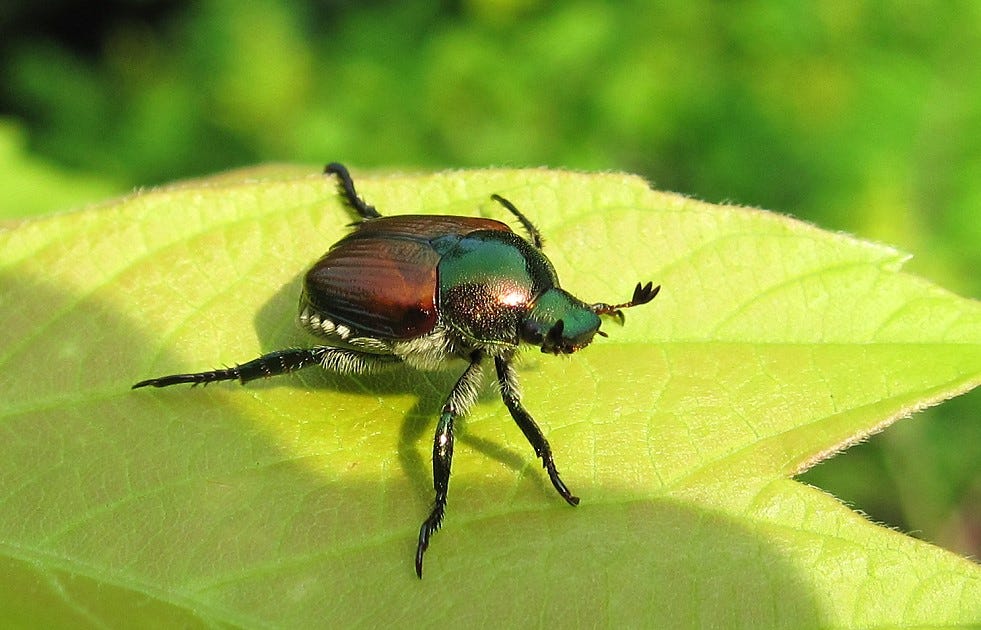
A reader sent Owen Sound Current a photograph of a beetle found in an Owen Sound garden earlier this week, along with an identification attributed to local naturalist Peter Middleton: Japanese beetle.
We asked Middleton, an honourary life member of the Owen Sound Field Naturalists and guest columnist via Neighbourwoods North, to confirm the identification and to say what gardeners finding the insect should know.
The insect is Popillia japonica, he confirmed, a member of the scarab beetle family native to the main islands of Japan.
“It is an exceedingly aggressive invasive that has suddenly exploded in Owen Sound and will quickly defoliate plants,” Middleton wrote. “Your roses may be at risk.”
How to identify it
Middleton described what local homeowners should watch for: “It is easily recognized, being about 10 mm. (approx. half an inch) in length. Adults sport glossy, metallic green heads and thoraxes, that contrast with shiny dark bronze elytra (wing covers) on their back.”
“Along each side of the abdomen are seven tufts of white bristles that set it apart as a species,” he added. Those white bristles are the feature that separates it from similar-looking beetles.
Middleton calls it beautiful, but destructive.
The beetle is not new to the province. The Canadian Food Inspection Agency says it was first found in North America in southern New Jersey in 1916, and first recorded in Canada in 1939, in a tourist’s car arriving at Yarmouth, N.S., by ferry from Maine.
It is now established in Ontario, Quebec, New Brunswick, Nova Scotia and Prince Edward Island.
Middleton says hotter summers appear to have been a boon for the species.
What the damage looks like
Adults feed openly and often in clusters, and the CFIA lists more than 300 host species. Rose bushes seem to be a favourite, Middleton says.
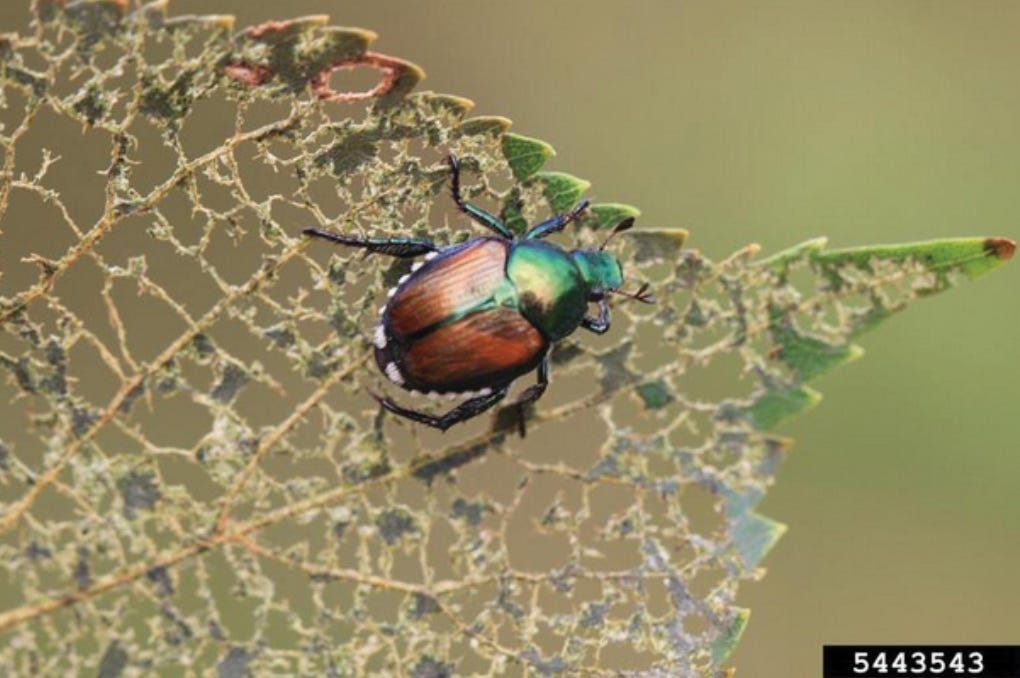
The beetles skeletonize leaves, eating the soft tissue and leaving the veins intact — a lace-like remnant that gardeners often notice before they spot the beetles themselves.
The larvae are the second, less visible half of the problem. They live underground and feed on the roots of lawn grass and other plants, producing patches of brown turf that feel spongy underfoot and lift away easily.
Middleton says the species breeds prolifically, and that a single adult sighting can be followed within a day or two by a multitude that seems to appear from nowhere.
What works, and what makes it worse
Along with the identification, Middleton passed along the standard advice for gardens seeing these numbers: knock the beetles into soapy water in the morning, when they're sluggish, since the soap keeps them from flying off.
He says hand-removal is about the only effective control at this scale. The method matches guidance from University of Missouri Extension. Doing it daily matters: feeding beetles give off scents that draw in more, so the morning round keeps the afternoon crowd smaller.
Baited traps are the common mistake. University of Minnesota Extension advises home gardeners against them, because the floral and pheromone lures pull in far more beetles than the trap catches — including from a few doors down.
Experts also caution that insecticides can do more harm to pollinators than the beetles do, since the beetles feed heavily on flowers. Fine netting or insect mesh can protect valued plants that don’t need pollinators.
Ontario gardeners don’t need to report the beetle. The CFIA asks for sightings only in British Columbia, the Prairie provinces and the territories, where the insect isn’t established — in Ontario it has been present for decades, and the agency says management advice falls outside its mandate.
Adults feed from late June into mid-October, so there’s still a stretch of season left.
“Good luck to any gardener who finds them,” Middleton wrote.
Editor’s Note: Thanks to Peter for taking the time to answer our questions, and to the reader who shared the tip.
Related:


.jpg)