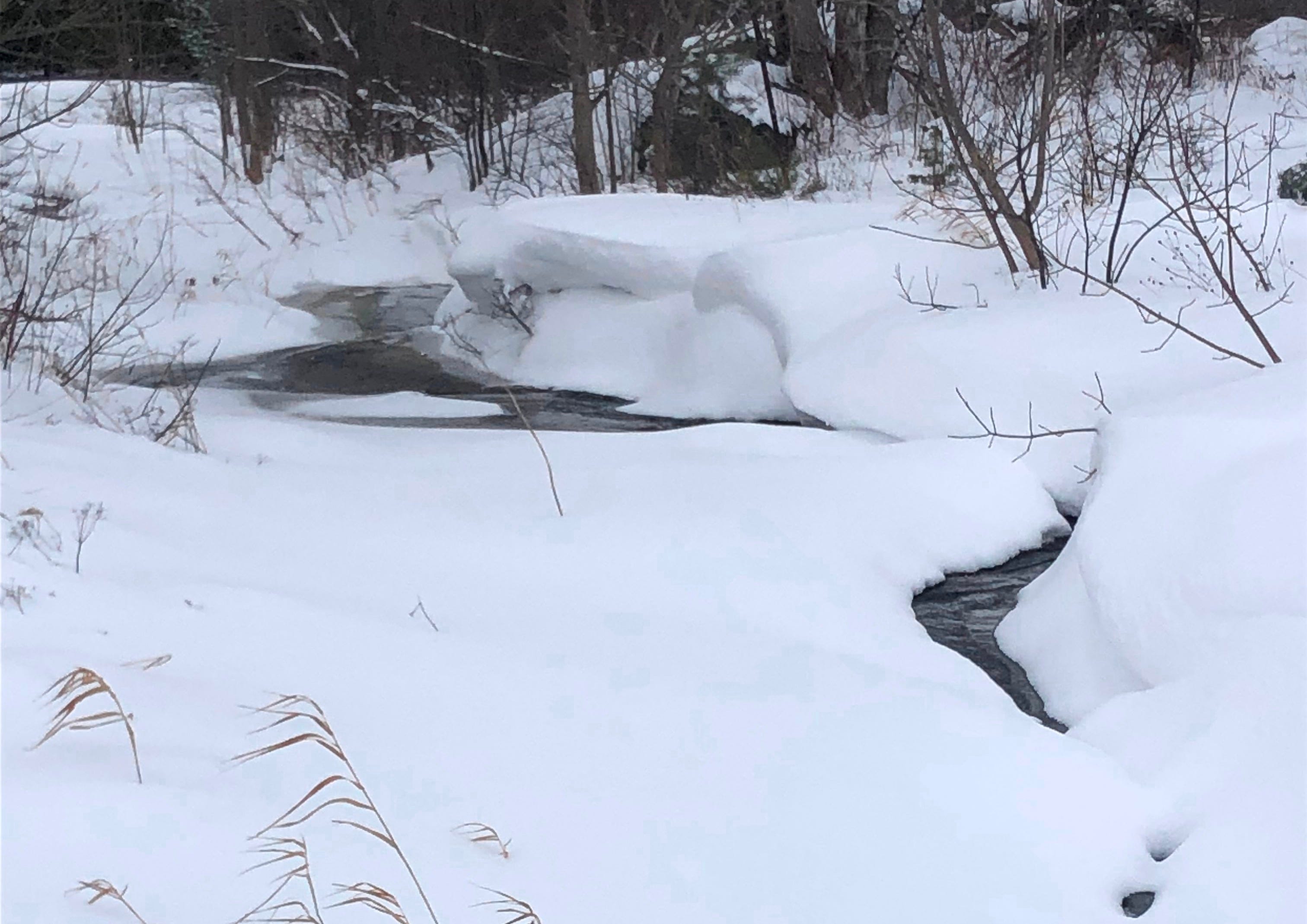
Snow: Mid-winter Reflections
A winter reflection by Peter Middleton, submitted via Neighbourwoods North, explores snow’s vital role in Earth’s climate and why it’s more than just a nuisance.
COMMUNITY CONTRIBUTION
by Peter Middleton, submitted on behalf of NeighbourWoods North
Snow, for many, is an inconvenient fact of life, for three to four months each year. The alarm goes off; it is dark. The howl of the wind can be heard outside. Opening the drapes, sweeps of falling snow swirl through the spotlight of the street lamps. Ploughs and sanders clear streets and sidewalks. City life must go on, despite the inconvenience!
Others look forward to the arrival of the snow, and the endless opportunities it brings for outdoor recreation.
Naturalists too, celebrate the winter landscapes. Snowfalls record the patterns of weather, seen in wind-sculpted drifts on fields, or in the beauty of trees hung with crystal garlands. The lives of creatures, rarely seen, come alive; tracks indicate a vibrant and active winter ecosystem. The tiny footprints of a mouse scurrying across a snowy surface suddenly disappear under the imprint of an owl’s wings, etched as it dropped upon its prey. Life goes on.
But snow is much, much more.
“What I saw, as I hid from the blizzard, behind my sleigh, were flakes made up of tiny molecules, the base of an all-important ecological chain. For the first time I saw them, not as a hindrance, but as intrinsic elements of the world system, important players in the planet’s and humanity’s future.”
— Will Steger, Crossing Antarctica (New York: Alfred A. Knopf, 1992)
Earth is the only planet where conditions exist that are suitable for supporting life as we know it. Snow is a critical part of that reality — insulating soils, conserving and distributing water and, most importantly, tempering global climate.
During the winter months, the sun’s rays are, ironically, at their most intense — due to an anomaly in the annual orbit of the Earth around the sun. Solar radiation constantly warms the Earth as it passes through the atmosphere and strikes the planet’s surface.
Winter snow, glaciers, ice fields and arctic icepack in the polar and temperate regions of the planet are particularly effective in moderating the warming effects of solar radiation. Snow-covered expanses function as giant mirrors. They reflect incoming solar rays back into space, effectively cooling the planet and maintaining Earth’s thermal equilibrium — the relatively stable temperature regime upon which our living Earth is dependent.
Since the Industrial Revolution, humanity’s population explosion and ever-expanding industrial activity have caused the planet’s mean temperature to rise significantly. It now threatens the thermal equilibrium of the planet. The impacts are well known and documented.
Ice cover on the Great Lakes, for example, has declined significantly since 1970. Without the blankets of ice and snow, more of the sun’s radiation is absorbed by the dark surface waters of the lakes, increasing their ambient temperature and, subsequently, that of the surrounding region. The climate becomes warmer and a feedback process becomes established. Global warming continues — and accelerates.
The miracle of snow is in peril, and with it, the critical role it occupies in our lives and the future of the planet.
When next it snows, take a moment to admire the fragile beauty of the lowly snowflake. It is a unique gift. Ponder what the Earth might be without it.
Thank you to sponsors of The Owen Sound Current Writers’ Fund, who make these community contributions possible. Contributions from the community do not necessarily reflect the opinions or beliefs of The Owen Sound Current and its editor or publisher.
Related:


Thanks Peter! A lovely reflection that will help me get through this cold and snowy winter.