

How 911 Calls Work in Owen Sound: Inside the Region's Emergency Communications Centre
Owen Sound Police Chief Craig Ambrose explains how 911 calls are queued, answered, and routed — and why hanging up to redial slows things down.

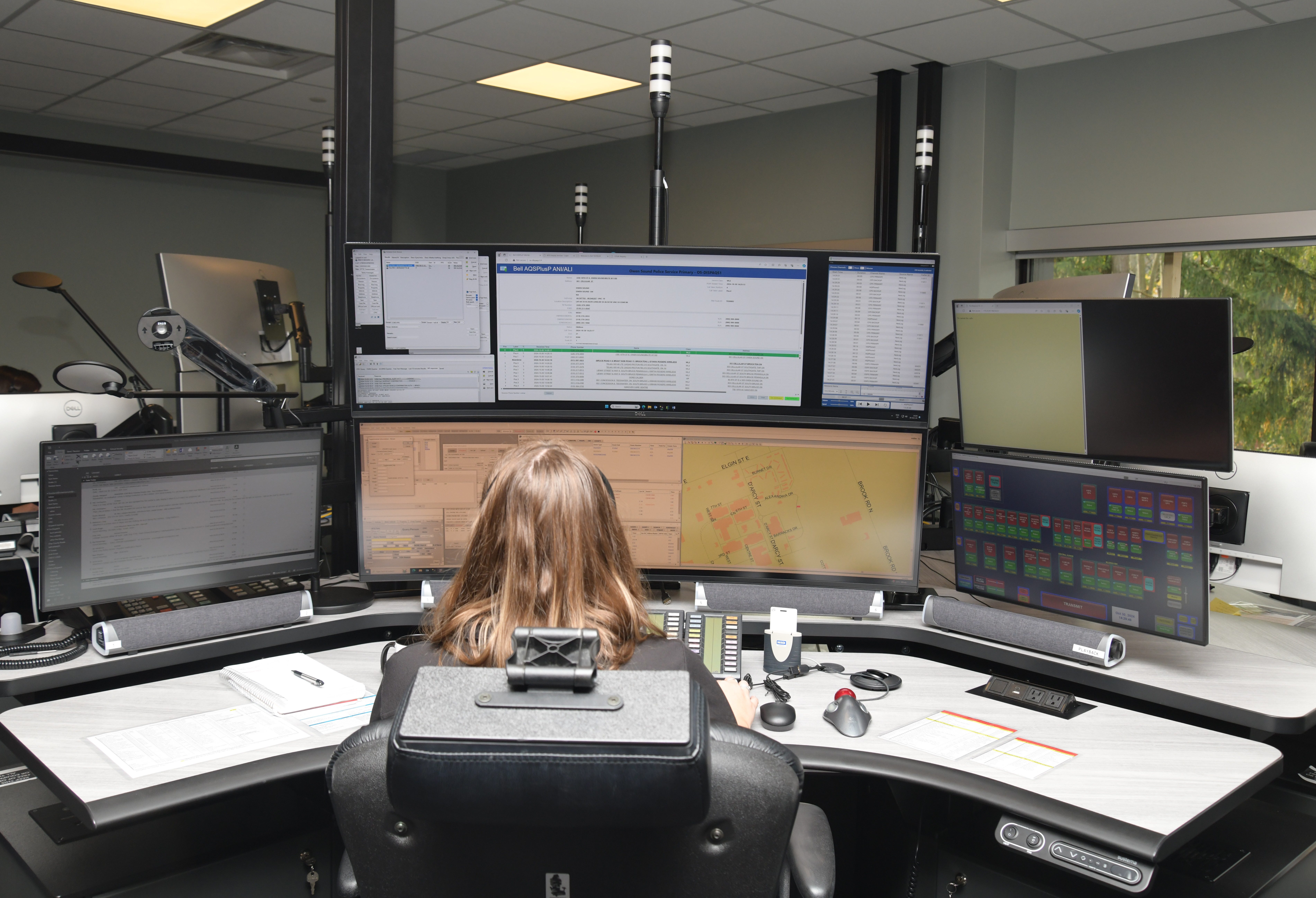
When a 911 call is placed anywhere in Owen Sound — or across the 28 municipalities and two First Nations communities served by the Owen Sound Emergency Communications Centre (OSECC) — it lands in a queue managed by trained communicators working out of a regional dispatch hub operated by the Owen Sound Police Service.
Owen Sound Police Chief Craig Ambrose recently shared additional detail with the Owen Sound Current about how the 911 system works, what callers should do when reporting an emergency, and a few common misconceptions about the system.
Hanging Up and Redialling Sends You to the Back of the Line
“All 911 calls are delivered to a queue and answered according to when the call is received,” he said. “If all dispatchers are busy, the call goes into a queue and if the caller remains in the queue they will be delivered to a dispatcher immediately upon hang up with another 911 call.”
Hanging up and dialling again, he said, has the opposite effect of what callers may intend.
“If the caller were to hang up and dial again they will end up at the end of the queue and have to wait again until a dispatcher is free. Also if people hang up it extends the time taken to call back and check with the caller as to why they hung up.”
In other words: staying on the line — even if it feels slow — gets a caller to a dispatcher faster than hanging up and trying again.
What OSECC Does
OSECC is operated by the Owen Sound Police Service and serves a population of more than 370,000 people. It functions as both a primary and secondary Public Safety Answering Point (PSAP).
As a primary PSAP, 911 calls are routed directly to OSECC for six police services: Owen Sound, Saugeen Shores, Port Hope, West Grey, Hanover, and Cobourg. As a secondary PSAP, OSECC handles fire dispatching for departments in Huron and Perth Counties, with calls transferred in from another primary PSAP.
The centre also dispatches for Grey County Roads Department after hours and maintains the Grey County Radio Project.
OSECC is staffed by eight full-time and 14 part-time communicators, along with switchboard operators, management, and IT support.
What Happens When You Call
According to OSPS, when a call-taker answers, they will ask whether the caller needs police, fire, or ambulance, and will confirm the municipality where the emergency is taking place.
Callers are asked to stay on the line and follow instructions. The call-taker remains on the line to ensure the caller is connected to the appropriate agency.
Cellular and internet phones do not always display exact location information, OSPS notes, so callers should be prepared to give their address, cross streets, and any nearby landmarks.
Interpretation services are available in more than 170 languages and can be accessed in less than a minute.
Next Generation 911 Is Here — But Text and Video Aren’t Yet
As we reported in November 2025, OSECC has transitioned to Next Generation 9-1-1 (NG9-1-1), a digital, internet protocol-based system replacing the older analog network. The Canadian Radio-television and Telecommunications Commission has mandated all PSAPs make the transition by March 2027.

The upgrade has already improved location accuracy — particularly in rural areas where the older E911 system could only triangulate a general area from cell tower signal.
But two of the most-publicized features of NG911 — texting and video to 911 — are not yet available locally.
“Text to 911 is a feature of NG911. We have transitioned to NG911 but that feature is not part of the original release and will be added in the coming years when updates come,” Ambrose said. “Video is another future release.”
In the meantime, members of the Deaf, Deaf-Blind, Hard of Hearing and Speech-Impaired (DHHSI) community can communicate with a 911 operator through Text with 9-1-1 (T9-1-1), provided they have pre-registered their cellphone with their wireless service provider. OSECC is also equipped with TTY machines.
OSPS advises that anyone who has not registered for T9-1-1 should call from a landline and stay on the line; the call-taker will see the address and dispatch police.
An AI Assistant Handles Non-Emergency Calls
In March 2026, OSPS launched an artificial intelligence answering assistant called CARA (Community Assistance and Response Agent) to help manage non-emergency calls. The system, developed in partnership with Canadian firm Hyper (formerly HyperAI), greets callers, gathers preliminary information, and either provides guidance or routes the call to a human operator.

Ambrose has previously told Owen Sound Current that CARA is trained to redirect any emergency calls to the appropriate queue based on priority, where they are answered in the same format used before the AI was introduced.
The Communications Centre and the City Budget
OSECC’s regional dispatch model has been a recurring point of discussion at Owen Sound City Council, where Police Chief Craig Ambrose has defended the operation as essential to keeping local policing costs sustainable.
During the City’s 2026 budget deliberations in January, some councillors questioned whether the communications centre — which provides dispatch services to five other police agencies in addition to Owen Sound — was discretionary, and whether scaling it back could ease pressure on the local tax levy.
Ambrose told Council the opposite was true. Owen Sound requires its own 24/7 dispatch regardless of whether it serves outside agencies, he said, and the revenue generated by external contracts offsets costs that would otherwise fall to local taxpayers.
He estimated the cost avoidance for 2026 — if all external service contracts were dropped — at $2.99 million, with $500,000 of that from NG911 contracts alone. If the city were to shut OSECC down entirely and contract its own dispatch out, Ambrose said the police budget would increase from just over $9.8 million to $12.15 million.
“There’s nobody else right now offering the services to dispatch for a police service,” Ambrose said at the January 16 budget meeting. “That’s why we’ve been successful in our revenue stream.”

Council ultimately approved a 5.5% police levy increase, below the 7.23% the Owen Sound Police Services Board said was required to maintain adequate policing. The decision left the service to absorb roughly $150,000 in unfunded costs.
The introduction of CARA — initially funded through a grant tied to the 2023–2026 Police Service Board operations plan — is one of the measures intended to manage workload pressures on the communications centre as call volumes continue to climb. Dispatch calls handled by OSECC are now approaching 19,000 annually, according to figures presented to Council.
When Not to Call 911
OSPS reminds residents that 911 is for police, fire, or medical emergencies only — situations where someone’s health, safety, or property is in jeopardy, or a crime is in progress.
911 call-takers cannot provide information on weather, power outages, or phone numbers for other municipal services.
Local non-emergency numbers:
Owen Sound Police Service: 519-376-1234
Owen Sound Fire & Emergency Services: 519-376-2512
Brightshores Health System, Owen Sound: 519-376-2121
Related:


