

Owen Sound Police Budget Faces Shortfall for 2026 as Council Rejects Full Funding Request
Owen Sound Council rejects requested police budget increase despite warnings from senior officers and board, leaving 2026 policing needs underfunded amid rising crime and regulatory costs.

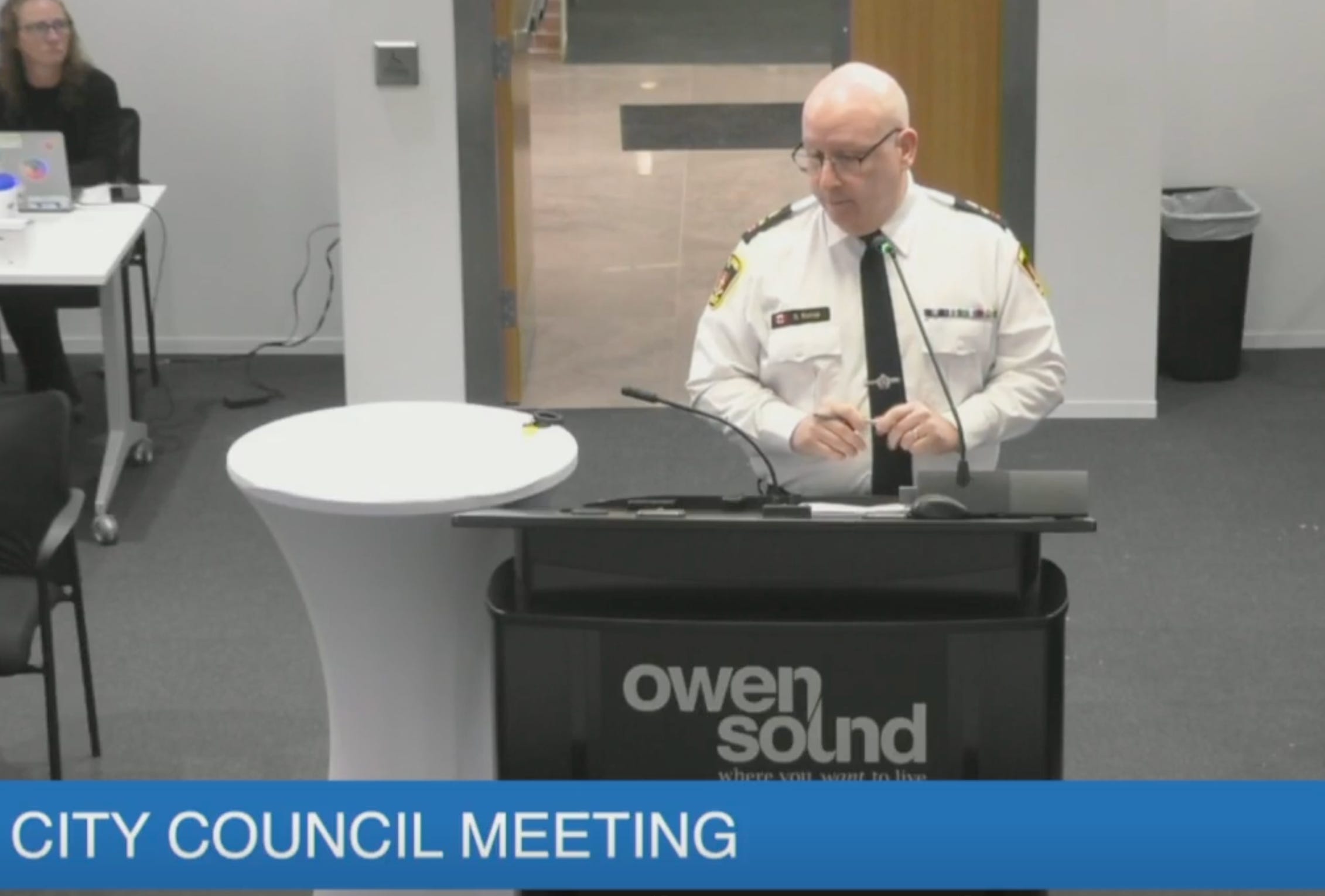
The Owen Sound Police Service is heading into 2026 with less funding than it says is necessary to maintain core operations, after an amendment to restore the service’s full budget request was voted down during final deliberations on Friday.
Councillor Carol Merton brought the amendment forward during the Strong Mayor budget meeting on January 16. It would have increased the city’s police levy from the Mayor’s proposed 5.5% to 7.23%, the revised figure approved by the Owen Sound Police Services Board following months of financial review.
“This amendment reflects what the Police Board has determined is the minimum required to continue delivering adequate and effective policing,” Merton told Council. “These are not discretionary costs. These are known, unavoidable obligations — many of them outside local control.”
Even so, the motion failed to gain the two-thirds majority required under Ontario’s Strong Mayor legislation, leaving the police service to absorb more than $150,000 in unfunded costs.
What Drove the Police Budget Request?
An exchange between Police Chief Craig Ambrose and Mayor Ian Boddy, after the budget presentation, highlighted the recurring budget tension caused by Owen Sound’s role as a regional social services hub.
Ambrose noted that trials involving high-risk individuals from Bruce County are now being held in Owen Sound, citing the superior facilities and security capabilities of the local courthouse.
While these cases bring increased court security requirements and staffing demands, they don’t come with proportional funding.
“We are tracking all the hours,” Ambrose told Council, when asked if Bruce County had been billed for those costs. “I intend to submit an invoice… whether or not anybody’s going to want to pay it, I don’t know.”
At the same time, the city continues to serve as the default social services centre for many neighbouring municipalities — a fact highlighted recently when Saugeen Shores Police posted publicly that they are transporting unhoused individuals to Owen Sound due to the lack of an after-hours emergency warming shelter in their own jurisdiction.

City staff and police leadership have repeatedly warned that while Owen Sound bears the infrastructure costs and service burden of a regional hub, funding models have not adapted, leaving city taxpayers to foot the bill.
Increased Operating Costs Unavoidable: Bishop
Council heard Friday that the police service’s budget pressures were not driven by new programs or staffing expansions, but by the City’s rising crime rate, non-negotiable contractual obligations, and external cost escalations, including:
Salaries and benefits, governed by multi-year collective agreements, which account for the majority of spending. These were locked in through arbitration or past council approvals and include negotiated wage increases and benefit liabilities.
Inflationary increases in equipment, uniforms, vehicle replacement, and information technology systems that have have spiked due to global supply chain volatility.
Court security requirements, mandated under provincial standards, require staffing that must be maintained regardless of local budget constraints.
Retirements and one-time benefit payouts — including OMERS liabilities — further compounded the 2026 pressures.
Increased demands for service, as outlined below.
Deputy Chief Dave Bishop, in his presentation to the Police Services Board, emphasized that these cost drivers left “very little room” for reductions without impacting core policing services.
The 7.23% increase, he noted, was not an enhancement request, but “a maintenance budget — the cost of keeping the lights on and fulfilling our obligations under the Police Services Act.”
Chief Craig Ambrose echoed that in his written submission to Council, warning that failing to fund the full request could force reductions in proactive and community-focused services.
“This request reflects real, unavoidable costs,” Ambrose wrote. “Anything less may require difficult decisions that could impact our ability to meet the expectations of the community and our legislative responsibilities.”
Crime is Increasing; Staffing Is Not: Bishop
While fixed operational costs were the primary drivers of the police budget request, senior officers told Council those pressures are being compounded by rising call volumes, increased regulatory oversight, and a policing environment largely shaped by decisions outside local control.
Bishop told Council the police service is now confronting levels of crime and workload that far exceed those of a decade ago, without a corresponding increase in staffing.
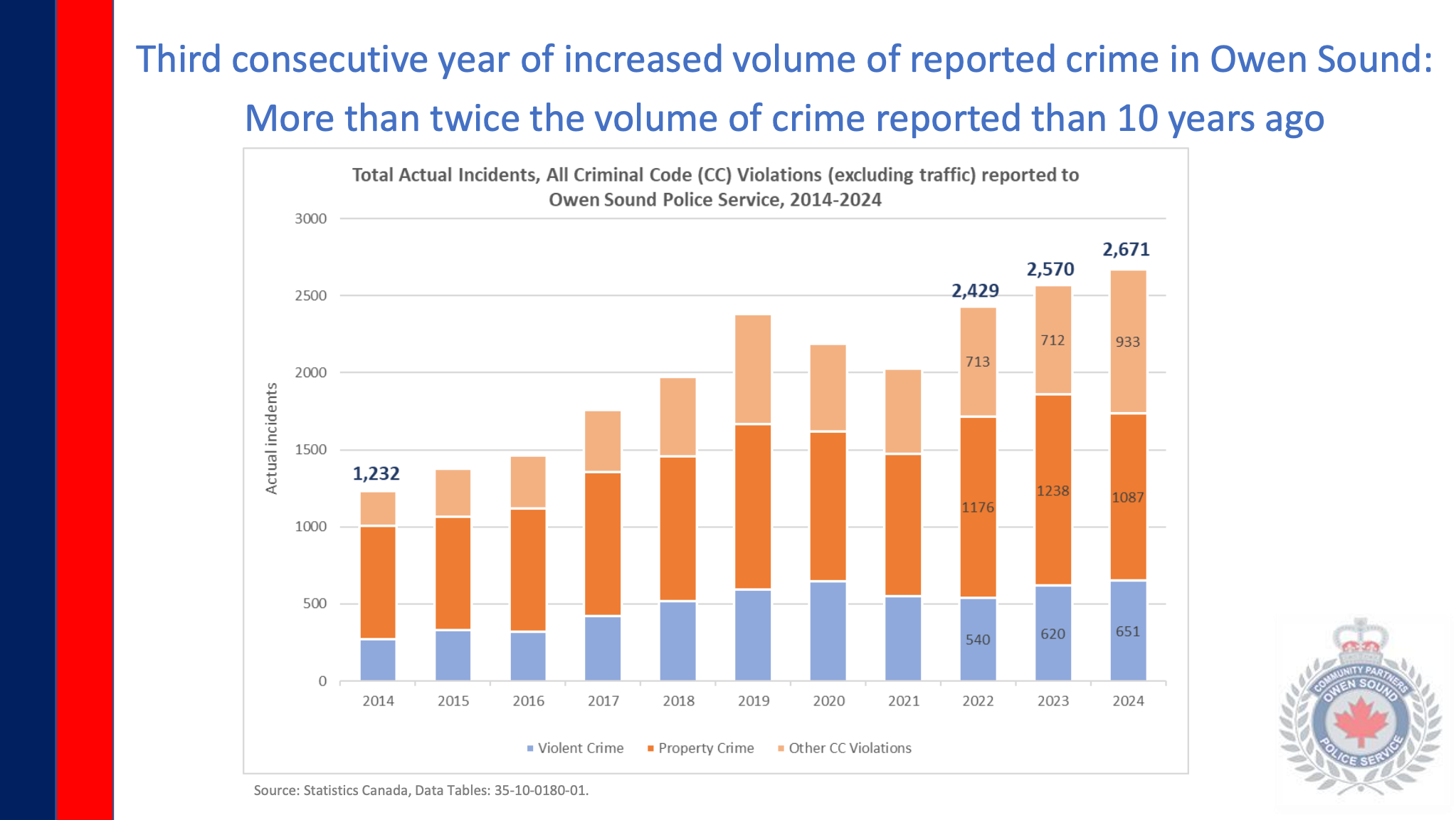
According to his presentation:
Reported crime in Owen Sound has more than doubled over the past 10 years
The city has recorded the highest total crime rate among comparable Ontario municipalities for the second consecutive year
More than 50% of those charged are repeat offenders
In 2024, just 10 individuals accounted for 578 calls for service
Owen Sound officers carry the second‑highest criminal workload per officer among similar-sized police services in Ontario
Despite that, staffing levels have remained essentially flat.
“Everything else has doubled here,” Bishop said, referring to calls, crime, and workload. “But we’re still at the same staff we were 13 years ago.”
The result, he said, is one of the highest calls-for-service-per-officer ratios in the province, with officers increasingly stretched across emergency response, investigations, court duties, and mental health apprehensions.
Bishop described modern policing as “one of the most highly regulated professions” in Ontario, noting that the Community Safety and Policing Act (CSPA) — which came into force in mid‑2024 — fundamentally changed how police services operate.
“Right now, with the new act, we have three different oversight bodies in the province that all have a piece of looking at what we do, how we do it, how it’s regulated, auditing…” Bishop told Council.
“Those changes have been profound for us and all of the other services in the province — and there was no funding that came with it.”
Bishop said the cumulative effect is significant.
“There are things that come almost on a daily basis that end up hitting us that we don’t have control over — and they cost us money, and they cost us time.”
Increasing Mental Health-Related Calls for Service Also Driving Costs
Council heard that policing demand in Owen Sound continues to rise sharply:
Keep reading with a 7-day free trial
Subscribe to The Owen Sound Current to keep reading this post and get 7 days of free access to the full post archives.