

Committee Approves Four-lot Infill on 23rd Street West Over Neighbours' Objections
A corner property in the city's northwest will be split for two semi-detached homes and a single-detached house. Two nearby households asked the Committee of Adjustment to refuse it.

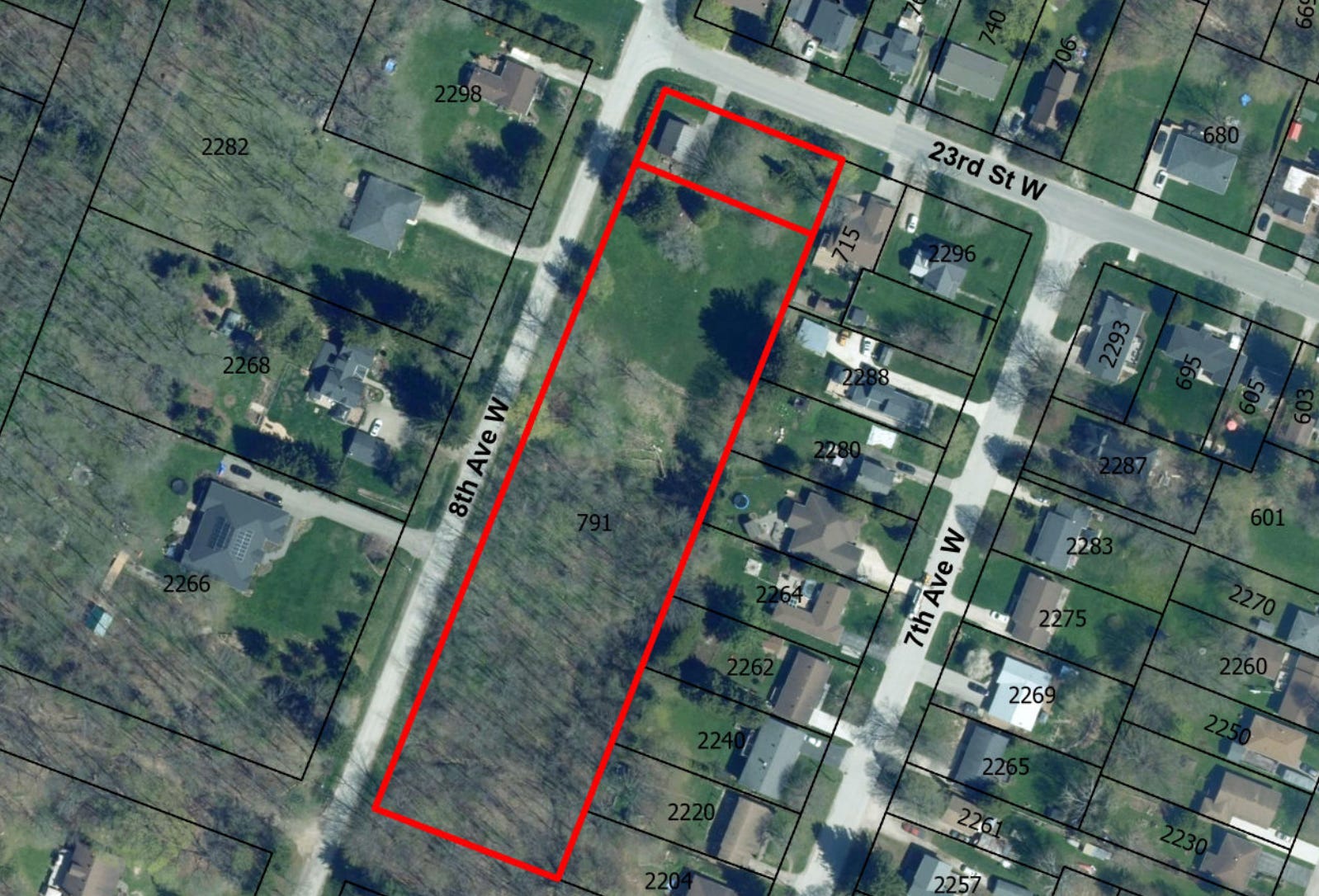
Owen Sound’s Committee of Adjustment approved a residential infill project at 791 23rd Street West on June 2, clearing the way for a builder to carve a large corner property into four new lots for two semi-detached homes — four dwelling units in total — plus a retained lot where a single-detached house is already under construction.
The committee approved both the severance (Consent applications B05-2026 to B08-2026) and a related minor variance (A05-2026) after brief motions and no recorded debate. The applications were brought by Ron Davidson Land Use Planning on behalf of Jody Brown, whose numbered company, 2235130 Ontario Ltd., owns the land.
The decisions came over written objections from two nearby households, both of whom argued the new lots are too narrow and out of character with a street of large, mature single-family properties. Only one of the objectors appeared in person at the hearing.
What was approved
The property sits in the northwest quadrant of the city, on the corner of 23rd Street West and 8th Avenue West, against the municipal boundary with the Township of Georgian Bluffs.
It runs to roughly 9,700 square metres, but a steep, wooded ravine occupies the entire rear (southern) portion — about 0.6 hectares designated as Hazard Lands and containing significant woodlands, wetlands and a watercourse. No development is permitted there, and as a condition of approval the builder must convey that land to the City for long-term environmental protection.
The buildable northern strip, fronting 23rd Street West, is being split into four lots of roughly 10 metres of frontage each, to be developed as two semi-detached buildings. An existing single-detached house and detached garage at the corner will be demolished. On the retained parcel, a single-detached home is already going up.


All told, the project adds four new units to a property that historically held one house. Across the 0.4 hectares of developable land, that works out to a net density of 12.5 units per hectare — a figure staff described as low-density residential, and, notably, half of what the City’s Official Plan envisions.
Senior Planner Jacklyn Iezzi noted in her report that the Plan generally calls for a minimum of 25 units per net hectare, which on this site would have permitted up to ten units. The proposal comes in at five.
The variance, and a point of confusion
Much of the neighbours’ opposition centred on the minor variance — and on this point, the objectors and city staff were partly talking past each other.
The variance does only one narrow thing: it reduces the required lot frontage for the single-detached house on the retained lot from 12 metres to 10, a two-metre reduction. It exists because of a technicality in how the zoning by-law treats corner lots.
The by-law deems the shorter street-facing lot line to be the “frontage,” and although the retained house faces and is accessed from 8th Avenue West — where it has about 200 metres of road frontage — its short 10-metre edge along 23rd Street West is what counts under the rules.
That 10-metre strip is needed because municipal water and sewer run along 23rd Street West; 8th Avenue West, as a shared boundary road with Georgian Bluffs, has no municipal services to connect to.
Crucially, staff clarified that the variance does not apply to the four semi-detached lots. The R3 zone already permits semi-detached dwellings on 10 metres of frontage as of right, so those lots comply with the by-law without any relief.
In other words, refusing the variance would not have prevented the four-lot, four-unit configuration the neighbours objected to; it would only have affected the single house on the retained parcel.
The objections
In a written submission dated May 22, Joanne Robinson urged the committee to refuse the variance, arguing it failed all four tests under the Planning Act. She wrote that while the individual reductions might look small in isolation, the cumulative effect of putting four units on reduced frontages — more density, more hard surface, more driveway activity and servicing demand — could not reasonably be called minor in the context of the surrounding neighbourhood.
She also pointed to the property’s proximity to a school route and public intersection, and to drainage and stormwater problems she said residents had already experienced after recent nearby development.
Mike and Joan Matejcic, who live nearby in Georgian Bluffs, filed a submission on May 27 and were the only objectors to speak at the hearing. They made clear they were not challenging the severance itself, but objected to the narrow lots and, more pointedly, to the semi-detached form.
The surrounding streets, they wrote, are characterized by wider lots with mature trees, shrubbery and substantial lawns — green space that smaller lots cannot support. They argued the four 10-metre lots would be inconsistent with the street’s pattern and the ratio of building footprint to lot size, and said their preference would be a single home on the 40-metre frontage, or two at most.
They also raised parking spilling onto a street with no sidewalks, a block from a public school, and the prospect of diminished property values. As a constructive note, they suggested the city require an artist’s rendering of proposed developments in future, to help residents understand what is actually being proposed.
What staff and the applicant said
City staff recommended approval of both applications, finding the project consistent with the 2024 Provincial Planning Statement and in conformity with the County and City Official Plans and zoning. Staff framed it as exactly the kind of efficient, fully serviced infill the province is pushing municipalities to support.
On the neighbours’ specific concerns, staff offered clarifications. On building height — the Matejcics had worried about three-storey semis — staff noted the maximum permitted height is 10 metres (rising to 12.5 metres once the city’s newly updated zoning takes full effect), the same limit that applies to any house on the street, and that no height relief was being sought.
On density, traffic, drainage and neighbourhood character, staff maintained that the analysis showed conformity with the Official Plan’s intensification policies, and that the four additional units were not expected to significantly affect the local road network.
Presenting for the applicant, planning consultant Ron Davidson described the variance as a technicality, explained the odd lot shape as a servicing necessity, and noted the city’s Official Plan now requires a mix of housing types. He also told the committee that an archaeological assessment had been carried out on the site the previous week and had found nothing.
A handful of commenting agencies — the City’s Engineering and Building divisions, Grey County, the Ministry of Transportation, Canada Post, Bell Canada, and the Grey Sauble Conservation Authority — raised no objections, though Engineering and the conservation authority both recommended an overall grading and drainage plan.
(Grey County has recently scaled back its planning-policy commentary on minor variances and consents within settlement areas; its ecology staff reviewed the file and waived the requirement for an environmental impact study.)
What happens next
Approval is subject to conditions, including demolition of the existing house and garage, a grading and drainage plan, an archaeological assessment, a five-per-cent parkland dedication or cash-in-lieu, conveyance of the hazard lands to the City, and a deeming by-law that Council will need to pass to merge the old subdivision lots. Construction of the semi-detached buildings will face further review at the building-permit stage.
The committee’s decision carries a 20-day appeal period to the Ontario Land Tribunal.
The hearing is the latest instance of a tension the Owen Sound Current has reported on before: residents invoking traffic, drainage and neighbourhood character against new housing, set against a planning framework — reinforced by the city’s freshly adopted 2026 Official Plan — that treats intensification as a goal rather than a concession.
On 23rd Street West, the recurring irony held: the neighbours called the project too dense, while the city’s own plan considered it well under the density the site could carry.
Source: City of Owen Sound Committee of Adjustment Meeting, June 2, 2026
Related:


