

City's Affordability Case Fails as Firefighter Pay and Benefits Reach $5.5M a Year
The City covered $1.55 million in back pay from money set aside since 2019, and will fund the higher ongoing wage and benefit costs for fire hall through taxation.

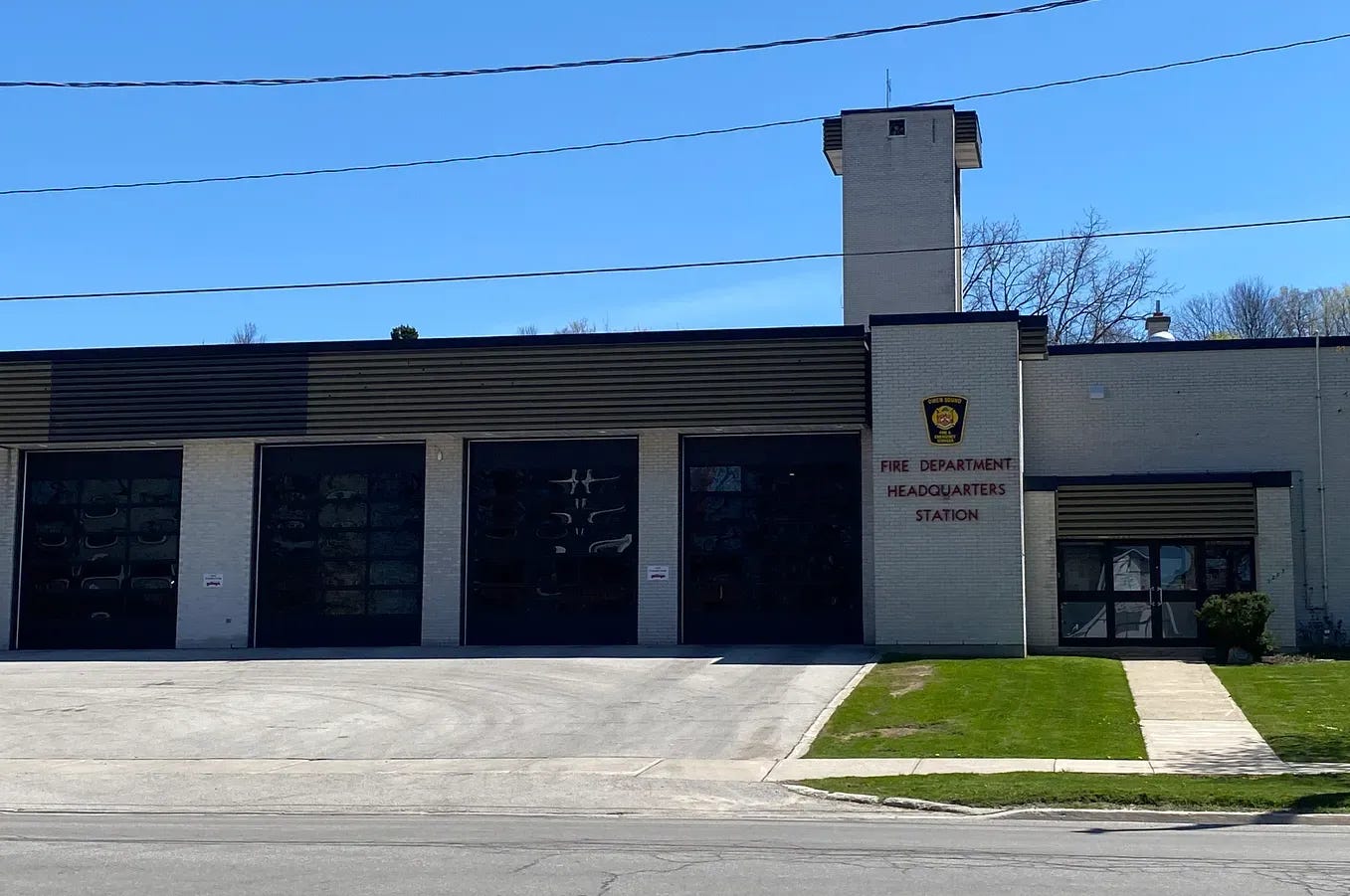
Through an arbitration process that ran for more than four years, the City of Owen Sound argued it couldn’t afford to pay its firefighters more. The arbitrator awarded the increases regardless.
The binding decision, handed down March 9, set the contract for the City’s full-time firefighters from Jan. 1, 2019 through Dec. 31, 2026. City manager Tim Simmonds confirmed the City’s ability-to-pay argument was rejected in a June 13 email to the Owen Sound Current.
“With regard to the ability to pay, legal counsel on behalf of the City, made submissions on the City’s ability to pay that were not accepted by the Arbitrator,” he wrote.
The email, sent in response to Owen Sound Current’s questions in March about the binding award, also put figures to a decision the City had not costed publicly since the ruling came down. The award carries a one-time retroactive payout of about $1.55 million, Simmonds said.
It also sets the annual cost of fire-service pay and benefits at about $5.5 million — what the City spends on fire personnel, not the full fire department budget.
“These costs are funded through taxation,” Simmonds wrote.
What the City now confirms
The retroactive payout — about $1.55 million, covering Jan. 1, 2019 to March 14, 2026 — is a one-time cost the City funded without drawing on reserves.
“Money had been set aside each year in the budget,” Simmonds wrote. “Those monies that were accrued each year, covered the retroactive payments and no additional reserve money was required.”
That confirms a claim a City director made at a May committee meeting: that the City had accrued enough to fully cover the back pay. Until now, the only public figure was in a May 7 corporate services report, which put 2026 fire services budget pressure at roughly $90,000 and described the retroactive payments as still being calculated.
The $5.5 million Simmonds cited is the annual pay-and-benefit cost under the awarded rates, not the cost of the increase. The award’s ongoing cost shows up as new budget pressure: about $93,500 for the remainder of 2026, roughly $66,000 of it from higher benefit costs, supervisory pay differentials and increased OMERS pension contributions.
That pressure carries into the 2027 budget.
Award terms already on the record
The March 9 decision set wages and benefits for the 29-member full-time bargaining unit, including 26 suppression firefighters, from Jan. 1, 2019 to Dec. 31, 2026.
The top-rate base salary for a first-class firefighter rises from $99,821 in 2019 to $121,099 in 2026 — a cumulative 21.3% over the seven years, with an increase in each year of the agreement.
Those yearly increases are retroactive: the City must pay the difference between what firefighters actually earned each year and the newly awarded rates, back to 2019. Firefighters move up a salary grid by years of service before reaching the top rate, so not all earn that figure.

The award also raised psychological services coverage to $4,000 a year, set a line-of-duty death benefit at twice salary, established parental leave top-ups at 75% of salary, and set supervisory pay differentials at 119% of base.
Where it sits in the budget
The $5.5 million is compensation alone — fire-service wages and benefits — and the largest single piece of the City's fire spending, though not the whole of it.
The fire services levy requirement for 2026 is about $6.2 million, roughly 15.9% of the City’s $39-million municipal levy. Wages and benefits make up the majority of fire service costs.
How the decision was made
Fire-sector contract disputes that can’t be settled at the bargaining table go to binding interest arbitration under the Fire Protection and Prevention Act, 1997 — a process that takes the outcome out of council’s hands. The province rewrote the criteria arbitrators must weigh in 2018.
Bill 57 no longer requires an arbitrator to treat a municipality’s “ability to pay” as a distinct criterion, replacing it with factors that include the economic health of the municipality and the interest and welfare of the community.
Municipalities had sought that change. Through the Association of Municipalities of Ontario, they welcomed it as putting local fiscal circumstances more clearly within an arbitrator's decision-making, though AMO also cautioned that the amendments do not guarantee arbitration outcomes.
Ontario has 437 fire departments — 32 career/full-time, 210 composite, and 195 volunteer/part-time. Owen Sound is one of the 32 career/full-time departments. With about 21,600 residents, Owen Sound is among the smaller Ontario municipalities to run a fully career fire department.
The City went in looking to cut
The affordability submission was not the City’s only attempt to hold down fire costs. Owen Sound entered the arbitration seeking to reduce its full-time firefighter complement over time through attrition. That staffing question was resolved in a separate 2025 arbitration decision and was not revisited in the final wage-and-benefit award.
In February 2024, former councillor John Tamming asked council in writing for the City’s proposed staffing reduction, the projected annual savings and a cost estimate. Simmonds declined to answer most of it, citing the live arbitration.
“I’d reserve any comment or response to a number of those questions at this particular time,” he said at the time.

The Owen Sound Current asked the City for its analysis of its ability to pay in March 2026. Simmonds confirmed only that the City's submissions on the point were rejected; the analysis itself was not provided.
The Current also asked for the cost of the benefit enhancements, the supervisory pay differentials and the pension impact to be itemized. Simmonds gave a single combined figure — about $66,000 — without breaking it down.
The report stays closed
The staff report setting out the financial implications of the award went to a closed council session on labour relations, and the City is not releasing it.
“As the report went to a Closed Session meeting as it related to Labour Relations, we will not be sharing the report,” Simmonds wrote.
The Municipal Act permits councils to close meetings to discuss labour relations. It does not require the City to keep the report confidential. The City has decided not to release it.
Several questions remain. The City has not itemized the $66,000 in benefit, differential and pension costs, provided a year-by-year breakdown of the retroactive pay, or said whether the $1.55 million is net of an interim award the arbitrator issued in 2021. Nor has it confirmed whether the $5.5-million annual figure covers the full fire service — the budget's salary line includes the chief and deputy — or the 29-member bargaining unit alone.
The City has also not disclosed the legal costs of this arbitration. The previous round, covering 2015 to 2018, cost about $980,000 in retroactive pay and $220,000 in legal fees.
Related:
