

Voting on Ryerson Park's New Name Opens, Guided by a Policy Adapted From Yale
Residents can rank shortlisted names for the former Ryerson Park until August 28, in the city's first renaming under its 2021 naming policy.

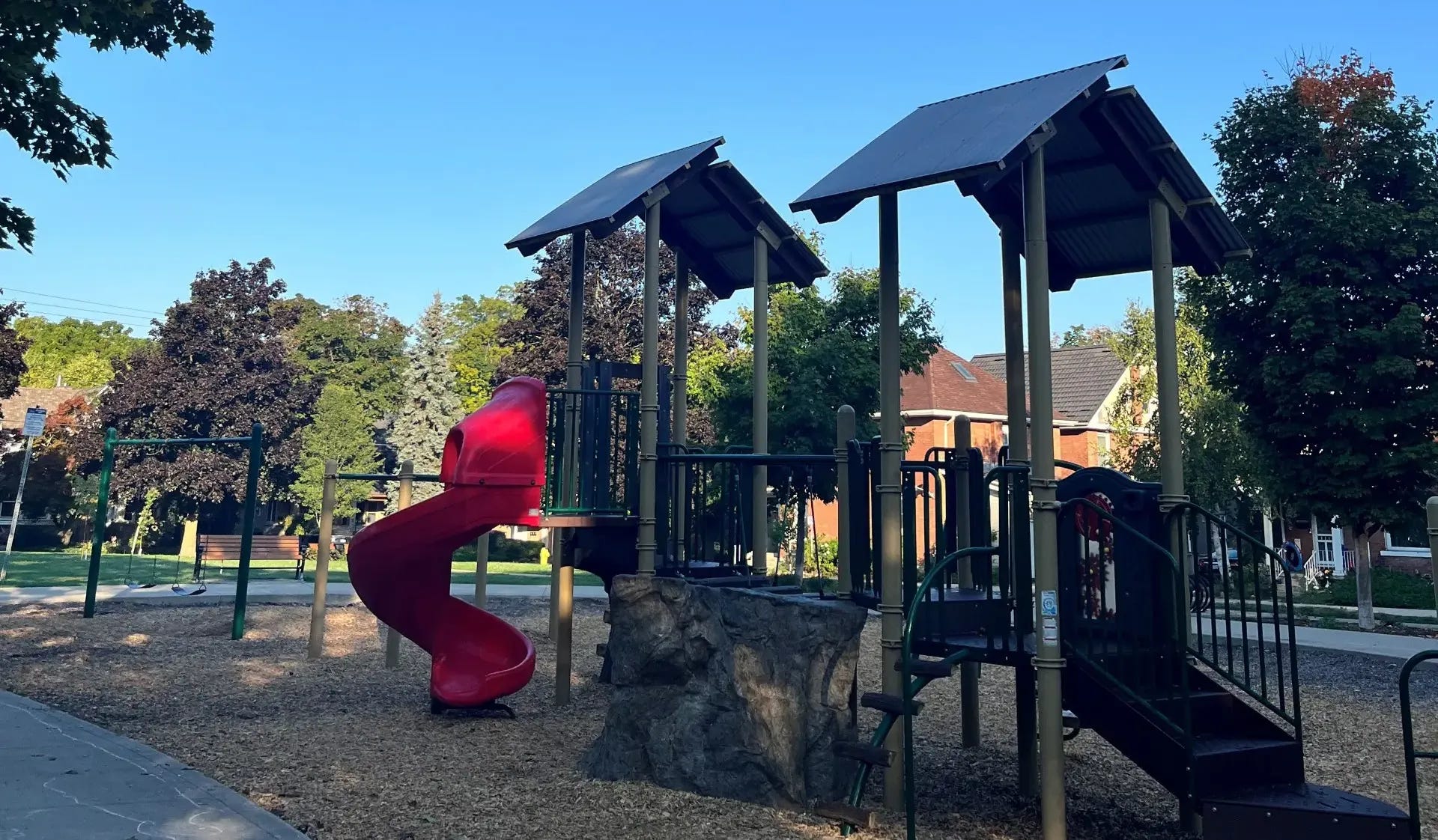
Residents can now help choose a new name for the neighbourhood park formerly known as Ryerson Park, in a second round of public engagement the City of Owen Sound opened July 15. Through August 28, residents can rank their top three choices from a shortlist of names on the City’s OurCity platform.
It is the first park the City has moved to rename under its Naming and Re-Naming Policy for City Parks and Facilities, adopted by Council in 2021, and the process reached a point where staff proposed setting that policy aside for one name — an option the committee declined.
The policy guiding that decision isn’t really Owen Sound’s. Its core was adapted from a report written for Yale University, a private American university, to help it decide whether to remove names like that of a slavery advocate from its buildings.
Owen Sound kept Yale’s framework but not the scholarly review Yale said was essential to using it. And the first time the City applied the policy, an Anishinaabe name offered by the Saugeen Ojibway Nation didn’t fit, so staff proposed stepping outside the policy to accommodate the request.
What residents can vote on
The shortlist residents are ranking is made up of names with a locational reference. Among them: Old School Park, Boyd Street Park, Eighth Street Park and Ryerson School Park, chosen after Council directed that locational names be given priority.
Names honouring individuals, which residents also submitted, were set aside. In a June 24 staff report, the City noted that the policy gives honorific naming a lower priority and that staff did not put those forward for voting.
The honorific submissions left off the ballot included Billy Bishop, Bob Rutherford, John “Daddy” Hall, Norman Bethune and Nahnebahweequay (Catharine Sutton).
At the June 24 committee meeting, the councillor who moved the recommendation acknowledged the excluded names were significant community figures who did not fit the policy's call for a locational name.
A name offered outside the vote
The City also consulted the Saugeen Ojibway Nation (SON) on the naming. According to the June 24 report, prepared by Director of Community Services Pamela Coulter, SON appointed two councillors — Janine Manning of the Chippewas of Nawash Unceded First Nation and Theresa Roote of the Chippewas of Saugeen First Nation — as its representatives. City staff met with SON representatives at the park on May 27.
From that meeting, an Anishinaabe name was offered: Niisinaabe-ki, which the report translates as “Person lowered to the earth” and connects to the descent from the escarpment to the base of the hill and to the creation story.
The report says the name was offered by an Elder and residential school survivor from the Chippewas of Saugeen First Nation.
SON asked that the name be considered on its own merits rather than through the ranked public vote. Staff wrote that doing so “would be a deviation from the policy” but “may be appropriate in this instance,” and set out two options for the Community Services Committee: set the policy aside and select the Anishinaabe name, or include it in the ranked voting.
On June 24, the committee recommended that the name go forward through the ranked public vote alongside the locational suggestions, rather than being selected separately (the option staff had flagged as a policy deviation).
How the renaming came about
The renaming began with a resident application under the policy. A Council-appointed working group reviewed it and, as the Current reported after the December 17 committee meeting, found the park’s name came from its proximity to the former Ryerson Public School rather than from a decision to honour Egerton Ryerson.
Council ratified the recommendation to rename in January and directed that the process follow the policy, prioritize a locational name and install a plaque recording the park’s naming history.
The broader push to rename places bearing Ryerson’s name followed the 2021 identification of unmarked graves at former residential school sites.
Egerton Ryerson’s connection to the residential school system is cited by advocates for renaming and disputed by others, including a Toronto Metropolitan University historian who told Council in January the association rests on flawed research.
The working group concluded the park was not named to honour Ryerson in the first place.
The process has been long. A petition to change the name drew more than 400 signatures in 2021, the year the park’s sign came down; Council did not begin the formal renaming process until May 2025, and a new name is not expected to be settled until late 2026.
Over that span, the process drew on more than the policy required: a historical review, a dissenting deputation heard, direct engagement with the Saugeen Ojibway Nation and a name offered by one of its Elders, and a commitment to install a plaque recording the park's naming history.
What the City’s policy says
The City’s media release links to the full policy. Most of it reads as municipal policy usually does: directive and procedural. It assigns Council the final decision, requires a minimum of 10 days’ public notice and sets out application forms, staff reports and committee steps.
One section reads differently. In setting out how the City should weigh renaming “on account of values,” the policy stops telling decision-makers what to do and starts telling them how to think about the issue: that a name should stay unless there's an exceptional reason to change it, that the person seeking the change carries the burden, that tradition weighs on the side of keeping things as they are.
It says there are many reasons to honour tradition, that historical names carry wisdom “not immediately apparent to a current generation,” and that “no generation stands alone at the end of history with perfect moral hindsight.”
It states that “human lives are large and contain multitudes.”
The section establishes a presumption against renaming that is strongest for names honouring a major contributor, and directs decision-makers to weigh a namesake’s “principal legacy” across three timeframes: the era the person lived, the time of the naming and the present.
Where the language comes from
Those passages are not unique to Owen Sound. The policy’s renaming section closely follows — and in places reproduces word for word — the 2016 Report of the Committee to Establish Principles on Renaming, adopted by the governing corporation of Yale University, a private institution in the United States.
Adapting an existing framework is common in municipal policy, and often sensible; a small city doesn’t need to invent its own philosophy of renaming from scratch.
Owen Sound borrowed the framework. What it didn't borrow was the method that made it work.
The sentence about no generation standing “at the end of history with perfect moral hindsight” appears in both documents, as do the “principal legacy” test, the presumption against renaming in exceptional circumstances, the three-timeframe analysis and the “non-erasure” obligation to preserve history when a name is removed.
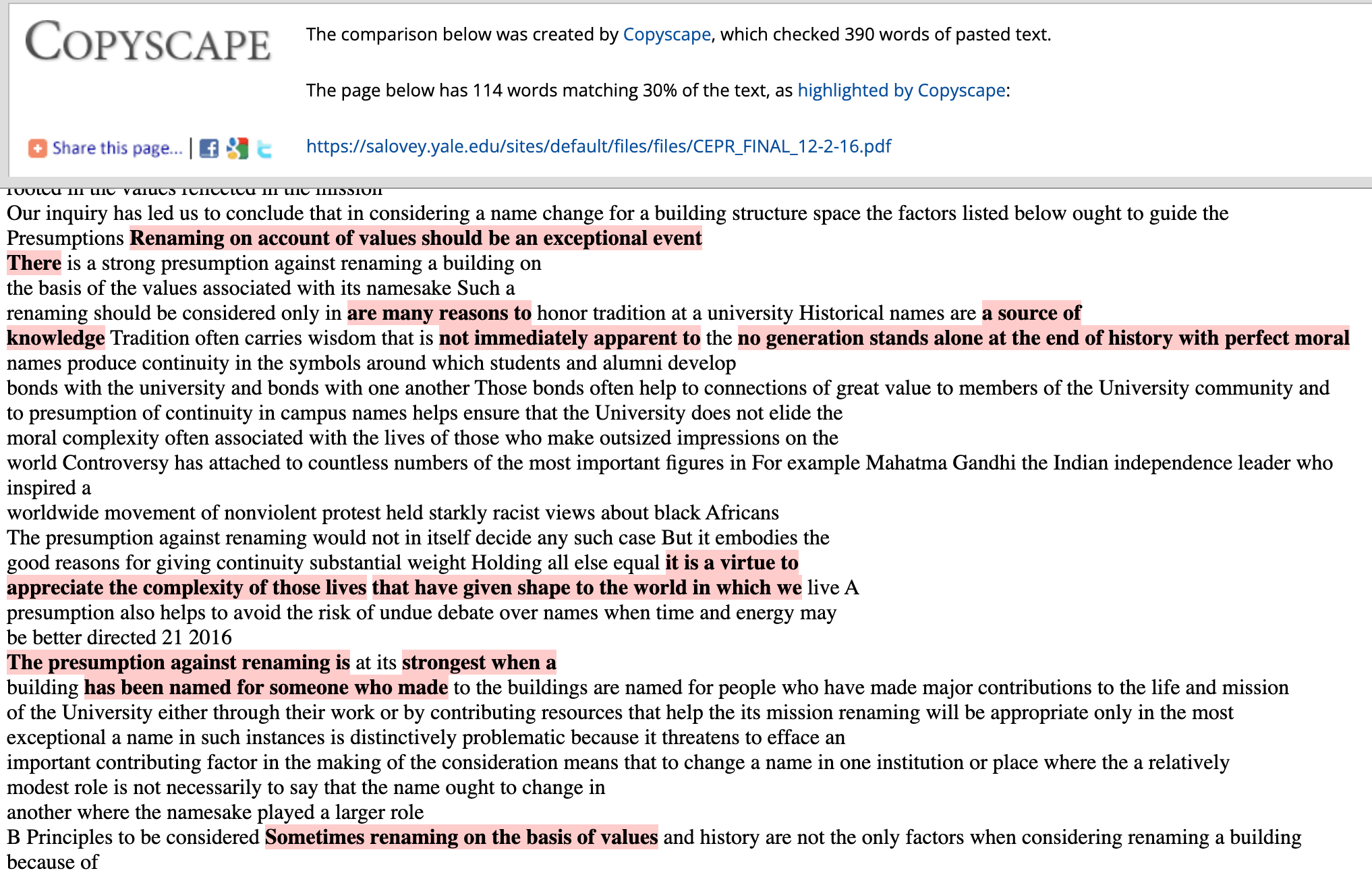
The line about lives that “contain multitudes” also appears in the Yale report, which attributes it to the American poet Walt Whitman; the City’s policy carries no attribution.
The two documents part company at a key point. Yale’s framework measures a name against “the mission of the University,” a written statement the report quotes and returns to throughout. Owen Sound’s version substitutes “the vision and values of the City.”
Yale wrote its principles to weigh the honorific names of historical figures — its central example was John C. Calhoun, a 19th-century American politician and defender of slavery.
Why it matters
Yale built this framework to weigh the names of historical figures like Calhoun, and it required historians and scholarly study to apply.
Owen Sound kept the test and dropped the method. Its renaming decisions fall to a working group of three councillors, the clerk and the city manager, which the policy does not require to include a single historian.
A municipality’s footing is different from that of an American Ivy League school: it holds parkland in trust for all residents and draws its authority from provincial statute and the electorate rather than from an institutional mission.
Whether a public body should treat a park’s name as a statement of civic values, the way Yale treats its buildings, is a question the policy takes a position on without acknowledging.
The Yale report also set conditions on how its framework is applied.
Determining a “principal legacy,” it says, “obliges the University to study and make a scholarly judgment,” and should rest on scholarly consensus rather than shift at any single person’s or group’s discretion.
The committee that wrote it was composed largely of historians and worked its abstract tests through named examples to show what the terms meant.
The Owen Sound policy keeps the “principal legacy” test and the three timeframes but not that method: the examples are gone, and it requires no scholarly study. In this instance, the working group did review a historical report and hear a deputation from a historian, but the policy leaves that to discretion rather than requiring it.
For the naming that followed, the City did consult directly with Saugeen Ojibway Nation.
The policy itself leaves no record of whether Council was told in 2021 where the section came from, or whether anyone assessed how a framework written for a private American university fits an Ontario municipality.
The vote, and what it doesn’t cover
Residents were not asked whether the park should be renamed; Council decided that. Their say has been limited to two rounds: suggesting names, and ranking the ones staff put forward.
The policy’s first real test came from the naming itself. When the Saugeen Ojibway Nation offered an Anishinaabe name through direct engagement and asked that it be weighed on its own merits rather than dropped into a public ranking, staff found the policy had no room for it — accommodating the request, they wrote, “would be a deviation from the policy.”
The committee placed the name in the ranked vote instead, the course the policy allowed.
A policy instructs. It tells decision-makers what to do: hold a hearing, give notice, weigh a report.
An argument takes a side. For most of its length, CS087 instructs. In the section that governs renaming, it takes a side: that names should stay, that the burden falls on whoever wants one changed. That case was built by a Yale committee setting a presumption against removing names like Calhoun’s from its buildings.
It now sits in a policy about Owen Sound's parks.
The first time the City used it, a framework written for a private university met a name offered by an Elder on Saugeen Ojibway Nation territory — and could only handle it as an exception.
Related:

