Toys of Yesterday: Eaton Beauty Dolls
Bruce County Historical Society shares a look back at the evolution of an iconic Canadian toy in this story from the organization's 1986 Yearbook.
SUBMITTED
by Olive Hepburn, Bruce County Historical Society
Dolls are as old as recorded history and were being made in Egypt 3,000 years ago.
Dolls came with heads made of many different materials: wood, brass, tin, papier-mâché, wax, glazed china and bisque (unglazed porcelain). The bodies were of cloth or kid leather; the hands and feet were usually a mixture of wood and flour. Those bodies made of kid were made to bend at the knees, hips and elbows.
Hard-headed china dolls with cloth bodies were very durable. The lower arms and legs were made of the same china and the overall doll was very poorly proportioned. The hair was moulded in either black or yellow and the eyes and features were painted on.
Bisque dolls in the 1800s had solid or blown glass eyes. Sleeping eyes came later. Bisque dolls were easily broken and many a little girl’s heart was broken along with her doll’s head. Fortunately separate heads were available so the doll could be renewed for 15 or 20 cents.
Many rag dolls were favourites; some came ready painted, to be cut out, sewed and stuffed with sawdust or rags (the Bessie doll was one of these). Some rag dolls were homemade from head to toe and dearly loved.
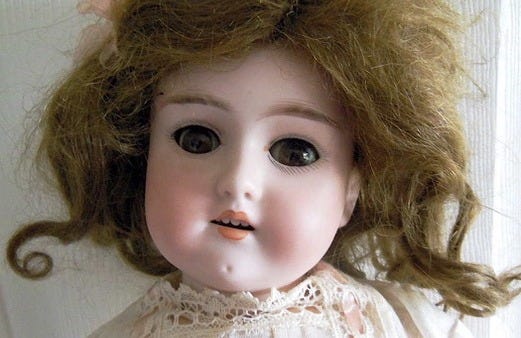
In 1900 came the Eaton Beauty doll. The T. Eaton Co. called her “Lady of Surpassing Beauty” and that she was. When the doll arrived in the mail she really was a dream come true, with bisque head, real hair eyelashes shading her sparkling go-to-sleep eyes. Her pretty face was like a sunbeam with its rosy cheeks and mouth just slightly open to show her pearly teeth.
She had a dimpled chin and flaxen or brown ringlets of hair which hung around her neck. The body was made of a wood and flour mixture and jointed at neck, elbows, wrists, hips, knees and ankles. All this for a dollar if it was a 20” doll. A 36” doll could be had for five dollars. A doll like this was the pride of its owner indeed.


The Eaton Beauty was made in Koppelsdorf, Germany. The two world wars caused complications and she was made in Canada and then in France. In the mid-thirties, she came again from Germany.
Competition in Toyland became stronger in the 1930s and she lost her Queenly reign to the age of plastic, but the Eaton Beauty will forever remain a bright bit of social history and a nostalgic delight to those of us who grew up in the first quarter of this century. (Extra heads could be bought for this doll also.)
A very special doll like the Eaton Beauty came in a box much like a shoe box. When it was received at Christmas or birthday time, it was taken from the box and the little owner was allowed to hold it for a time. Then the cover was fitted over the back of the box and the holes for the string that went round the neck and feet of the doll were poked through this extra strong backing. The doll was put in and tied securely and hung on the wall in the open box, there to be viewed in all her glory, only to be taken down and played with on very special occasions.
Mechanical dolls and toys are no new invention. They have been known, I am told, as far back as the third century B.C. Dolls were made to represent famous people of the day. There was a cute Charlie Chaplin doll complete with the famous hat and cane. He danced when wound up, shuffling his feet as Charlie did. There were dancing bears and drummer boys and merry-go-rounds with horses and riders that went round and round to the music of the carousel, all in very brilliant colours.
Do you remember the iron penny banks? They were made in the shape of buildings, animals, etc. If time and patience permitted, you could shake your money back out, but the bank was easily taken apart by removing the screw that held the two sides together.
There were many toys made of iron, such as a pony and cart and a red fire engine complete with eight black horses and the crew of men in their bright helmets. Pull trains too were of both iron and wood. A little girl could have a little iron stove with pots and pans.
Little girls played house with their little china or tin dishes and did their doll’s wash in a little washtub with a washboard and ironed it with small irons and an ironing board just like Mother’s. Their dolls slept in cradles or carriages just like the real babies of that day. Sometimes they had Apple-head dolls and sometimes those made with painted corn-husks. (To be continued.)
This story is from the 1986 Yearbook of the Bruce County Historical Society.
The fifth edition of Norman Robertson’s book “History of the County of Bruce” is available in the stores listed on our web site, brucecountyhistory.on.ca, or by emailing Bill Stewart, willstew@bmts.com.
It is also available at these book stores: Bruce County Museum, Southampton; Treasure Chest Museum, Paisley; Holst Office Supplies, Walkerton; Little Blue House Café/Gallery, Tiverton; Hamilton’s Toys and More, Kincardine; Berford Street Books, Wiarton; Shops at 84 Main, Lion’s Head; Readers’ Haven Book Store, Tobermory.
Submitted by Robin Hilborn for Bruce County Historical Society.
Related: