

The Downtown Problem Owen Sound Council Can't Define
Police data shows downtown calls rising and proactive patrols cut by half since 2023 — but council can't agree on what the problem is, who's responsible, and whether the River District is in crisis.

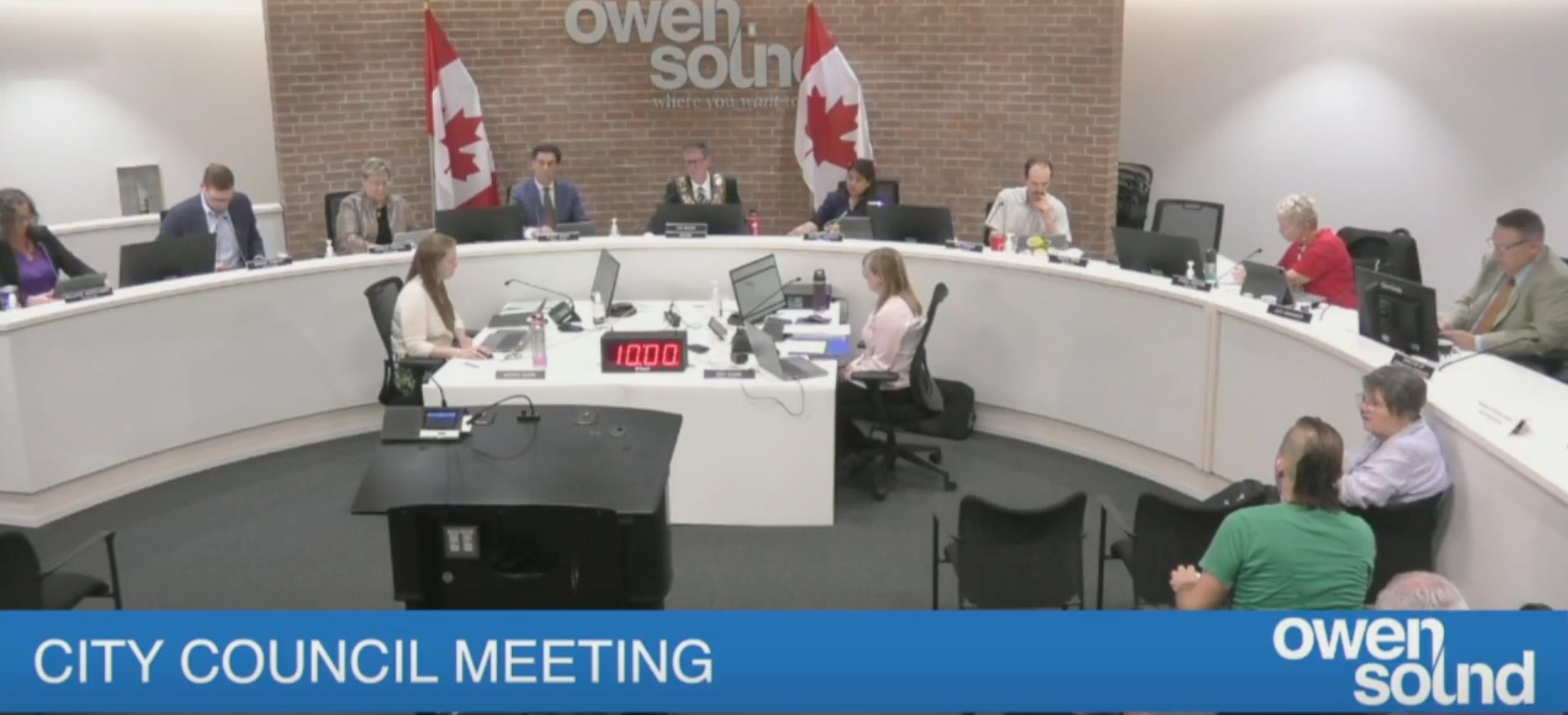
The police board wants the city to act on "social disorder." But the data, the chief, the mayor and council each describe a different problem — and a councillor questioned whether the board understands the file it weighed in on.
The Owen Sound Police Service Board's call for council to act on downtown "social disorder" ran into resistance from council itself on June 15, and exposed how far apart the city’s decision-makers are on what the problem even is. The deputy mayor and a councillor challenged the premise that the River District is in crisis. Mayor Ian Boddy’s answer was that the region is already doing everything it can.
The special meeting, held before council’s regular sitting, opened with a statistics presentation from Police Chief Craig Ambrose and closed with a divided discussion of the police board’s letter.
What it surfaced was disagreement not only over solutions but over the problem itself: the board described disorder, the chief described scarcity, and a councillor called the “crisis” a moral panic. Answering a letter about conditions downtown, Boddy replied with what the county spends on housing, and his conclusion that “we’re not that bad.”
What the numbers show
Ambrose walked council through computer-aided dispatch data covering 2023 through the end of May 2026.
Citywide, total calls have held roughly steady, between about 18,700 and 19,000 a year. The growth is concentrated downtown. In the first five months of 2026, River District calls rose 17% over the same period last year, while citywide calls rose about 5%. The River District — downtown’s commercial core along the river — now accounts for 30% of all calls, up from a 27-to-29% band over the previous three years.
By the numbers: OSPS calls in the River District First five months of each year (January–May), from dispatch data presented June 15. These are calls for service — not crimes or charges.
30% of all Owen Sound police calls came from the River District in 2026, up from 27% in the same period last year
River District call volume rose 17% over the same five months of 2025 — against about 5% citywide
Proactive patrols fell from 789 calls (2023) to 391 (2025), recovering to 460 — a drop from 37% to 20% of downtown activity
Reactive calls climbed from 1,325 to 1,870 since 2023, now 80% of downtown activity (up from 63%)
Sharpest jumps, on small numbers: weapons +320% (5 to 21), suicide-related +200% (7 to 21), assault +133%
Citywide call volume has held roughly flat — about 18,700 to 19,000 a year
Proactive work — foot patrols, community service, traffic enforcement and bar checks — fell from 789 such calls in the first five months of 2023 to 391 in 2025, recovering to 460 this year. Its share of downtown activity dropped from 37% to 20%.
Reactive calls climbed from 1,325 to 1,870 over the same windows and now make up 80% of downtown activity, up from 63% in 2023. Ambrose tied the proactive decline to a shortage of available officers, though police later told council the service is back to full strength and will increase its downtown presence.
The package flagged steep increases in some categories: weapons calls up 320% and suicide-related calls up 200% in the first five months of the year. Those rest on small numbers — weapons calls rose from five to 21, suicide-related calls from seven to 21 — so single incidents move the percentages sharply. Assault calls, on a larger base, rose 133%.
Ambrose was careful about what the data represents. The counts are dispatched events, not founded crimes or charges, and the figures do not record what caused any call.
What the numbers don’t show
The service does not track calls by geography as a matter of routine; staff produced the River District breakdown by hand, plotting dispatch coordinates within a downtown boundary year by year. Ambrose said OSPS is buying new analytics software.
Pressed on where the people generating downtown calls come from, Ambrose said officers record names, dates of birth and current addresses, but the service does not compile statistics by origin. Someone unable to meet their needs elsewhere, he said, becomes a resident of Owen Sound. He could not say what share come from outside the city.
That question — who the downtown system is serving — ran through the rest of the meeting without being answered.
A difficult conversation
Between the data and the board’s letter came the meeting’s most substantive stretch — a long exchange in which councillors and the chief worked through why downtown’s problems resist a policing answer.
Ambrose set the terms. The discussion was not really about homelessness, or mental health, or any one group, he said, but about a perception of safety, and about residents asking police to solve problems police cannot solve.
“We’re not the right people to deal with a lot of the social issues,” he told council, “but we’re the ones that get called” — the responders who pick up the pieces, often after hours, when no other service is available, to keep a situation from escalating.
Councillors took that further. Coun. Jon Farmer, pointing to his professional background in the field, noted that much of the chief’s own list — attempted suicide, mental-health calls, domestic disputes — reads as symptoms of social distress, and asked whether rising rents and a strained economy were pushing up call volumes in ways the data cannot parse. The chief said the service does not track calls to that level of cause.
The frustration running through the exchange was not a lack of talk but a lack of results.
Ambrose said the service already sits at every relevant table — Violence Prevention, Community Safety and Well-being, weekly county calls — and can phone Grey County’s housing staff directly.
“I just don’t think anybody has what they need to make each sector work appropriately,” he said. He wanted “something concrete” to come forward “instead of having this conversation every six months.”
A pilot meant to divert non-police calls — the Neighbourhood Response Team, run by Safe ‘N Sound and Grey County — had come and gone over the winter without a signed agreement or, in his reading of the numbers, any measurable change. Both Ambrose and Coun. Melanie Middlebro agreed that the trial run had probably taken place at the wrong time of year, but that’s when the funding was available.
Coun. Carol Merton located the problem differently. The fix, she argued, was a wider table: the same people having the same discussion had produced the present situation, and those who most need to be in the room — people with lived experience, and the agencies working directly with them — were not there.
“Nothing about us without us,” she said, citing the Canadian Alliance to End Homelessness.
The two readings sat in tension. Merton saw a convening problem; Ambrose had just described being at every table already, every week, with nothing to show for it. The tables he named were the institutional ones — committees, county staff, fellow chiefs — which may be Merton’s point.
Whether a wider table with more people at it would break the pattern or simply add more complexity, the meeting did not resolve.
The Police Board’s ask
The meeting's central document was a June 10 letter from board chair John Thomson, conveying a motion the board passed May 27. The board is the civilian body that oversees the police service, separate from both council and the chief's day-to-day operations.
Moved by board member M. Dickson and seconded by B. O’Leary, it asks council to “take action on concerns raised by the River District, Police Service Board, Council and Municipal residents regarding loitering and other social disorder matters” in the city, particularly downtown.
The letter traces the concern to a March 2025 board meeting, where members discussed shoppers feeling unsafe and business owners locking their doors during the day to control who comes in — conditions it says continue today.
Related:

It attributes the rise in calls to “disorderly behaviour, public visibility of substance abuse, threats, and assaults,” and points council to a tool already in force, Nuisance By-law No. 2024-026.
The letter also restates Ambrose’s position that policing alone cannot fix the problem, and that a response needs the city, Grey County, the police service and community agencies working together.
The letter is more definite about cause than the chief was willing to be. It names disorder, substance use, threats and assaults as the reasons calls have climbed — the same causal link Ambrose told council the dispatch data cannot establish.
The same downtown, read differently
What followed the letter was not one response but three.
Boddy, who also sits on Grey County council, repeated what he stated at a higher-tier meeting recently: that the region is already doing the work. He described the homelessness funding as provincial money that passes through the county, most of it spent in Owen Sound, with no option to bank what goes unspent.
Grey County spends more per capita on housing and homelessness than any other upper-tier municipality in the province “by a long shot,” he said, and council had raised that spending by 1%. He compared Owen Sound favourably to Ottawa, London, Toronto and Edmonton: “We’re not that bad.”
Related:

The mayor’s defence rests on what the county spends. The board’s letter and the police data both speak to whether conditions are improving — and both indicate they are not: the letter says the problem first raised in March 2025 continues today, and Ambrose told council there is still no treatment bed available when someone is ready for one.
Per-capita spending, and a favourable comparison to bigger cities, measure neither.
Coun. Jon Farmer rejected the framing outright. The premise that more officers downtown would reduce harm “is not actually borne out,” he said, drawing on a background in domestic-violence response: police presence does not stop bad things from happening.
He pointed to his own experience — a car rolling through a stop sign in front of his child’s stroller while an officer stood across the street, unable to identify the vehicle — to argue that the recurring threat to his family’s safety downtown over five years has been reckless driving, not the population the board describes.
Farmer called the crisis narrative a moral panic “not informed by curiosity or data,” coming mostly from people he does not encounter on his daily trips downtown, and said it was not true that board members’ personal views represent everyone who lives, works and visits the area.
He described a bustling River District — new businesses, weekend crowds, concerts, a tour bus of Bruce Trail Club hikers — that he said the board’s discussion ignored.
Much of his critique went to whether the board grasped the file it had weighed in on: he said members referred to a pilot program by the wrong name without acknowledging it was a Safe ‘N Sound and Grey County collaboration, and had not engaged with Grey County’s draft housing and homelessness response plan, published in February, despite counting former county councillors among their members.
In his sharpest language, he called the board’s approach “an authoritarian fantasy” that assumes “we can just punish people into wellness,” and said real leadership means relationship-building, not “pointing the finger at other organizations.”
No police board member spoke to the motion during the discussion or responded to the councillors’ criticisms; the letter stood as the board’s position.
Deputy Mayor Scott Greig, a downtown business owner for 20 years, echoed much of Farmer’s critique while drawing a different conclusion.
He defended Grey County staff, saying it was “absolutely not true” that they were failing residents, and called out criticism of them he said had been aired at the May 27 police board meeting.
He stressed the people at the centre of the issue “are not criminals” and that the city is not criminalizing homelessness. But he also backed stronger bylaw enforcement and municipal resources to respond to disorder and cleanup — citing loaded grocery carts left on a steep riverbank, and people impaired downtown whose safety, he said, was at risk — and supported the city’s review of other municipalities’ bylaws.
Greig framed the problem as long-standing and regional. People come to Owen Sound for the services it provides as the area’s hub, he said, recounting encounters over many years with people who told him they were from elsewhere.
“It’s taken a generation to get to where we are now,” he said. “It will take a generation to get out of this mess.”
Greig also raised a process question that went largely unanswered. He said he had not seen formal documentation of the board’s concerns beyond the minutes, and asked twice whether anything formal had been filed.
Ambrose responded that the service attends River District meetings and that officers had met for hours with downtown business owners and Downtown Improvement Area members about specific concerns — what he considered formal concerns — but would not say who he met with.
What stands in the way
Beneath the disagreement over the problem, a set of concrete obstacles surfaced, and on most of these, the room agreed.
The supports aren’t there when people are ready for them.
There is no treatment or detox bed waiting at the moment someone decides to act, the chief said, and a missed window may not reopen. Merton argued the evidence favours a housing-first approach — a roof first, wraparound supports after — but the system to deliver it is not in place.
No one clearly owns the fix.
Housing and homelessness are Grey County’s mandate as the provincial service manager; bylaw enforcement is the city’s; the money is the province’s. The board asked the city to act, the mayor answered with what the county spends, and the meeting’s reflex was to send the problem up a level — a councillor floated a joint city-county-police delegation to press the province at the Association of Municipalities of Ontario conference.
Police are stretched, and there is often no one else to call.
Proactive patrols fell by half between 2023 and 2025, court-security duty pulls officers off the street, and prevention has given way to response. For the low-level disorder, welfare checks and cleanup that fall below a police matter, no non-police municipal service exists to respond, so it lands on police anyway. The chief warned that community safety and well-being work flounders where no one is assigned to it full time, and said no program in Grey or Bruce County is funded as well as it could be.
The tools are missing, or constrained.
The chief said he first raised the need for bylaw tools — the kind other municipalities use for licensing, shelters and communal living — with a city manager around 2019, and that the gap persists. Where enforcement is possible, the law limits it: court rulings, including out of Waterloo region, bar municipalities from clearing encampments without offering people somewhere to go, and there is nowhere to send them.
Enforcement doesn’t reliably lead anywhere.
After stepping back from charging simple drug possession, police have resumed making arrests, the chief said, but few charges are advancing through the courts. And a small group of people are charged again and again — arrested, released under supervision, and back generating calls — without the cycle breaking.
The data has blind spots.
Police cannot say where the people generating downtown calls come from, do not track calls by geography as a matter of routine, and do not separate the repeat callers from the totals, so the numbers cannot show how much of the rise is new people in distress and how much is the same people in crisis again.
People fall through every gap at once.
Greig described roughly 15 people he sees downtown regularly over a period of years who have been barred from one service after another, with nowhere formal to send them. Farmer pointed to a United Way report tracing a pipeline from incarceration to homelessness, with people released without identification, without a bank card, dropped into Owen Sound on a Friday evening.
What’s coming
City Manager Tim Simmonds said the chief brought him a Cobourg bylaw about six or seven weeks ago, and that staff — bylaw, the chief, the deputy chief and others — met to review it.
A report on River District actions is coming to council, he said, with bylaw updates expected in July touching the business licensing and property standards bylaws.
Police, meanwhile, said enforcement of the existing nuisance bylaw is largely complaint-driven, and that with the service back to full strength, officers will be downtown more.
Council voted to receive the board's letter — a procedural step that directs no action. The board had asked the city to act; council's formal answer was to file the request.
What it did not produce was agreement on the question underneath it: whether downtown Owen Sound is in crisis, slowly improving, or living through a structural problem no single order of government can fix and, if so, whose job it is to try.
See both reports and the full discussion here on the City’s website.
Related:


