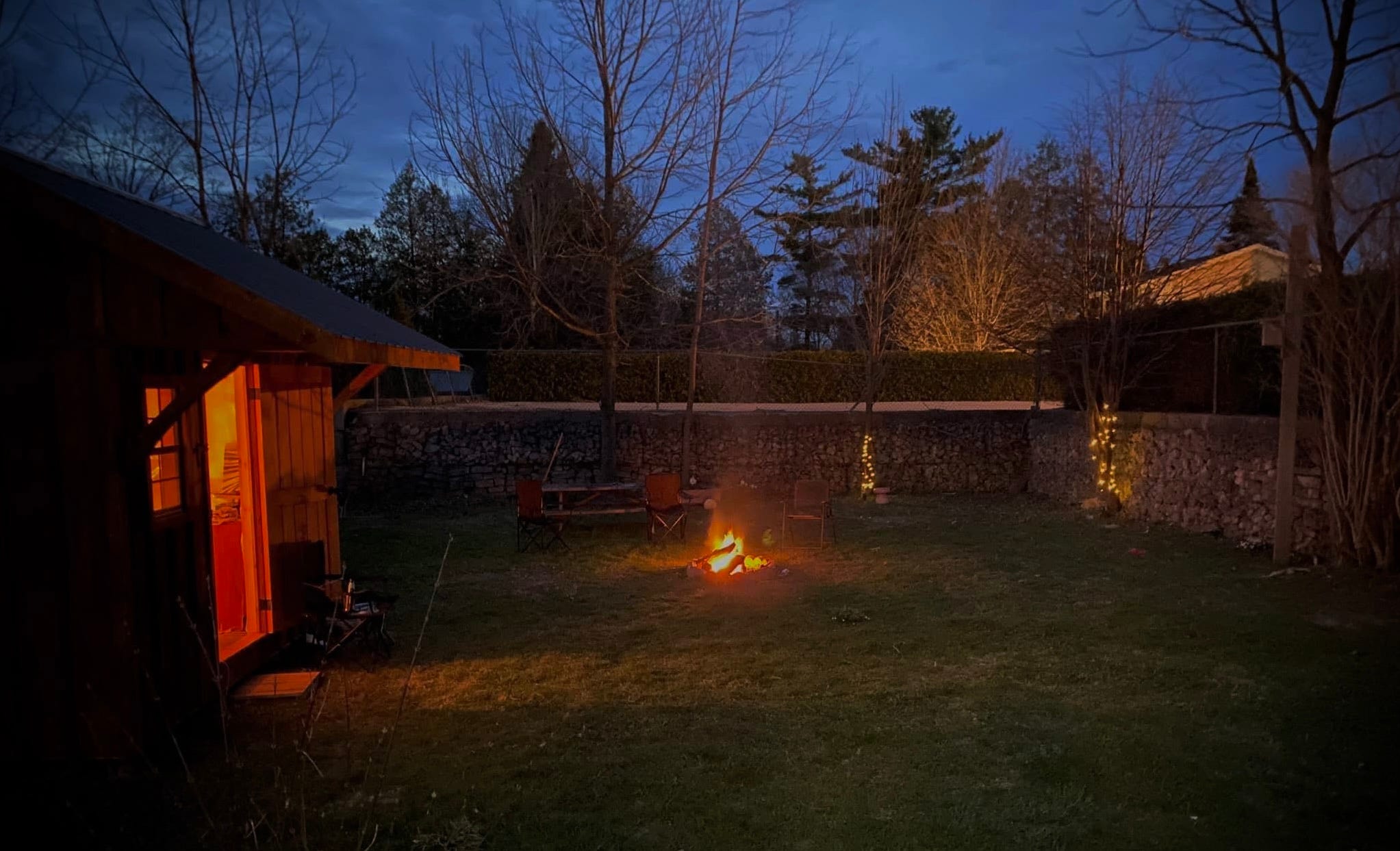
The Dark of Night
Brendan Mulroy writes of the creatures, folklore, and superstition around nighttime, then issues a challenge for readers. Enjoy this column from NeighbourWoods North.
COMMUNITY CONTRIBUTION
by Brendan Mulroy for NeighbourWoods North
Cathy Hird, a regular contributor to Owen Sound Current, has written eloquently of her time spent walking in the dark. I, too, enjoy being out in the gloaming and on into the night. I may stumble along, but it is a wonderful time for contemplation and exploration.
Human evolution has not adapted us for nighttime activity. Our vision will adjust to see in the dark, but only slowly. By and large, we have become a creature that needs nighttime for recovery, and not activity.
Hence, we do not go routinely into “that good night.” Rather, we ignore it, sleep through it or, as has become our practice since the invention of artificial light, we bright it out with lights.
Our human addiction to ‘the light’ has created light pollution. This form of pollution is yet another dagger which we have stabbed into the heart of the natural world.
What of the night? The Oxford dictionary defines it as that interval between day and day; a rather perfunctory definition, void of any mystery or romance.
And yet throughout history, the night was full of mystery and regarded as a time of terror. Your childhood memories likely recall that terror. It may take some prompting, but even adults will admit to at least some fear of the dark. And the dark has always lent itself to those with intentions less than noble.
The Bible speaks of men who love the dark only because their deeds were evil. Shakespeare describes “the good things of day that begin to droop and drowse, while night’s black agents to their preys do rouse.” In his novella, Heart of Darkness, Josef Conrad writes of a dark world while questioning the morality of the so-called civilized, or enlightened.
‘Where do the gods stand in this world of dark?’ is a question that Johan Eklof playfully asks in his book, The Darkness Manifesto. Eklof maintains that the gods are creatures of the day, collecting their paycheque to work the 9-5 shift. By night-time, they leave the world to its own resources.
The natural world brings many resources to the night, uninfluenced by the gods. Nature’s morality rests on the concept of kill or be killed. Ironically, darkness provides security for much of the activity that goes on in the natural world.
Contrary to our view of the night, it provides a ‘safe zone’ for those activities necessary for survival. And when it comes to survival, light actually plays a much more negative role.
Consider light’s effect on the world of the eel. Eels are mysterious night creatures, and because they only move under the protection of the night sky, we have learned little about them until recently.
Eels will hide even from the light of a growing moon. They will migrate only when the moon is covered, and artificial human-made lights are turned off. Despite these restrictions, some of the eel population still manage to travel thousands of kilometres to their birthplace in the Sargasso Sea.
However, the world’s eel population has shrunk by 90% over the last 50 years, mainly from the negative effects of artificial light.
We have all seen insects, particularly moths, attracted to light. The light’s presence disrupts their nighttime activity; they need the dark to function normally. Hypnotized by lights, moths become easy prey for bats.
Bats are mammals that have evolved to be primarily active at night; they have become experts at hunting nocturnal insects. Humans have benefited hugely from their consumption of mosquitoes, but again, influenced by our fear of the dark, we have placed bats firmly in the dark world of terror.
We still do not know how the COVID-19 virus, SARS, was transmitted from bats to humans, but that knowledge only adds new fuel to our burning fear of this creature.
At a less fearsome level, we know that plants respond to changes between light and darkness. It is not just warmer weather that will delay leaf fall. Trees growing close to streetlamps will hold onto their leaves for several weeks longer than the same species that is exposed only to natural light.
Locally, our Bluewater Astronomical Society invites the public to join them for dark-sky viewings. They pursue a dark environment, but their objective is to see the light of stars. The Bruce Ski Club encourages people to come out and enjoy cross-country skiing at night. A lit track is provided, but the dark trails may tempt you!
With all these thoughts in mind, I challenge you to this proposal: come winter, put out the lights and consider an evening or nighttime walk. The snow cover will help ‘light’ your way and introduce you to the dark.
Who knows what you might meet!
Thank you to sponsors of The Owen Sound Current Writers’ Fund, who make these community contributions possible. Contributions from the community do not necessarily reflect the opinions or beliefs of The Owen Sound Current and its editor or publisher.