

Owen Sound's Water Plant Struggled for Days Before the Public Was Told
Records show Owen Sound plant struggled to keep reservoirs full and water clear for nearly a week before a precautionary boil water advisory in March left households and businesses scrambling.

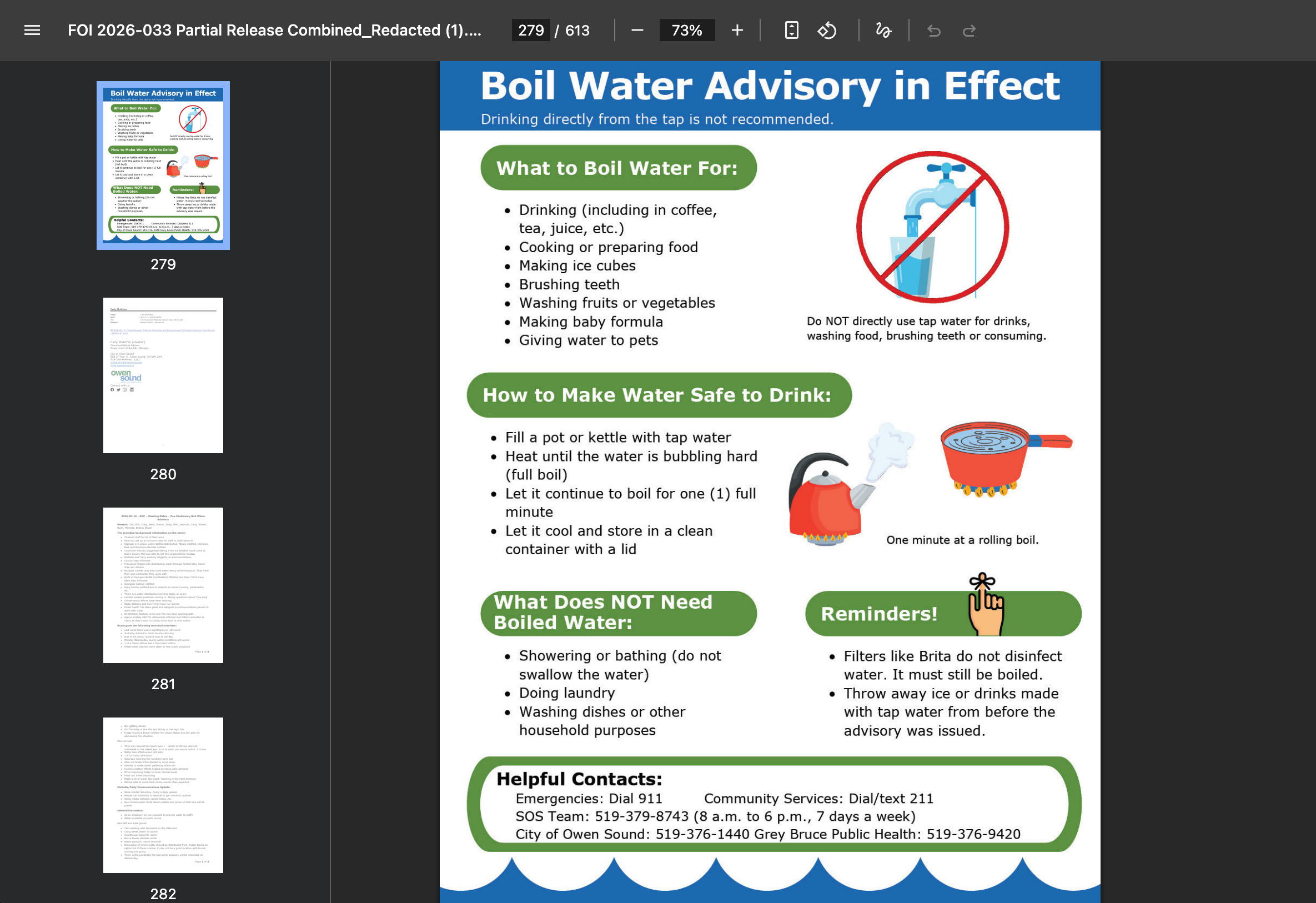
The City of Owen Sound’s drinking water treatment plant had been losing ground for the better part of a week before the City told the public to boil its water in March, records released to the Owen Sound Current show.
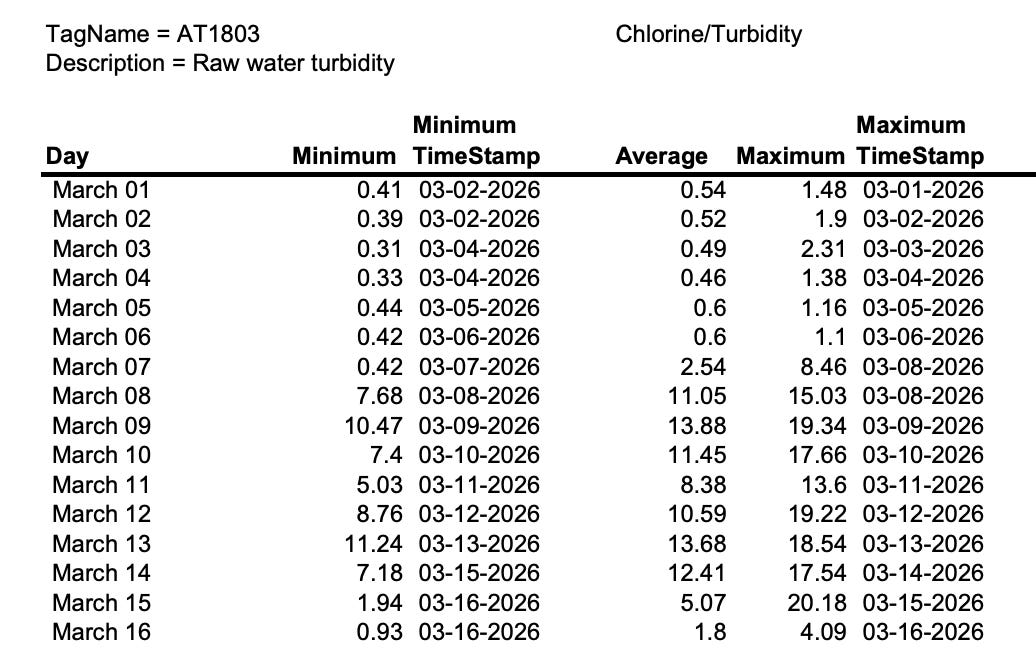
The City issued its precautionary boil water advisory on the evening of Saturday, March 14. But the plant’s own operating records show turbidity (cloudiness) climbing in the raw water from March 7, and the treated water leaving the plant crossing a key regulatory threshold on March 9, five days before residents were told anything.
Throughout the event, there was no indication the water was microbiologically unsafe. The advisory was precautionary: high turbidity can interfere with disinfection, and the City issued the advisory on that basis, not because any bacterial contamination was found.
The most recent bacterial sample before the advisory, collected March 9, met standards, and the City has maintained throughout that disinfection remained adequate. No bacterial contamination was detected at any point.
But the records release fills in a timeline the City never described publicly.
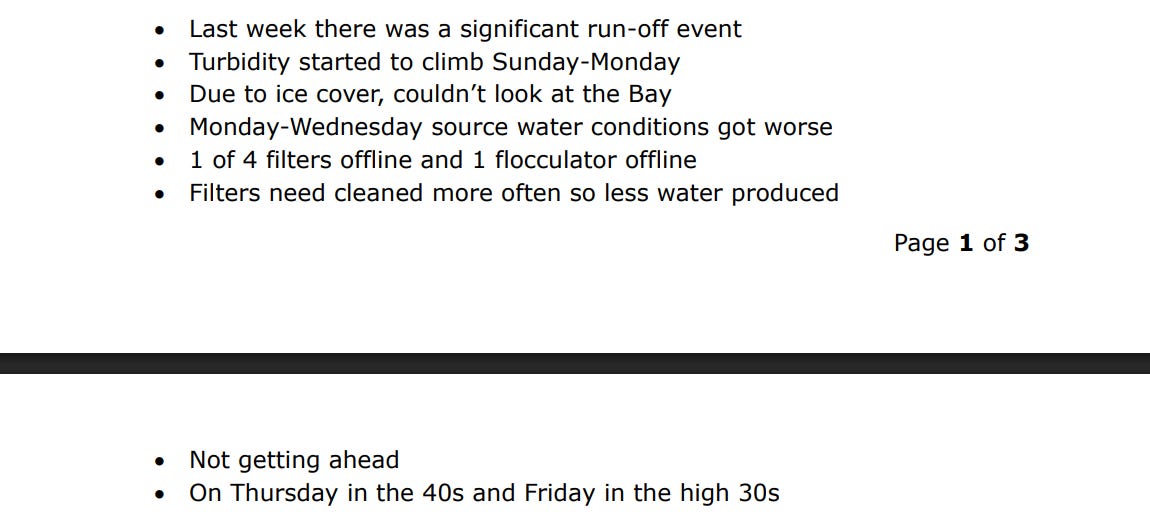
By Friday, March 13, the day before the advisory, the plant’s reservoir had fallen below half of its normal capacity. The Manager of Water and Wastewater later told an internal meeting it had been “on Thursday in the 40s and Friday in the high 30s.”
By then, the City was already managing the shortfall. Staff had shut off the City’s automatic hydrant flushing and closed its bulk water station, and had asked heavy users, the Town of Meaford and Owen Sound Fire to limit all non-essential water use.
The purpose of those requests was to reduce demand enough to let the reservoir recover and avoid an advisory altogether. The City’s own key messages put it plainly: lower demand “will help in remedial efforts.”
City Hall staff also drafted a message that Friday afternoon asking the public to do the same thing — to voluntarily cut non-essential water use. It was the same tool, aimed at the same goal.
That message was never sent.
The reasoning for holding it is in the City’s own notes: if the reservoir recovered overnight, staff preferred not to raise the issue publicly.
But it did not fully recover. By the following evening, the advisory was issued.
The City did nothing wrong in preparing internally, and the advisory, when it came, was precautionary. The City believed reduced demand would help; it said so, and it asked institutions to conserve on exactly that basis.
The same request to residents could have served the same end, while also alerting people that something was wrong and giving them time to prepare.
Instead, the public was told nothing, even as the plant lost ground day after day from the previous Sunday, until conservation was no longer the question and a boil water advisory was.
By the time residents were made aware there was an issue, roughly 30 hours had passed from when the City began asking institutions to conserve — time in which, had they known, residents could have filled a jug, bought water, or made arrangements for their families, businesses, and vulnerable residents.
What the numbers show
The plant draws its water from Georgian Bay.
The plant’s performance began slipping days earlier. From March 7, the raw water coming in grew sharply more turbid, with the daily average roughly quadrupling overnight, then climbing again the next day.
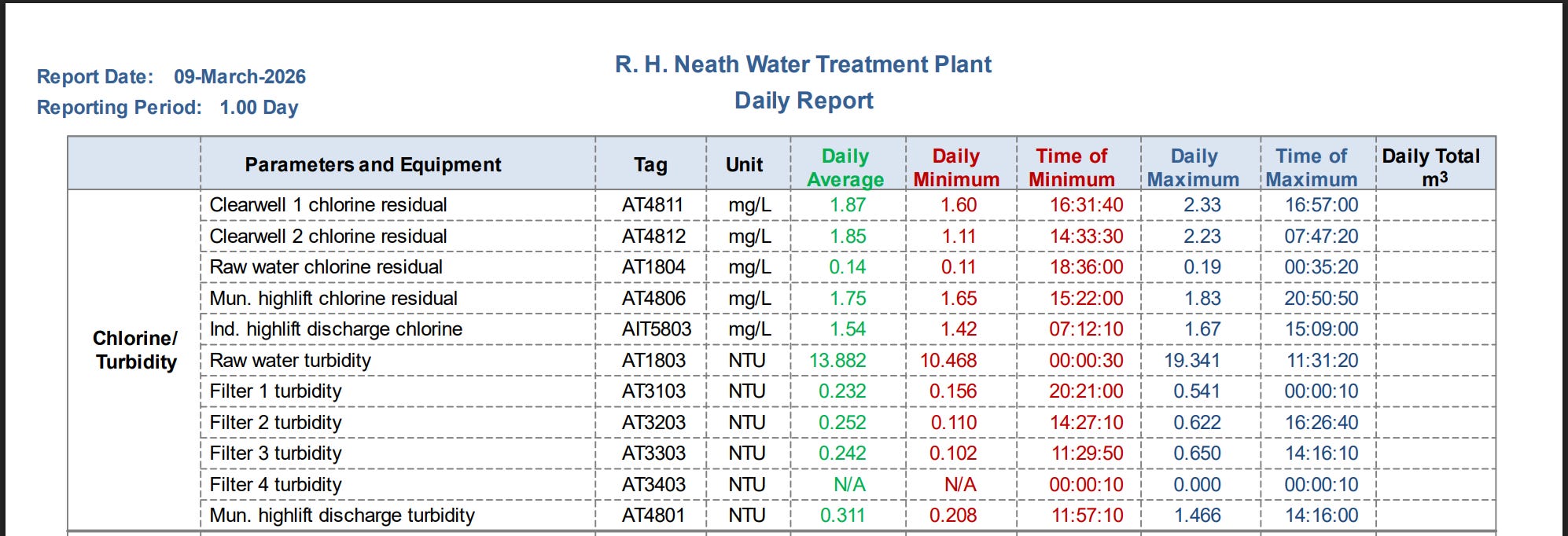
By March 9, the treated water leaving the plant for the distribution system briefly recorded a reading above 1.0 Nephelometric Turbidity Unit (NTU), and by March 10 one of the plant’s individual filters was well above that mark. It stayed there, day after day.
Neither of those figures triggers a mandatory report to the province — that threshold is measured on the plant’s combined filter output, which did not cross the reporting threshold until the afternoon of Friday, March 13. The City filed its adverse water quality report to the Ministry and to Grey Bruce Public Health that evening.
But the falling reservoir and the plant’s steadily worsening filter performance through the week show a system under mounting strain well before any reporting obligation was triggered — and well before the public was told anything.
The records were released to the Current this month under a freedom-of-information request, four months after it was filed. They are redacted and the release is partial, because a third party has appealed the City’s decision to disclose.
The advisory arrived in difficult conditions for residents.
It was issued on a Saturday evening, in winter weather, and parts of the region were without power, which meant some households were being told to boil water they had no easy way to boil.
In its own advisory FAQ, the City told residents it did not send a phone alert because the event was not a declared emergency, and directed them to subscribe to City notifications by email.
Public Health, meanwhile, contacted as many of the roughly 480 affected restaurants as it could, including some in person, according to the City’s records — even though Grey Bruce Public Health has told the Current that responsibility for notifying the public rests with the municipality, not the health unit.
We reported in March that some restaurant owners were serving municipal water eighteen hours into the advisory, unaware it had been issued.
How a weekend advisory reaches residents who aren’t already following the City online, and reaches those least able to respond to it, are questions the records raise and the City has not fully answered.
The plant was short two units
The strain did not arrive at a plant operating at full strength.
One of the plant’s flocculators — equipment that helps clump fine particles so filters can remove them — had failed on December 23, nearly three months earlier. The City confirmed this month that it has been out of service continuously ever since, and remains offline today.

A second unit, one of the plant’s four filters, had been taken offline on February 4 for scheduled refurbishment. That work began February 4, six weeks after the flocculator failed, as the spring run-off season approached. It was still offline when the advisory was issued.
The City’s own 2023 staff report had warned that during spring thaw, when raw water carries more suspended sediment, the plant “requires its total capacity.”
The City’s public explanation vs internal records
On Friday, March 13, the day before the advisory, the Manager of Water and Wastewater emailed the Mayor, Council and the City's senior leadership team about the plant's condition, and the Town of Meaford and Owen Sound Fire were asked to limit non-essential water use. By the pre-dawn hours of Saturday, City Manager Tim Simmonds was on a call with the region's Medical Officer of Health discussing the plant.
Residents were not told until roughly 6 p.m. that day.
The next morning, March 15, the City published its own account of what had happened:
“What we experienced was primarily a source water issue.
The quality of water coming into the treatment plant had very high turbidity (cloudiness), which makes it much harder to treat efficiently.
While the plant itself has continued to operate and is functioning properly, the rate at which water could be safely filtered and treated was challenged by the quality of the incoming water.”
The poor conditions, it explained, were driven by warm temperatures and heavy rain, made worse by ice cover that trapped the poor water and made it harder to see coming.
While everything in that explanation is true, it is also incomplete.
The account made public is entirely about the water coming in. It does not mention that the plant treating that water was short two of its units: the flocculator that had failed in December and a filter taken offline in February.
It does not mention that the reservoir had been drawn down, or that staff were increasing production to recover it — the push that the City’s own records identify as what tipped filter turbidity over the threshold.
And two days before telling the public the plant was “functioning properly,” staff had informed Council the filter work was “inevitably going to face some water production limitations,” and that “we also knew that seasonal source water quality impacts may become an issue.”
The plant kept making water throughout. But “functioning properly” and “a source water issue” describe a plant coping with bad luck from the lake. The City’s own internal records describe a plant already running short on capacity when poor quality water arrived.
City Hall still unwilling to connect it
The gap between the public account and the internal record is not just a March problem. Asked directly, this month, whether the reduced capacity from the two offline units contributed to the advisory, City staff would not say that it did.
The advisory “was related to elevated (above 1 NTU) filter effluent turbidity,” they told the Current, and “it remains unknown whether the additional capacity” — the capacity those two units would have provided — “would have been enough to avoid these conditions.”
The City’s own records, written at the time, are less equivocal. They describe staff increasing production to recover the falling reservoir, and that increase — “combined with the source water quality,” in staff’s words — pushing the plant’s filter output over the reportable threshold on Friday afternoon.
Four months on, with the records released, the City’s public position remains that the connection is unknown.
Still offline, and the challenging season still lies ahead
The failed flocculator will not be replaced until late 2026 or early 2027, staff confirmed, and it remains out of service today.
The City also confirmed when the plant is most vulnerable: the period of high precipitation and run-off, when the ground is frozen or saturated, which they said runs from January through April.
That timing leaves little margin. If the replacement arrives at the later end of the City’s own estimate — early 2027 — it would land in the middle of the season identified as the plant’s most difficult, with the plant short the flocculator until it does.
The plant’s second original walking beam flocculator, dating to the 1960s, is still in service. A 2023 staff report described it as identical in age and condition to the one that failed, with “a high probability that a similar failure could occur in the short term.”
Asked whether the City still holds that assessment, staff did not answer directly, saying only that the matter remains “a priority” pending a consultant’s review. Its replacement is not yet budgeted and will be considered at November’s capital budget meetings.
Despite this, staff told Owen Sound Current in July that the likelihood of a significant failure in the next six months “remains low.”
What the City has not answered
Staff have not answered questions about which records the third-party appeal covers, or whether the City is holding the full file over an appeal that may reach only part of it.
They have not addressed what the City weighed in taking a filter offline for scheduled work while the flocculator was already down and run-off was approaching — a question first put to the City on July 5.
And asked what the plant would do if its remaining 1960s flocculator failed before the replacement arrives, staff said recirculation pumps were “an option,” and that the effect on the plant's ability to treat poor source water “depends on a multitude of factors” — though at the May committee meeting, staff had described those pumps as unable to achieve proper mixing.
None of this is to say the City acted in bad faith, or that the water was unsafe. It wasn’t shown to be. Staff worked through a weekend and into the following week to bring the plant back, and they did.
But the same equipment is still out of service. Spring run-off will come again before it is replaced. And four months on, there has been no public accounting of how this event unfolded, how residents and businesses were affected, or what the City would do differently if the plant comes under the same strain again.
Those are conversations worth having — not to assign blame, but so that the next time the plant struggles, the people who depend on it aren’t the last to know.
A household that has a day’s warning can fill a jug or purchase bottled water. Grocery stores can stock up. A restaurant can plan. Someone caring for a vulnerable family member can prepare. That is what a public conversation buys: not certainty that it won’t happen again, but a community readier for it if it does.
That conversation hasn’t happened. It should.
This publication continues to work through the released records and will report further.
Owen Sound Current filed this freedom-of-information request on March 16, the day the advisory was lifted, and paid $772.50 in fees. This reporting is funded entirely by readers.
Related:


