
Owen Sound Council Rejects County Road Transfer Agreement, Calls for Funding Revisions
Owen Sound council has rejected Grey County’s road transfer plan, warning it could expose the city to over $70 million in long-term capital risk and add $330,000 in annual operating costs.

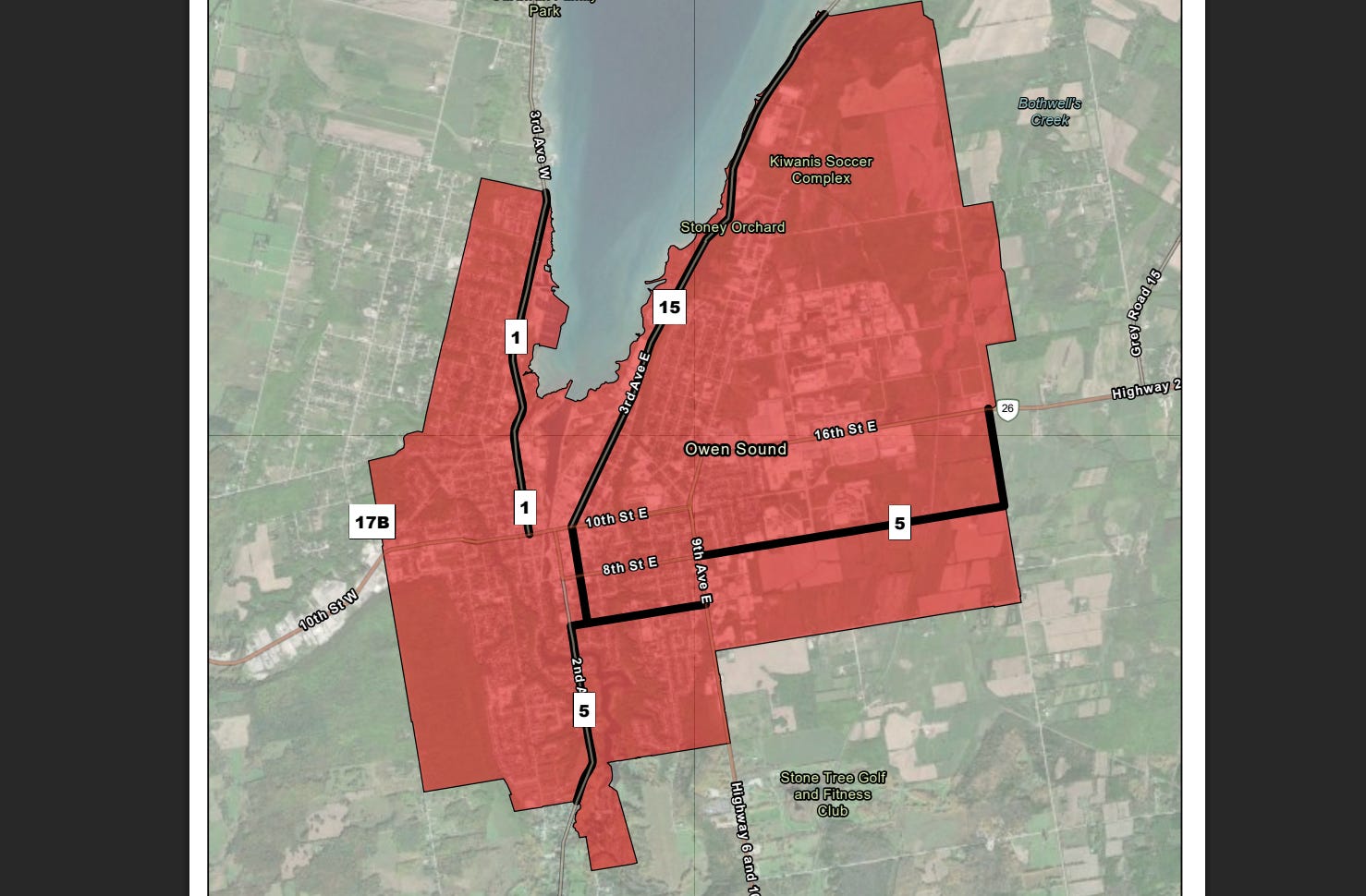
City council has formally declined to approve Grey County’s proposed urban road transfer agreement, citing significant financial risk, unresolved asset condition concerns and what staff describe as an inequitable funding model.
At a special meeting Monday afternoon, council endorsed staff recommendations that the City:
Decline to approve the draft Road Transfer Agreement at this time;
Request that Grey County Council not approve the Urban Road and Road Exchange Task Force recommendations;
Ask the County to continue the task force and undertake further financial and operational analysis, including incorporating a risk premium for urban roads;
Direct City staff to work with County staff to revise the funding approach before any agreement returns to council.
The report will now be forwarded to Grey County Council and all lower-tier municipalities.
While the County has authority to transfer roads without lower-tier consent, council said it will not sign the agreement in its current form. During debate, Councillor Melanie Middlebro argued that “Owen Sound residents are being completely disadvantaged,” reflecting broader concerns at the table about long-term taxpayer exposure.
Council has previously raised concerns about the proposed transfers, including questions about development charges and long-term capital costs, but Monday’s decision marks the first formal rejection of the agreement.
Related:
What Is Being Proposed?
Grey County seeks to transfer approximately 15.4 kilometres of urban county roads within Owen Sound’s boundaries to the City, including portions of Grey Roads 1, 5 and 15. The proposed transfer date is July 6, 2026.
Under Section 52 of the Municipal Act, the County has authority to transfer roads “with or without consent or funding support,” a point acknowledged repeatedly during the meeting.
However, City Manager Tim Simmonds stressed that Monday’s report was not about authority.
“This report is not about whether the county has the authority to download roads. That point is not in dispute,” Simmonds said.
“Rather, this report focuses on whether the current approach fully reflects the realities and implications of transferring urban roads, and whether the proposed funding framework appropriately aligns with the responsibilities being assumed by the city,” he added.
A $70 Million Gap?
City staff estimate the replacement value of the roads proposed for transfer at approximately $87.6 million, not including bridges, structural culverts, retaining walls or 11 sets of traffic signals.
Simmonds told council the difference between the County’s proposed funding and the City’s projected capital exposure is substantial.
“Staff’s analysis show that the gap, which could be in excess of $70 million in capital and more than $300,000 in annual operational costs between the county’s proposed funding and the city’s estimated cost, is too great for the city to proceed as proposed,” he noted.
Grey County’s transition funding proposal totals $9.5 million over 10 years, with annual payments subject to County budget approval.
Asset Condition Concerns
A central issue raised in the 30-page staff report was the reliability and completeness of asset information provided by the County.
Director of Public Works and Engineering Lara Widdifield said some data sets appeared incomplete or inconsistent, including pavement condition ratings and structural assessments.
One example discussed at length was the retaining wall along Grey Road 5 near Harrison Park, commonly referred to as Cemetery Hill.
City staff conducted a 2025 Ontario Structure Inspection Manual (OSIM) assessment, assigning the wall a condition rating of 14 out of 100.
“We recommend the wall be replaced during the next construction season,” the City’s structural review states, noting ongoing rotation and erosion concerns.
Widdifield emphasized that while the County’s funding model treats roads equally within classifications, urban roads present different risks.
“Urban roads are more complex, constrained, and tend to be multi-laned or subject to forecasted upgrades due to development pressures,” she said. “The formula does not include development charges or ancillary tangible capital assets such as bridges, structural culverts, traffic signals and retaining walls.”
She added: “Without a risk adjustment, the model remains equitable in theory but not in practice.”
Development Charges and Deferred Projects
City staff also flagged concerns regarding development charges (DCs) collected by the County for projects within Owen Sound.
The County’s 2021 DC Background Study identified $36.3 million in road work over a 10- to 20-year horizon, including projects within Owen Sound. However, several capital projects within the City have since been deferred or eliminated.
Between 2022 and 2026, staff identified:
$4.8 million in eliminated capital projects;
$7.8 million in deferred capital spending;
No Owen Sound road projects remaining in later years of the County’s 10-year forecast.
Council questioned whether development charge funds collected for projects in Owen Sound would be transferred alongside the roads. Staff confirmed no such proposal has been made.
Mayor Ian Boddy asked directly whether any reserves or DC funds had been offered as part of the agreement, to which Widdifield replied, “No.”
Operational and Staffing Impacts
In addition to capital risk, staff estimate approximately $330,000 in new annual operating costs, representing roughly a 1% impact on the City’s tax levy, based on current estimates.
The City would assume responsibility for:
11 additional traffic signalized intersections (a 50% increase in inventory);
Bridge and structural culvert inspections;
Storm sewer maintenance;
Line painting and arterial road upkeep;
Collision cleanup and after-hours response.
Staff indicated the transfer could require:
Two additional full-time public works staff;
Additional engineering capacity;
Expanded fleet and equipment.
Council Raises Equity, Liability and Governance Concerns
Council’s discussion went beyond frustration with timing and raised issues with structural equity, long-term liability, governance principles and the broader implications for Owen Sound taxpayers.
Several councillors questioned whether the City was being asked to assume disproportionate risk for infrastructure that may already be in declining condition.
Councillor Melanie Middlebro was particularly blunt about the fairness of the approach, arguing that the City is being disadvantaged twice — by inheriting significant infrastructure obligations while also contributing to increased County levies associated with rural road uploads elsewhere.
Middlebro described the proposal as “completely unfair” and said, “Under no circumstances can this council support any further movement in this agreement without coming to a better deal for the Owen Sound taxpayer.”
Councillor Travis Dodd focused on governance and partnership, referencing repeated statements at County Council that roads could be transferred “with or without consent.”
He said while the County may have the legal authority, the approach raises broader concerns. “We can do lots of things that we don’t require consent,” he said, “but it’s how do you want to leave the partnership of that county?”
Dodd also questioned the assumption of liability, insurance implications, and whether development charge commitments made to developers would ultimately fall to the City.
Mayor Ian Boddy echoed concerns about fairness and historical context, noting that the original framework for Owen Sound joining Grey County included considerations of equity.
While he said he is not opposed to road rationalization in principle, Boddy stressed that the financial terms must reflect reality. “I’m not opposed to two of these downloads in principle. I just think it’s got to be really fair and the money’s got to be fair,” he said.
Councillor Jon Farmer characterized the issue as one of risk transfer rather than simple asset exchange, questioning whether the County’s per-kilometre averaging approach adequately accounts for immediate reinvestment needs.
Farmer argued that treating all roads as though they are in comparable condition “does not reflect best practice or organizational excellence.”
Deputy Mayor Scott Greig, who sits on County Council, acknowledged that the County’s broader road rationalization strategy is intended to optimize the regional network, but agreed there are unresolved discrepancies and fairness questions that need further discussion before any agreement proceeds.
By the end of the 90-minute debate, council’s position was clear: the issue is not whether roads can be transferred, but whether the proposed financial framework properly accounts for urban complexity, asset condition risk, development charge implications and long-term taxpayer exposure.
What Happens Next?
Grey County Council has deferred its decision until March 26 to allow further consultation with lower-tier municipalities. County staff are scheduled to present to Owen Sound council at its next regular meeting.
Simmonds said the City remains open to collaboration. “Our hope is that the county will understand that this is not a rejection of collaboration, but a clear signal that there is still important work to be done,” he said.
For now, Owen Sound Council has formally indicated it will not approve the agreement in its current form.
Council also directed staff to obtain a legal opinion before any further steps are taken.
The review will examine three key areas: whether transferring all County roads out of Owen Sound affects the original agreement under which the City joined Grey County in 2000; what liability risks the City would assume by taking ownership of bridges, retaining walls and arterial roads; and how development charge commitments tied to County road projects would be handled if ownership changes.
Councillors said they want clarity on long-term financial and legal exposure before considering any revised agreement.
Related:


