

Our Town: What Owen Sound's Crime Numbers Show — and What They Don't
In a new column for his limited series 'Our Town,' David McLeish examines Owen Sound's rising crime severity — and why the numbers need careful reading.

OUR TOWN | OPINION
Our Town is a limited series of columns by Owen Sound resident David McLeish. This column reflects the analysis and evidence-based opinions of the author and is part of an ongoing opinion series. It is not news reporting.
In my last Our Town column, we looked at the factors that contributed to population growth in the surrounding townships fat outpacing that in the City of Owen Sound. Today, we’re exploring Owen Sound’s rising Crime Severity Index and its link to low household income.
Both individuals and communities suffer the consequences of poverty. Obviously, individuals bear the highest burden, but the circumstances in which they find themselves provoke behaviours that affect the community.
The topic of crime always solicits a broad range of opinions on social media. Some note that they are afraid to go downtown, others argue that they visit the downtown regularly and have never felt unsafe, while others point out that the perception of safety is personal, contingent upon one’s personal circumstances and history.
Regardless of one’s perspective, crime rates in Owen Sound are relevant to any discussion regarding the City’s future.
In this article, Statistics Canada’s Crime Severity Index (CSI) for Owen Sound is assessed through the lenses of time and comparable municipalities. Statistics Canada notes the Crime Severity Index (CSI), developed in 2009, “takes into account not only the change in volume of a particular crime, but also the relative seriousness of that crime in comparison to other crimes.”
In other words, the number of police-reported incidents (i.e. charges) for a given type of crime is multiplied by the crime’s weight (based on standardized information from court sentencing data over the previous five years) to give a measure that combines both the number and the severity of crimes.
For example, a murder has a weight of over 8,200, while property theft has a weight of 29. As such, the impact of one murder on the CSI is approximately 280 times greater than one property theft.
Owen Sound Current is the city’s only independent, locally owned, ad-free news source — in your inbox five days a week.
It must be stressed that interpreting crime statistics is challenging and the author is not an expert. As such, the reader is cautioned when interpreting the information provided.
The following chart illustrates the overall, Violent, and Non-violent CSIs for Owen Sound from 1998 to 2024.
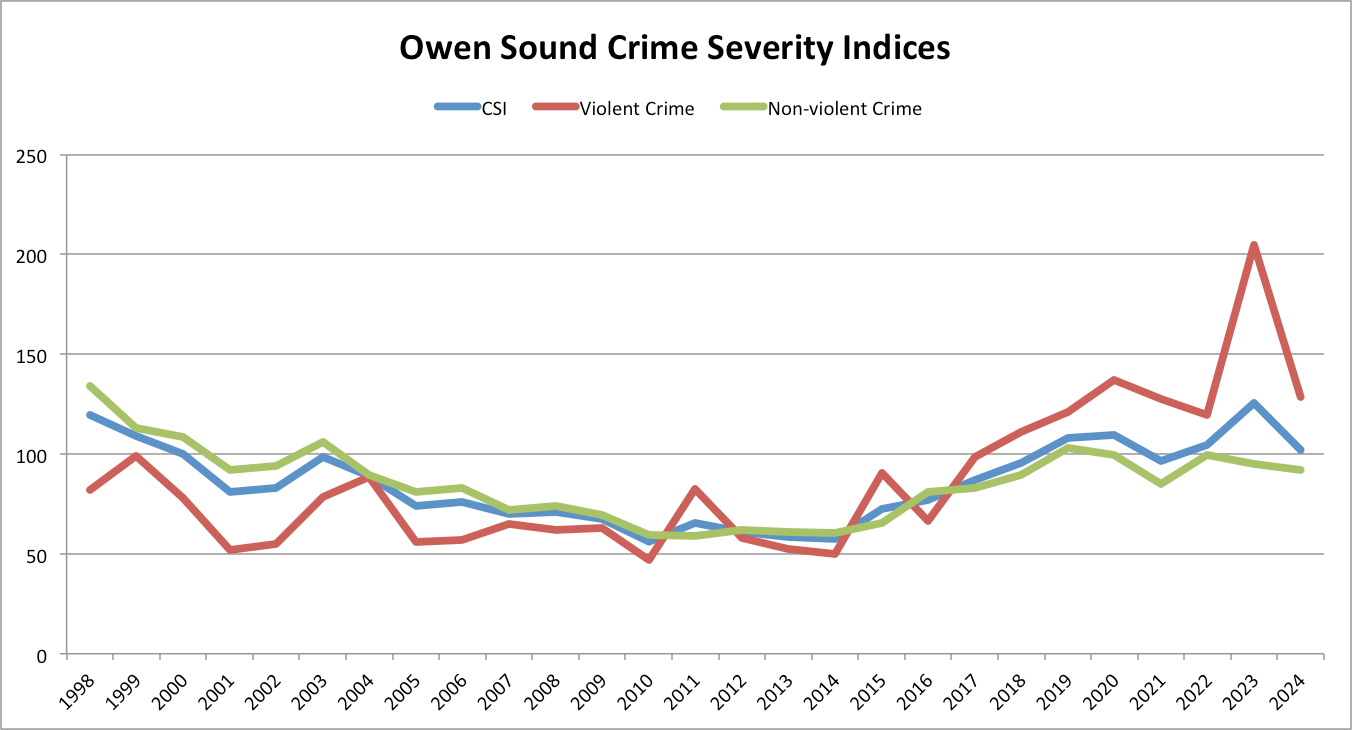
As can be seen, Owen Sound’s overall CSI declined from the late 1990s until about 2005, after which it was followed by a period of relative stability — that is, until 2014, after which it increased until 2023.
Rates for all three dropped in 2024, so it will be particularly interesting to see what 2025 looks like when those numbers are released.
Violent Crime rates have fluctuated widely with peaks every several years followed by a substantial uptick after 2016.
The recent increases in the CSI have been driven largely by charges under the Criminal Code, both for violent crime and to a lesser extent non-violent crime.
Three homicide cases in 2023 contributed substantially to the record high CSI that year — but assaults, which accounted for 60% of all Criminal Code violations that year, were also a factor.
Perhaps more importantly, not only has the number of charges increased from an average of 91 per year prior to 2017 to 129 per year since then, so too has the degree of violence.
Assault Level 1 (the least serious form of assault, includes pushing, slapping, punching, and face-to-face verbal threats) traditionally accounted for about 80% of all assault charges. This changed after 2015, to the point that it decreased to 58% of all assault charges in 2024.
In contrast, as can be seen in the following chart, Assault Level 2 (assault with a weapon or causing bodily harm), which previously hovered around 20% of all assault charges, increased to 39%, almost double, by 2024.
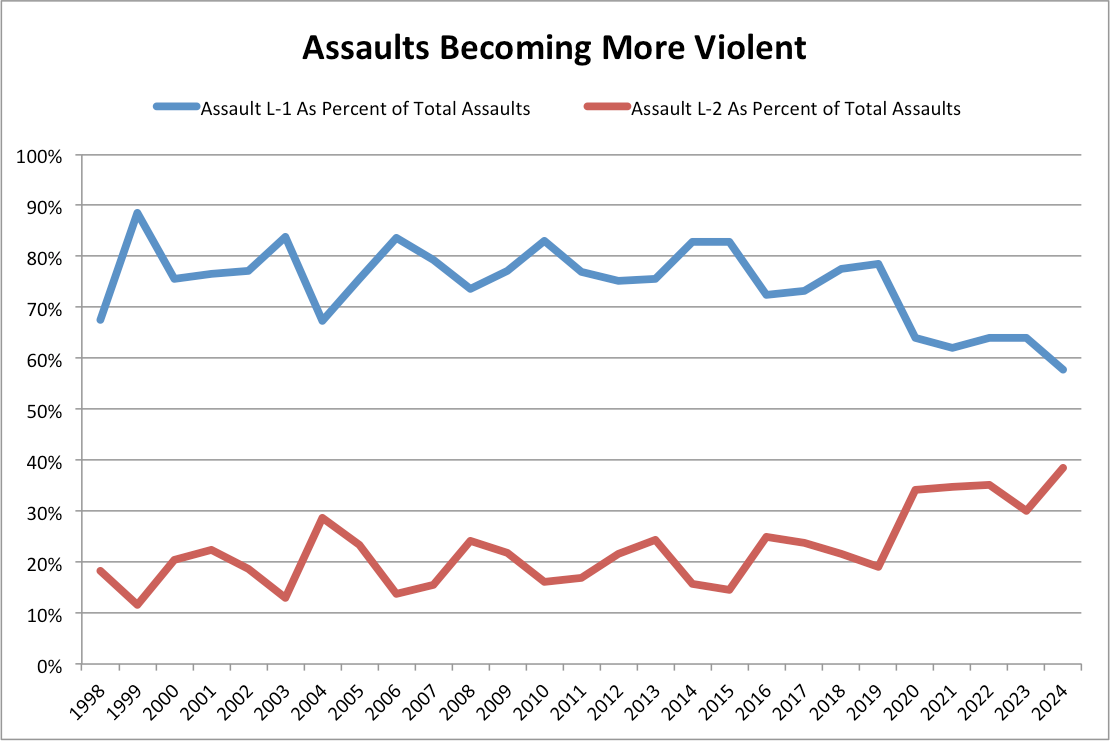
Assault Level 3 (wounding, maiming, disfiguring or endangering the life of someone) increased very slightly, from 2.3% to 2.8% of all assault charges.
In summary: the number of assault charges has increased, the proportion at Level 1 has decreased, while the proportion at Level 2 has increased.
Non-violent crime also increased after 2014, but it did not rise as sharply or by as much as violent crime. While not as low as it was in the decade from 2005 to 2015, it is currently similar to levels seen in the late 1990s and early 2000s.
In order to provide additional context, the Owen Sound CSI is compared with the average of seven other Southern Ontario municipalities — Brockton, Brockville, Cobourg, Collingwood, Orillia, South Bruce Peninsula, and Strathroy-Caradoc — as well as the CSIs for Ontario and Canada.
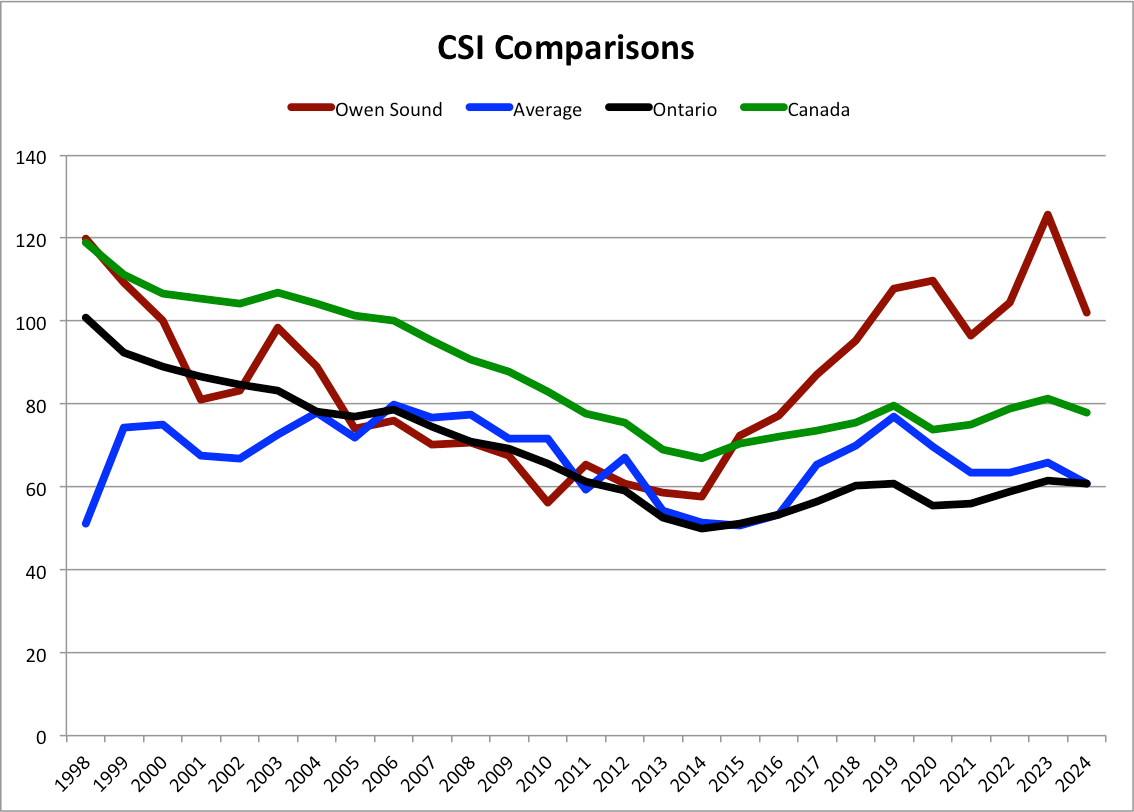
Owen Sound’s CSI was well below the national figure and generally similar to the other communities and Ontario from 2000 to 2014. After 2014, however, the City’s CSI is conspicuous by a startling increase relative to the other municipalities, the province, and the country. It will therefore be particularly interesting to see the indices for 2025.
As noted above, the assessment of crime statistics is complicated. Recall that the CSI is based on charges, not convictions.
Police Services report the number of incidents (i.e. an occurrence that requires follow-up action, such as a General Occurrence (GO) report). An incident does not necessarily result in a charge, but a proportion do.
In Owen Sound, the proportion of incidents that resulted in charges increased from 25% in 1998 to 47% in 2009, then fell to 30% in 2017 before increasing to 45% in 2024. Since charges affect the CSI, these changes have also contributed to the observed changes.
Furthermore, a charge does not necessarily result in a conviction. In fact, a 2024 CBC investigation revealed, “the majority of criminal cases in the province [Ontario] have ended with charges being withdrawn, stayed, dismissed or discharged before a decision at trial since 2020. In 2022-23, the latest fiscal year for which data is available, 56 per cent of criminal cases ended that way — a 14 per cent increase since 2013-14 when guilty decisions still made up most outcomes.”
Finally, even if the case proceeds to trial, the proportion of cases in Ontario that result in a conviction has dropped from 56% prior to 2014 to 42% from 2015 to 2024.
In summary, the City of Owen Sound Police Services find a crime being committed or respond to a complaint, they investigate, prepare an Occurrence Report, lay a charge, prepare a Crown Brief, and then depending upon what the prosecutor decides, either prepare for court or walk away, if the charge is dropped.
Even if the case proceeds to court, the charge could be withdrawn, stayed, dismissed or discharged, or it might proceed to trial.
This could be caused by many factors that go beyond the scope of this article.
But in short, in Ontario, the police can lay a charge only to see it dropped if the Crown determines that there is no reasonable prospect of conviction.
In 2023, a Committee comprised of Ontario Ministry of the Attorney General was tasked with examining the implications of pre-charge vs. post-charge screening and the differing Crown screening evidentiary thresholds in Canada.
This group recommended that consideration be given to “some form of Crown pre-charge screening” and that the “evidentiary threshold should consider adopting the higher “reasonable likelihood of conviction” evidentiary threshold.
The adoption of this higher threshold would enhance the administration of justice and would complement any transition to Crown pre-charge screening.” This could reduce the amount of time the police spend on cases that never go to court.
As Cass Kislenko noted in their 2023 article in The Maple, “…we know what the so-called root causes (of crime) are ... poverty, lack of access to education, lack of access to a living wage and lack of access to justice.”
Peter Kitchen previously documented this same assertion in a 2006 Department of Justice Canada report. He observed “a strong relationship between crime and socio-economic status” in lone-parent and low-income families, which were considered “particularly vulnerable segments of the population.”
Other factors included “significantly lower levels of educational attainment, poorer quality and older housing and higher unemployment.”
It seems that Owen Sound has several of these elements in spades.
As noted previously, many of our neighbours are lone-parent and low-income families, local wages are skewed to the low end of the spectrum, and high quality, affordable, rental housing is in short supply.
The following chart illustrates the relationship between the percentage of households in low income and the Crime Severity Index (CSI) for Owen Sound relative to 12 other communities. As can be seen, communities characterized by low incomes experience higher CSIs.
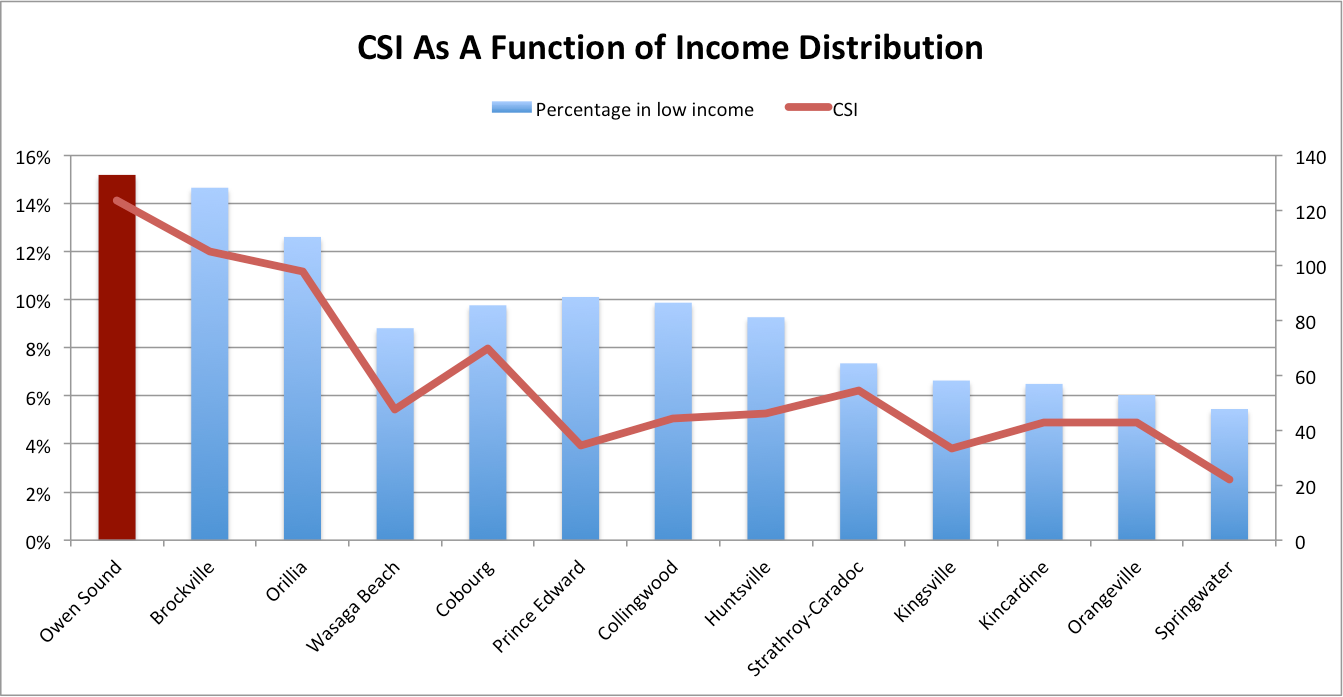
To be clear, this is not to say that everyone with a low income is a criminal.
The reader is therefore cautioned against broad generalizations, as they bear no relationship to fact. Rather, one needs to recognize that those struggling to survive under very difficult conditions can find themselves in uniquely challenging situations.
Faced with the need to meet basic needs, the desperation caused by a lack of adequate housing, a precarious food supply, and little to no hope of any improvement, people can experience survival behaviour and desperate risk-taking to meet their needs.
Peter Kitchen noted that policies to ameliorate these conditions should include “social upgrading in disadvantaged communities with high rates of crime and programs should be designed to reflect the social characteristics and meet the needs of the residents living in these areas.”
The study recommended that additional policy efforts should focus on factors such as:
housing quality and affordability,
education and training,
youth programs and services.
Thank you to sponsors of The Owen Sound Current Writers’ Fund, who make these community contributions possible. Contributions from the community do not necessarily reflect the opinions or beliefs of The Owen Sound Current and its editor or publisher.
In this series:


