

Our Town: The Manufacturers That Built Owen Sound — and What's Left
In this third column in his limited series 'Our Town,' David McLeish explores the rise and fall of Owen Sound's manufacturers from 1850 to today.

OUR TOWN | OPINION
Our Town is a limited series of columns by Owen Sound resident David McLeish. This column reflects the analysis and evidence-based opinions of the author and is part of an ongoing opinion series. It is not news reporting.
William Kennedy & Sons was one of the City’s first major and longest lasting manufacturers. According to Grey Roots, William Kennedy, a Scot from Dumfries, Scotland, arrived here:
“… in 1856 to install machinery in the Harrison Woollen and Grist Mill at the Mill Dam on the Sydenham River.
At that time the town had a population of 2,000 and William decided to remain there after the installation was completed.
In 1857 he opened a modest-sized planing and matching mill, which operated out of a small wooden shack, and in 1860, Thomas and Matthew, two of his sons, joined him.”
This modest beginning led to an ‘empire’ that spanned some 140 years and no doubt contributed significantly to the economy of Owen Sound. The company became known for shipbuilding through the manufacture of propellers, wind-less drive shafts and other equipment.
Grey Roots notes that “at one time, it supplied propellers for about ninety-five percent of marine traffic on the Great Lakes” and that “a Kennedy propeller drove the lead boat in the D-Day invasion.”
Employing an increasing number of workers, from 21 in 1871; 30 in 1887; 150 in 1911; and hundreds, including 350 at its Collingwood foundry, during WWI, the company seemed destined to be a permanent fixture. In his 2012 paper, “The Rise and Fall of an Ontario Business Dynasty: William Kennedy & Sons and its successors 1857-1997,” Keith R. Fleming notes that during the Depression:
“Matthew Kennedy took special measures to protect the jobs of his 250 employees. He thereby demonstrated what Mark Casson maintains is an attribute of dynastic leaders—the willingness to treat workers ‘as a part of the “extended family” of the firm’ during business slumps.”
During WWII, Fleming reports that the number of employees peaked at 840 in May 1942 before falling to 538 by August 1945. By the 1960s, the number of workers dropped, fluctuating between 370 and 450 over the next decades. By 1990 there were only 165 on the payroll and in 1993 there were only 30. Fleming notes that “with little warning what remained of BC-K was dismembered early in 1996.”
Another enterprise that was significant to Owen Sound was founded by John Harrison. Sometime around 1860, John Harrison relocated his sawmill at the Mill Dam, now powered by steam, to an expansive property along the banks of the Pottawatomi River at the N.E. corner of 2nd Ave W. and 14th St W.
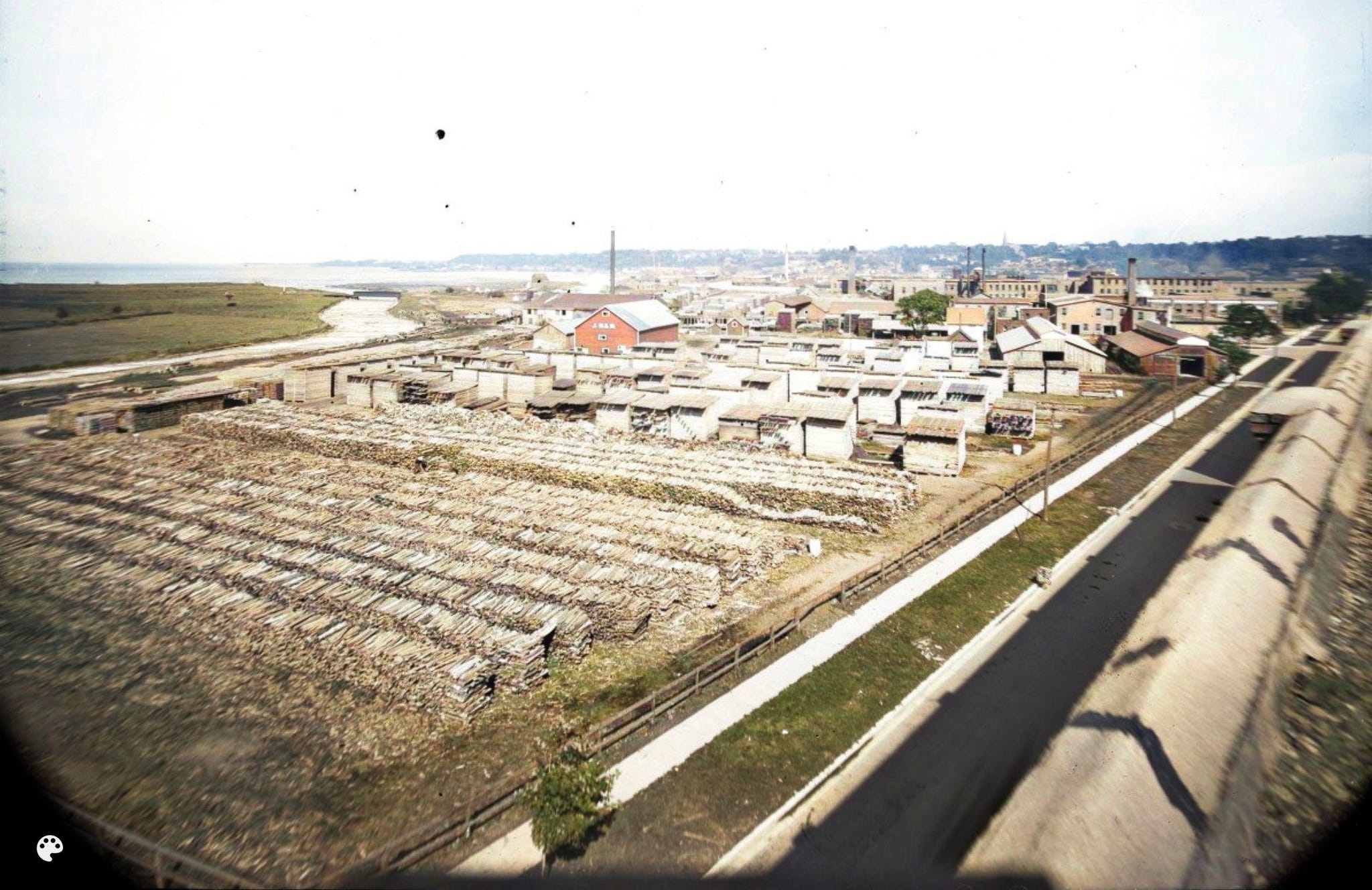
Later known as John Harrison & Sons Ltd., the business continued for some 80 years, eventually being sold on November 14, 1947, and demolished soon after (photo credit Steve Briggs, Grey Bruce Images).
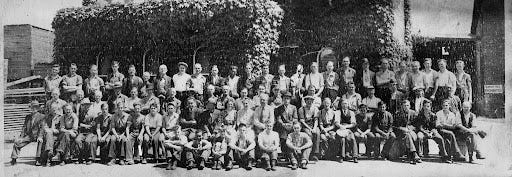
One photo on Grey Bruce Images shows some 75 employees.
By 1888, the port was important for Canadian Pacific’s steamships and Polson Iron Works. The latter was an Ontario-based firm that relocated to Owen Sound from Toronto. They built large steam engines, ships, barges, and dredges. The firm’s tenure here was short, however, as they returned to Toronto in 1897 when Owen Sound’s town council did not renew the firm’s exemption from property taxes.
It wasn’t until 1937 that Russel Brothers arrived from Fort Frances to establish another shipbuilding legacy. The company became a well-known Canadian steel boat builder, diesel engine manufacturer and steel fabricator. The company, extensively documented by Steve Briggs on his website (https://russelbrothers.com/), became a mainstay in the City, manufacturing boats until 1974 and then metal fabrication until 1994 when operations ceased.
Given the abundant forests that characterized Ontario at this time, it is no surprise that several wood furniture companies sprang up in the vicinity of Harrison’s mill. John and Archibald Hay moved to Owen Sound in 1892 and opened the North American Bent Chair Co. at 1st Avenue and 14th St. West.
According to Melba Morris Croft it was “the largest chair factory under the British flag,” employing 400 workmen. According to Grey Roots, the company ceased operations in 1945, and the building was sold to the RCA Victor Company. The factory building was torn down in 1980.
The National Table Co. Limited, at 1882 3rd Avenue East, was started in about 1898. Grey Roots notes that it “was listed in a manufacturer’s index in 1923 as a maker of bedroom furniture, dining room furniture and library furniture.” The factory closed in 1960, and the building was sold in 1962.
The North American Furniture Co., located at 1882 3rd Avenue East, was another major employer. Their factory, built in 1910, was originally located along 14th St. West. Despite a major fire, the factory was rebuilt and Grey Roots reports that by 1909 there were 50 on staff. In 1937, the North American Furniture Co. Ltd. was sold to the Harris Furniture factory (formerly of Meaford, Ontario).
“The plant was to close in 1960, sold at auction two years later for $18,000. The land was purchased by the City to [later] become the site of the later Bayshore Centre.” In their heyday “the four big furniture factories employed almost seven hundred men and a wage roll annually amounting to well over a quarter of a million dollars.”
The Owen Sound Chair Co. was built in 1912 to the immediate west. Grey Roots notes that “a July 1, 1927 advertisement in the Owen Sound newspaper mentions that the Owen Sound Chair Company Ltd. manufactured living room chairs, dining room chairs, office chairs, children’s chairs and Windsor chairs.”
It was sold to the Noma Toy company in 1937. “The Noma Toy Co. (1944-1947) became the Noma Lites factory and produced decorative seasonal lighting until 1963. Eventually, the factory buildings were torn down in the 1960s (1967), except for the office building of the North American Furniture Co. Ltd., which was made into a lawyer’s office.”
If you were here 117 years ago, in 1909, you would see a thriving harbour with wharves belonging to the Canadian Pacific Railway Company, Keenan Brothers, Davis and Malone, Northern Navigation Company, McQuay Tanning Company, Maitland and Rixon, Imperial Cement Company, Carney Lumber Company, Grand Trunk Railway, North American Bent Chair Company, John Harrison and Company, J.R. McLauchlan, Sun Cement Company, Owen Sound Cement Company, Grey and Bruce Cement Company.
Other than Keenan, now owned by Tanguay of Sherbrooke, Quebec, none of these companies remain today.
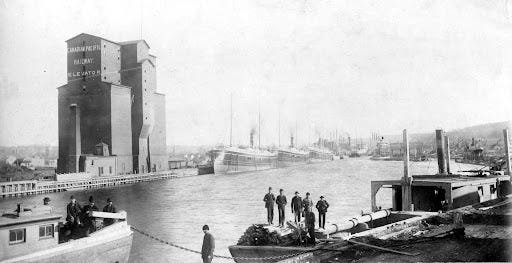
An 1892 photograph showing all three CPR steamships lined up next to the grain elevator at the Owen Sound harbour. Courtesy of the Toronto Public Library Archives.
Precise counts of the number of manufacturers operating on an annual basis were difficult to obtain, though the Dominion Bureau of Statistics reported 51 in both 1920 and 1960, suggesting that this was a reasonable estimate. In contrast, Vernon’s City Directory lists only 37 and 20 for years proximal to 1920 and 1960, suggesting that only the larger and more profitable businesses chose to advertise in that publication.
Grey Roots has produced a list of 30 furniture makers that operated in the City between 1862 and 1993. Unfortunately, business start and end dates are only readily available for 11 of these, so the remainder was unsuitable for the analyses presented here.
Based on these numbers, the analyses presented below represent somewhere between 30% and 70% of the businesses operating annually over the past century. The data suggests that these analyses include most major manufacturers and a large proportion of the employees.
For this analysis, I was able to compile data on the number and duration of operations for 43 companies that operated from 1850 to 2025. This includes: foundries, shipyards, wood products and furniture, automotive parts, stove works, glass-making, electrical appliances, mining equipment, packaging, printing, malt beverages, chemicals, and fasteners. Several of these companies changed hands, some more than once, but as long as they remained in Owen Sound and continued to produce the same or similar products they are included.
The manufacturing landscape changed over time. If we divide this period into four 50-year increments (1857-1907; 1908-1958; 1959-2009; and since 1975) changes such as the number of companies starting and the average duration of their operations can be measured. Obviously, the latter two periods overlap; however, in order to capture the most recent period over a similar time frame, it was necessary to add a fourth time period.
From 1857 to 1907, at least 23 companies commenced operations. These included manufacturers of marine equipment, lumber mills, a tannery, chemical and electrical products, furniture, steel boats, diesel engines, steel fabrics, print products, paint & varnish, and cement. On average these companies lasted 54.4 years.
Of particular note is Transcontinental RBW Graphics, which started in 1907 as Richardson, Bond & Wright Co. Limited (R.B.W.). It is the only business of those that commenced operations during this period that continues to operate today.
Between 1908 and 1958 an additional 10 companies started up, bringing the total during this period to at least 33 companies, a 43% increase. New on the scene were 2 more furniture makers, packaging, electronics, fire and security systems, and commercial food service equipment.
According to the Sun Times, one of the City’s longest standing companies, Van Wyck Packaging, which became Bellwyck Packaging Solutions, and most recently, MAX Solutions, commenced operations in 1916 as Fleming Folding Cartons. Of particular interest is the fact that C. A. Fleming was invested in both Richardson, Bond & Wright (RBW) and Fleming Folding Cartons. According to Grey Roots, George D. Fleming became the President of RBW in 1945 after C. A. Fleming died.
The Dominion Bureau of Statistics reported a manufacturing workforce of 1,560 employees with an annual payroll of $2,703,936 in 1920. On average, the companies operating between 1908 and 1958 lasted 39.3 years, a drop of 28% from the companies commencing operations during the previous period.
Only three of these companies (Van Wyck Packaging; Edwards, which became Chubb Edwards, then GE Security in 2005, and now, elements of which, operate as Troy Life & Fire Safety Ltd.; and Hobart Manufacturing, which is now part of the ITW Food Equipment Group) continue to operate today.
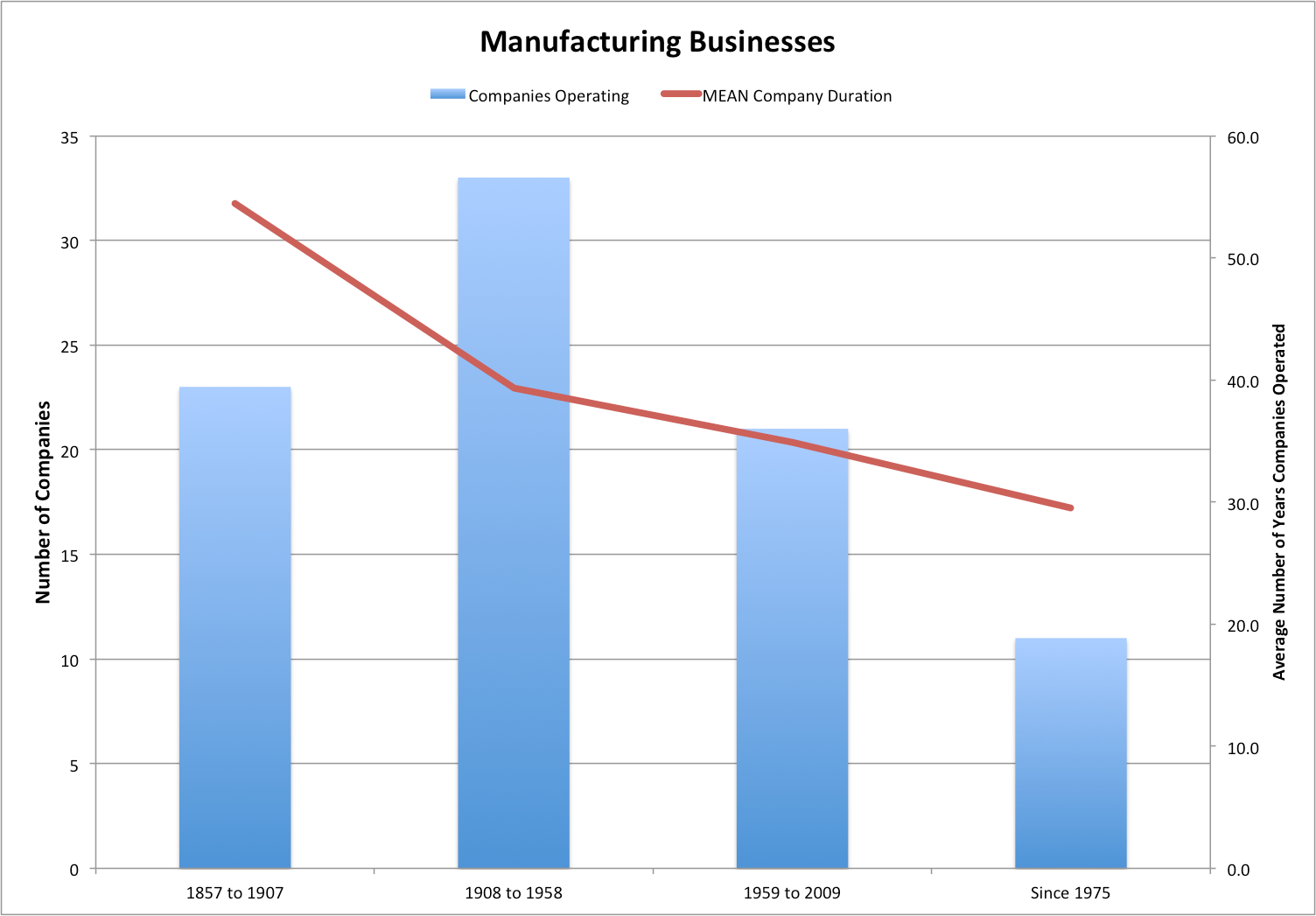
Change continued unabated after 1958. The number of companies operating appears to have dropped to 21, a 36% decrease from the previous period. Even more startling was the decline in the duration of operations, which dropped to 34.9 years, an 11% decrease over the previous period and a 36% drop from 1857 to 1907.
Despite these unsettling changes, the manufacturing sector continued to provide the City with permanent jobs and steady wages. A 1960 report noted a workforce of 2,136 employees with an annual payroll of $7,342,139.
The chart below illustrates an estimate of the number of manufacturing businesses that operated in each decade from 1850 to 2020.
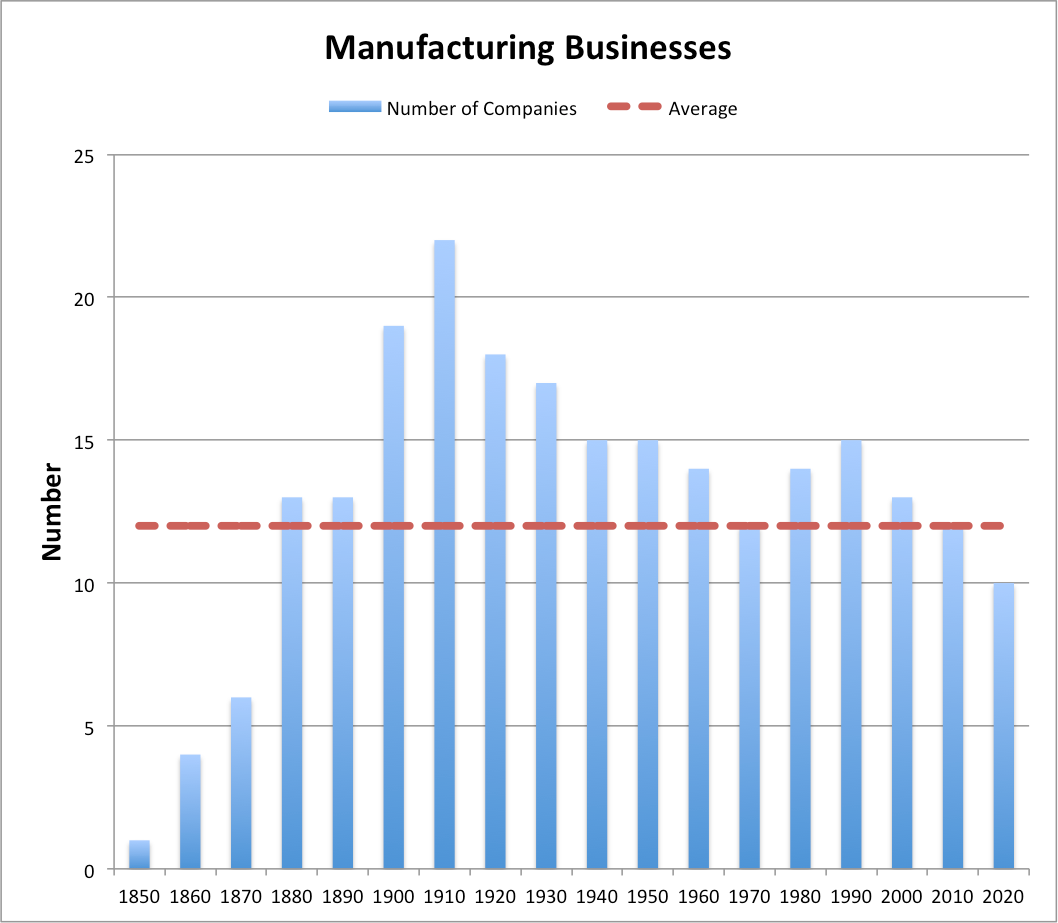
Gone now are stalwart fixtures in the community such as William Kennedy & Sons, the National Table Company, RCA Victor Co. Ltd., and Noma. Unfortunately, due to a lack of data it was not possible to accurately estimate the numbers of jobs lost due to these closures. Fortunately, the late 1950s and 1960s saw the arrival of some strong employers such as Hobart, PPG, and Goodyear/Veyance, and 1975 brought Munroe/Tenneco.
The 1990s brought Krueger Custom Steel & Manufacturing and Canvac. It wasn’t until 2008 that MacLean Engineering & Marketing Co. started operations in the City. It continues to expand its operations and is one of the City’s stronger manufacturers, making, in addition to mining equipment, the sidewalk plows that we see regularly throughout the winter months.
Since 1975, 8 companies ceased operations and 7 commenced operations, bringing the total to 11 operating in the 50 years between 1975 and 2025.
Over that period, 2 have ceased local operations (Tenneco and Canvac), leaving an estimate of 9 still operating (Transcontinental RBW Graphics, MAX Solutions, Troy Life & Fire Safety Ltd., Hobart Manufacturing, Fremaco Devices Inc., Krueger Custom Steel & Manufacturing, MacLean Engineering & Marketing Co., BWXT, Hydrogen Optimized).
Company lifespan is difficult to calculate for this last period given that many continue to operate today. The average duration of the two companies that started in/after 1975 but have since closed is 29.5 years. In addition, some of the remaining firms are American-owned, raising questions about their sustainability given the current tariffs imposed by the U.S.
The extent to which City policies affected the above-noted changes relative to business decisions made in response to regional, national, and global economic factors makes it impossible to ascribe any culpability.
Next time, we’ll take a look at the shift of Owen Sound’s retail from downtown to the east side.
Thank you to sponsors of The Owen Sound Current Writers’ Fund, who make these community contributions possible. Contributions from the community do not necessarily reflect the opinions or beliefs of The Owen Sound Current and its editor or publisher.
In this series:

