


OUR TOWN | OPINION
Our Town is a limited series of columns by Owen Sound resident David McLeish. This column reflects the analysis and evidence-based opinions of the author and is part of an ongoing opinion series. It is not news reporting.
In my last Our Town column, we took a deeper look at crime tends in Owen Sound and various ways they’re influenced. Today, in the final column for this series, we’re exploring why data shows Owen Sound near the bottom for household income and near the top for property taxes among Ontario peers.
Any discussion regarding the factors that affect Owen Sound needs to consider the extent to which property taxes fit into the equation.
Owen Sound City Council levies property taxes on all residential, business, and commercial property owners. Property tax has two components: a municipal portion, which is split between the City and the County, and an education portion, which helps to fund the school boards.
Municipal property taxes are considered “regressive” because they are based on the property, not the owner’s income. As such, they consume a larger percentage of income from lower-income households compared to higher-income households.
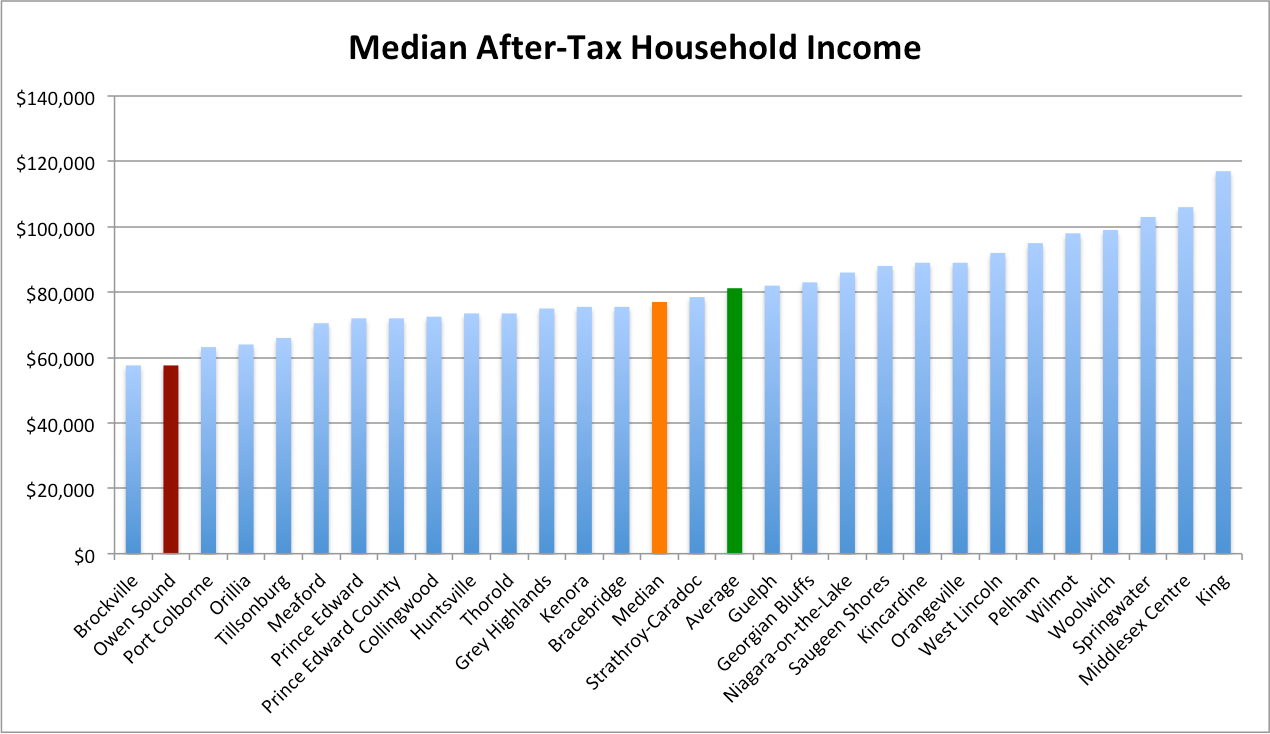
In the case of Owen Sound, where the median after-tax household income is $57,600, that can have adverse effected on a large segment of the population.
The tax rate is determined by multiplying a property’s assessed value as determined by the Municipal Property Assessment Corporation (MPAC), by the total tax rate set by the City (which goes to the City and the County) and the province (which goes to the school boards).
The City then determines the amount required to fund their operations and capital expenditures, the County does the same. The City sets its tax levy accordingly.
Although you pay your property tax to the City:
20 cents of each property tax dollar is passed on to Grey County,
8 cents is passed on to the school boards for public education,
and the remaining 72 cents of each tax dollar remain at the City to fund the services they provide (see pie chart below).
The exceptions are your water and wastewater, which are invoiced based on consumption, and garbage pick-up, which is based on the number of bags you put to the curb. For 2026, the residential property tax rate for school purposes was prescribed by the Province at 0.153 per cent of the assessed value of the property.
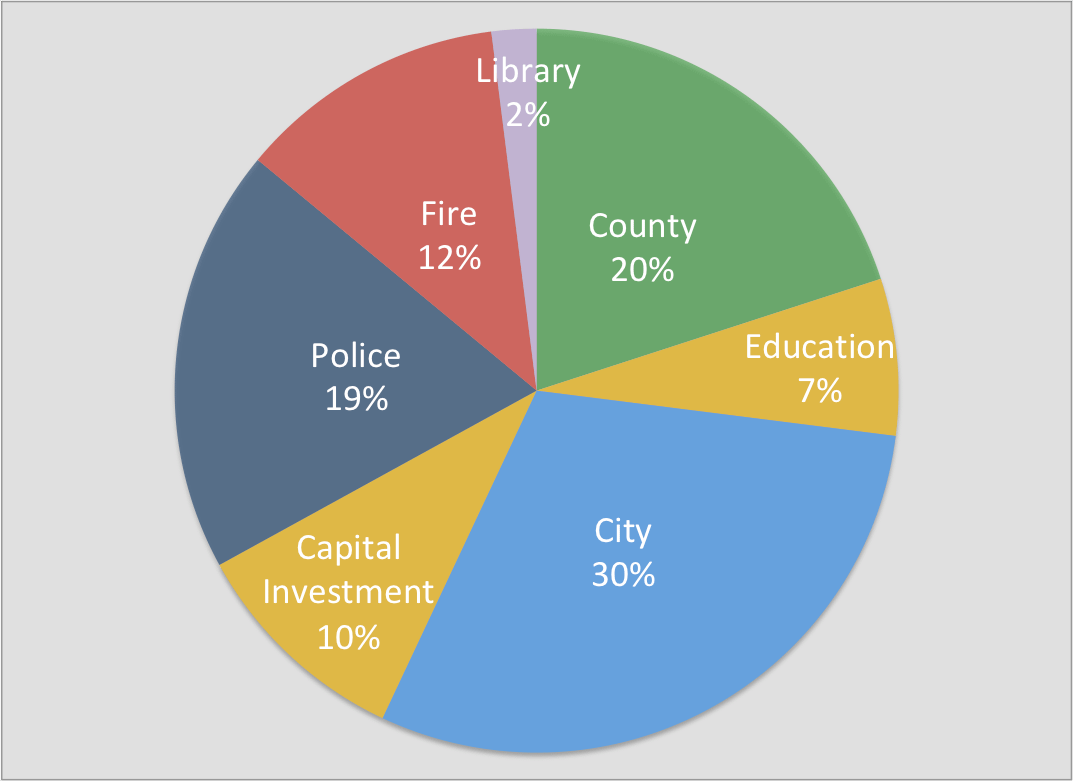
Rather than undertaking a detailed review of Owen Sound property taxes, I’ll refer you to Jim Hutton’s website for an abundance of information on taxes. I’ll include a few salient points and charts here, as they pertain to the challenges being discussed.
In particular, the relationship between income and property tax rates strikes at the heart of the problem faced by many local residents.
The following two charts illustrate how these changes have affected property taxes here relative to other Ontario communities.
Firstly, when compared to 27 other municipalities, Owen Sound’s Median After-tax Household Income ranks second lowest, well below the median and average for the group.
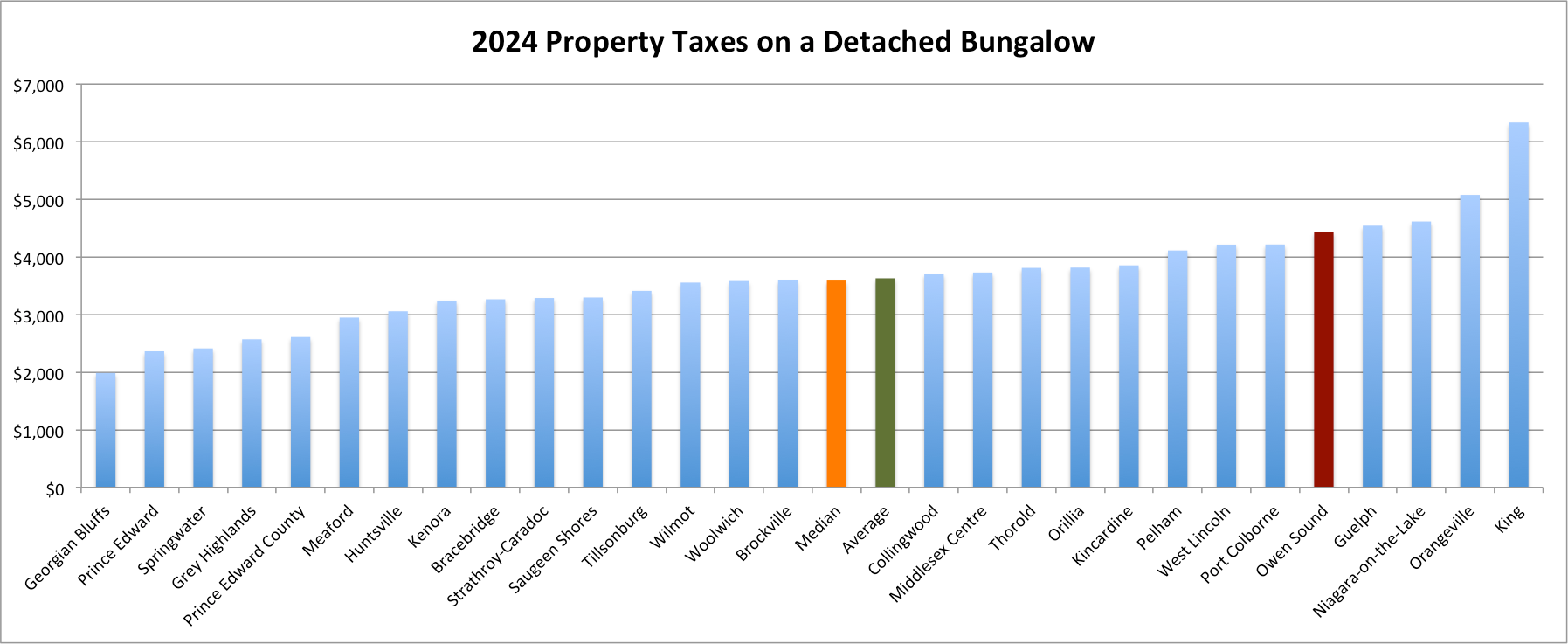
Secondly, Owen Sound ranks fifth highest in property taxes, relative to 27 other Ontario communities — well above the median and average.
Owen Sound’s property tax rate is the fifth highest of the group, surpassed only by Guelph, Niagara-on-the-Lake, Orangeville, and King.
These municipalities are conspicuous by the fact that their Median Household After-tax Incomes are substantially higher than Owen Sound, ranging from $82,000 to $117,000.
Also note that both the Median and Average tax rates on a detached bungalow are well below that of Owen Sound.
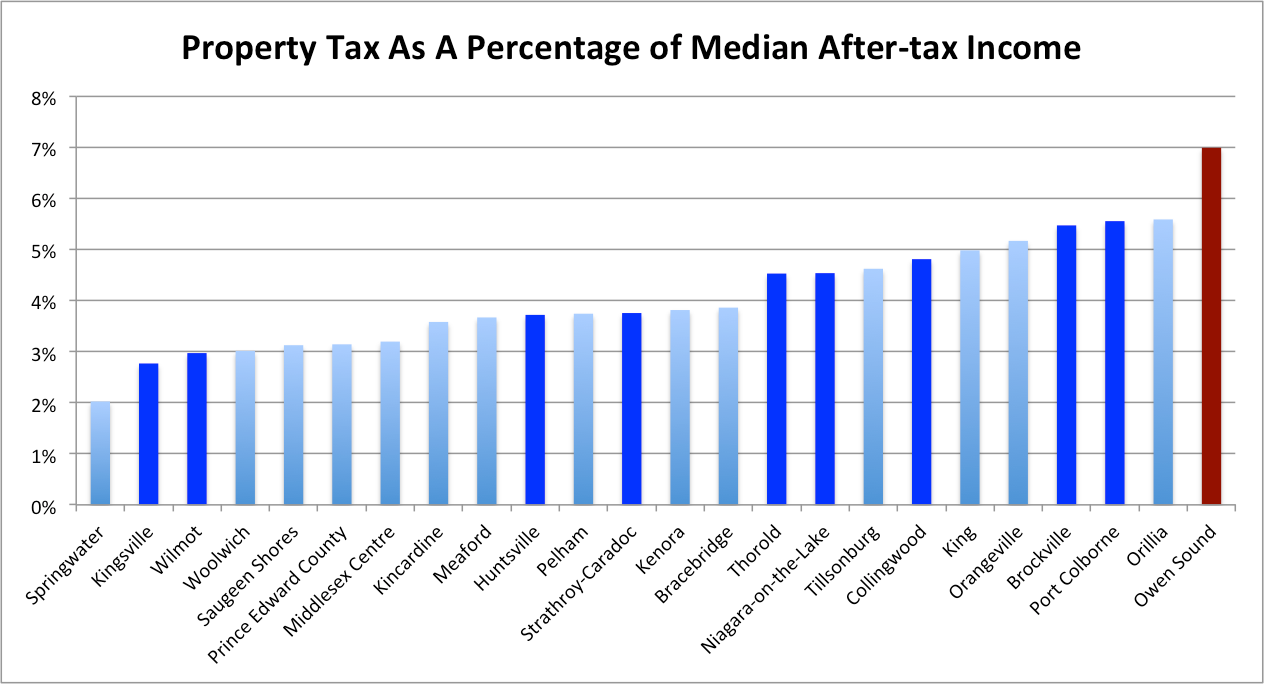
Third, combining the data from the previous two charts, the next chart illustrates the proportion of after-tax household income that Owen Sound property owners pay in property taxes, relative to those in 27 other Ontario communities.
Property Tax for a ÷ Median Household
Detached Bungalow After-tax Income
Those Owen Sound property owners or renters earning the median after-tax income or less pay by far the highest proportion of their disposable income (7%) on property taxes.
For example, in contrast, a resident of Kincardine pays 3.6% or ½ the rate in Owen Sound.
In general, property owners in the other municipalities pay 1.4% to 5.0% less of their disposable income on property taxes than Owen Sound property owners.
To help understand these comparisons, the communities with similarly sized populations are coloured dark blue. This indicates that taxes in Owen Sound are higher than all these other communities to varying degrees.
As discussed in a previous column, the above challenges are further exacerbated by the creation of thousands of residential lots in the surrounding townships in the 1980s and early 1990s and the subsequent construction of thousands of single-family homes on these lots.
As these houses were built, thousands of people that moved into the area or who chose to relocate from the city to a rural lifestyle purchased these homes.
In 2024, the property tax on a detached bungalow in Georgian Bluffs, Meaford, and Chatsworth were 55%, 34% and 18% less than the tax on a similar dwelling in Owen Sound.
Similarly, the property tax on a two-story house in Georgian Bluffs, Meaford, and Chatsworth were 43%, 19%, and 23% less than in the City.
This in turn leaves the city’s population, which has not seen any growth for 30 years, to cover the ever-increasing operational and capital costs.
To be fair, the City has no direct control over the median after-tax household income of local property owners. They only control the tax rate. As Hutton has observed, Owen Sound’s expenses need to be better managed.
Hutton has also pointed out that “revenue from taxation increased by $8.4 million, or 38%, over the fiscal years 2011 to 2020” whereas “the Consumer Price Index (CPI) increased by only 18.3% during this same period.”
As Hutton has suggested, the City’s budgetary process would benefit from several improvements including:
Implement a “Housing First” approach
At the end of the day, it seems unlikely that City Councillors consciously set out to make Owen Sound property owners the highest taxed in the province.
Rather, it likely happened incrementally, decision by decision over many years.
That said, decisions such as to waive/delay development charges certainly add more to residential tax bills. If local property owners cannot afford the property taxes levied by the City, then Council needs to explore alternatives.
What are our next steps, as a community? I invite you to reflect back over this collection of essays and share your thoughts. The Owen Sound Current accepts letters to the editor at owensoundcurrenteditor@gmail.com.
Thank you to sponsors of The Owen Sound Current Writers’ Fund, who make these community contributions possible. Contributions from the community do not necessarily reflect the opinions or beliefs of The Owen Sound Current and its editor or publisher.
In this series:


