

Our Town: A Brief History of the Town-Turned-City of Owen Sound
In this second column in his limited series 'Our Town,' David McLeish explores the conditions around Owen Sound's incorporation as a town and its eventual decision to be considered a City, instead.

OUR TOWN | OPINION
Our Town is a limited series of columns by Owen Sound resident David McLeish. This column reflects the analysis and evidence-based opinions of the author and is part of an ongoing opinion series. It is not news reporting.
Owen Sound has changed. Just how much depends upon how long you’ve lived here. A friend who has spent almost 70 years here recently lamented on the numerous closed up stores, the number of unhoused, and the lack of patrons enjoying downtown establishments. I’ve only lived here 33 years but even I have noticed many changes.
We are a product of our history. In other words, history has a way of influencing the present. It therefore makes sense to reflect upon the past when considering present and potential future states. For instance, unlike the First Nations who generally lived in harmony with nature, the first European settlers in the area saw the abundant forests as an obstacle to farming and a resource to be harvested.
Paul White’s website provides a wealth of historical information on the nascent community. As Paul notes, by 1842 the town soon had hotels, several stores, Ezra Brown’s tannery, Boyd’s wharf, and an infant shipbuilding industry. One of the first shipbuilders, Henry Wood, established a woodworking shop near the harbour. He launched his first vessel, the Anne Mackenzie, boasting a 100-foot keel with a 24-foot beam, in the late 1840s.
Other vessels launched from Owen Sound around that time include the Elizabeth Broder and the Belle McPhee, a two-masted schooner. These pioneers established a place from which other settlers could move further into the interior of what would eventually become Canada.
The Town of Owen Sound was incorporated on January 1, 1857 — and the early settlers quickly got to work.
They built a sawmill and a gristmill, and others took advantage of the abundant timber and fish stocks. For example, the harvest of lake trout from Georgian Bay in 1890 was 3,496,240 pounds (1,585,868 kg).
Unfortunately, by 1962 the harvest was zero due to a combination of overfishing and predation by sea lamprey, introduced via the St. Lawrence Seaway.
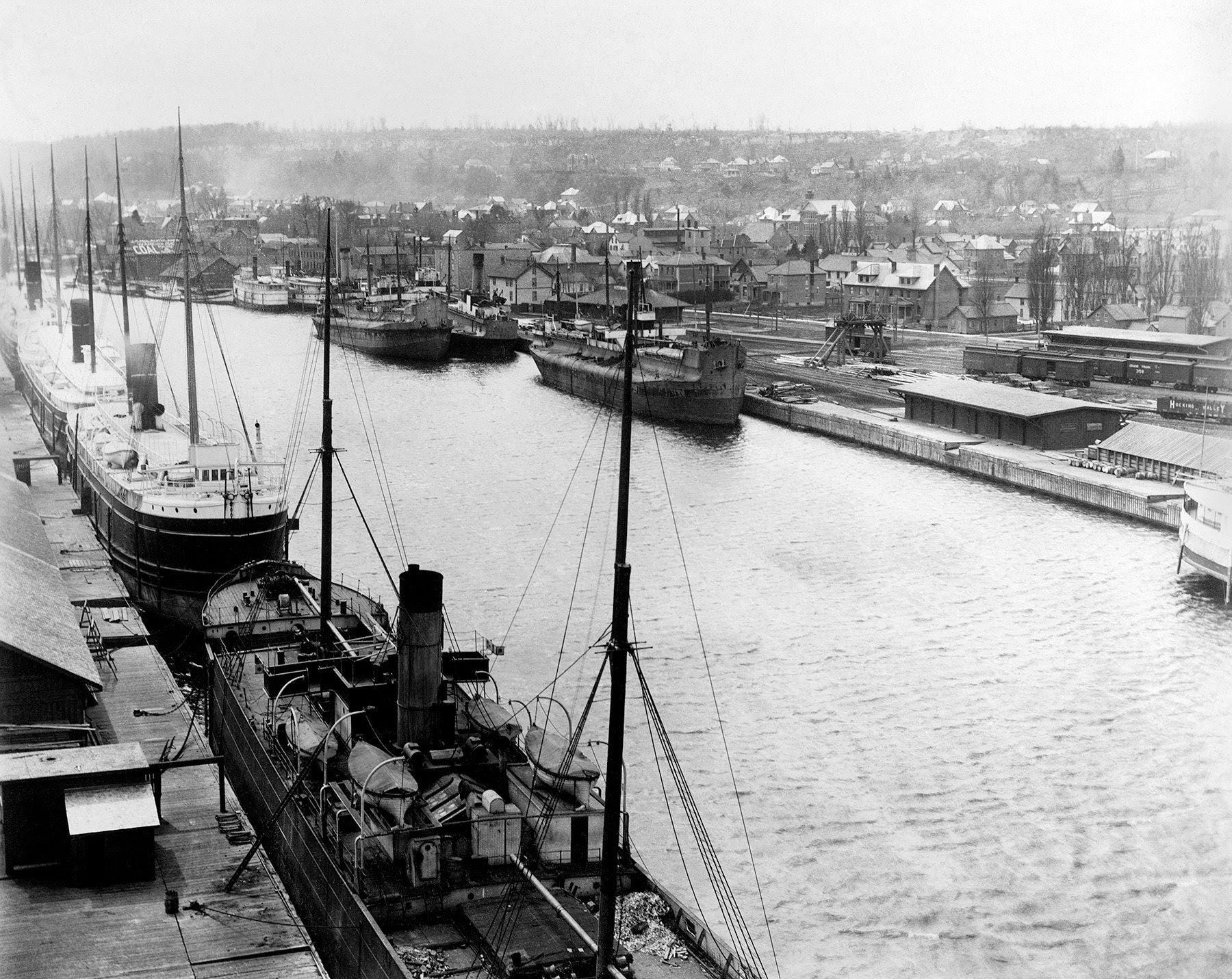
The exploitation and processing of these and other natural resources characterized several local industries for decades. In addition, Owen Sound’s location on Georgian Bay of Lake Huron also meant that the City provided a valuable transportation link. The inner harbour was first dredged by the federal government in 1860, earning a reputation (at its peak) as “one of the busiest – and safest – ports in Canada.”
Although it took some 23 years of lobbying, the first train to Owen Sound finally arrived on June 12, 1873.
Less than a decade later, in 1882, the Canadian Pacific Railway Company announced that Owen Sound would become the eastern terminus for its Great Lakes fleet. Together, these developments charted Owen Sound’s trajectory for several decades.
Not only did grain and freight move south after being unloaded from ships, passengers travelling west would arrive by train to catch steamers to Port Arthur and Fort William and then trains to the west. By 1911, there were 643 vessels docked in the City’s harbour.
In the 1912 book “Owen Sound On The Georgian Bay Canada,” Norah Thomson noted “the completion of the $1,500,000 dry dock, the system of interswitching, the Meaford-Thornbury radial, and the street car system” concluding that “Owen Sound will be the Liverpool of the north.”
The largest annual volume of grain ever handled in Owen Sound was 23.5 million bushels, or 639,560 tonnes, in 1945.
Passenger train service to Owen Sound ended in the 1970s and the trains stopped shipping cargo in 1989 (CN Rail) and 1994 (CP Rail) — about the same time that grain subsidies for rail shipments ended.
By 2014, only 13 vessel movements occurred, moving between 150,000 and 180,000 tonnes of product.
“Owen Sound banned the sale of alcohol in 1905 or 1906 and remained ‘dry’ until 1972, when voters approved the sale of liquor in bars and restaurants. This local prohibition lasted 66 years, making it the last city in Canada to lift its ban.” Manufacturing was well underway by this time, prompting Miss Thomson to enumerate the “two thousand men artisans and skilled and unskilled laborers at the different factories and mills here.”
One question that has piqued my interest is this:
Why is Owen Sound called a City when other communities, some larger than Owen Sound, are still called towns?
It turns out that Owen Sound is only considered a City because back in 1920, the Town Council thought becoming a City would help attract business.
They petitioned the Province for city status, pointing to the town’s manufacturing, shipping and rail infrastructure, and post WWI population growth. It seems there is no legal definition or set rules around population size to become a city; it’s really up to the community.
According to White, the Legislative Assembly of Ontario approved the notion that on June 1, 1920, Owen Sound would officially become a city, with all the rights and powers of cities under The Municipal Act.
In the next in this series, we’ll dig deeper into how manufacturing has impacted decision-making in Owen Sound over the better part of two centuries. Stay tuned.
In this series:
