
Letter: One Elder's Lessons Learned in EV Dreams & Winter Realities
Shawna Macivor shares what it was like to buy and drive her first electric car later in life — from environmental motivations to real-world charging lessons.

LETTER TO THE EDITOR
Buying a new or second-hand car is always a big decision. Especially at this point in our volatile history, when prices have risen astronomically. But there are many sensible choices even for older, single Greenies like me. Depending on personal circumstances, these include a small fuel-efficient gas car, a plug-in hybrid or a full EV electric vehicle.
I have always bought second hand cars with low mileage, preferably a year or two old, being unwilling and unable to pay a premium to drive a new car off a lot. As my old car started to rust badly, I knew I’d have to search for my next good used car.
Why an EV, and why now?
My instinct was to buy an EV, partly because it will likely be my last car (given my age) and partly because I believe the electric vehicle revolution will ultimately prevail. The cars are just superior. I’ve also followed climate science for years so had to set a good example for my granddaughter and her peers (although I acknowledge that EVs are not environmentally perfect).
Plug-in hybrids seemed to be a good bet, but the idea of having to maintain a car with two ‘engines’ (one gas, one an electric battery) made me hesitate. As I explored further, I discovered that the life-time costs (about 10 years) for a full EV are lower than all other types.
When I started researching EVs, there was still a government rebate. But Canada was about to be turned upside down by the once-reliable USA, rebates stopped, and the surge in those buying EVs slowed as people experienced ‘range anxiety’ (more on this later).
But I persisted, gradually homing in on a Nissan Leaf. I would have preferred to stick with a Subaru, but their EV was too big for my needs.
As I searched dealerships locally and online, the most abundant EVs in the second-hand market were Teslas. Though that car is undeniably good (and was then the leading seller in the global EV market), I ruled it out for the Founder’s Trump-supporting reasons.
More than a year went by and I didn’t see any of the low mileage small EVs I was looking for. When I asked dealers about this, they mentioned the expense of these cars and the way owners are hanging on to them a lot longer in uncertain times.
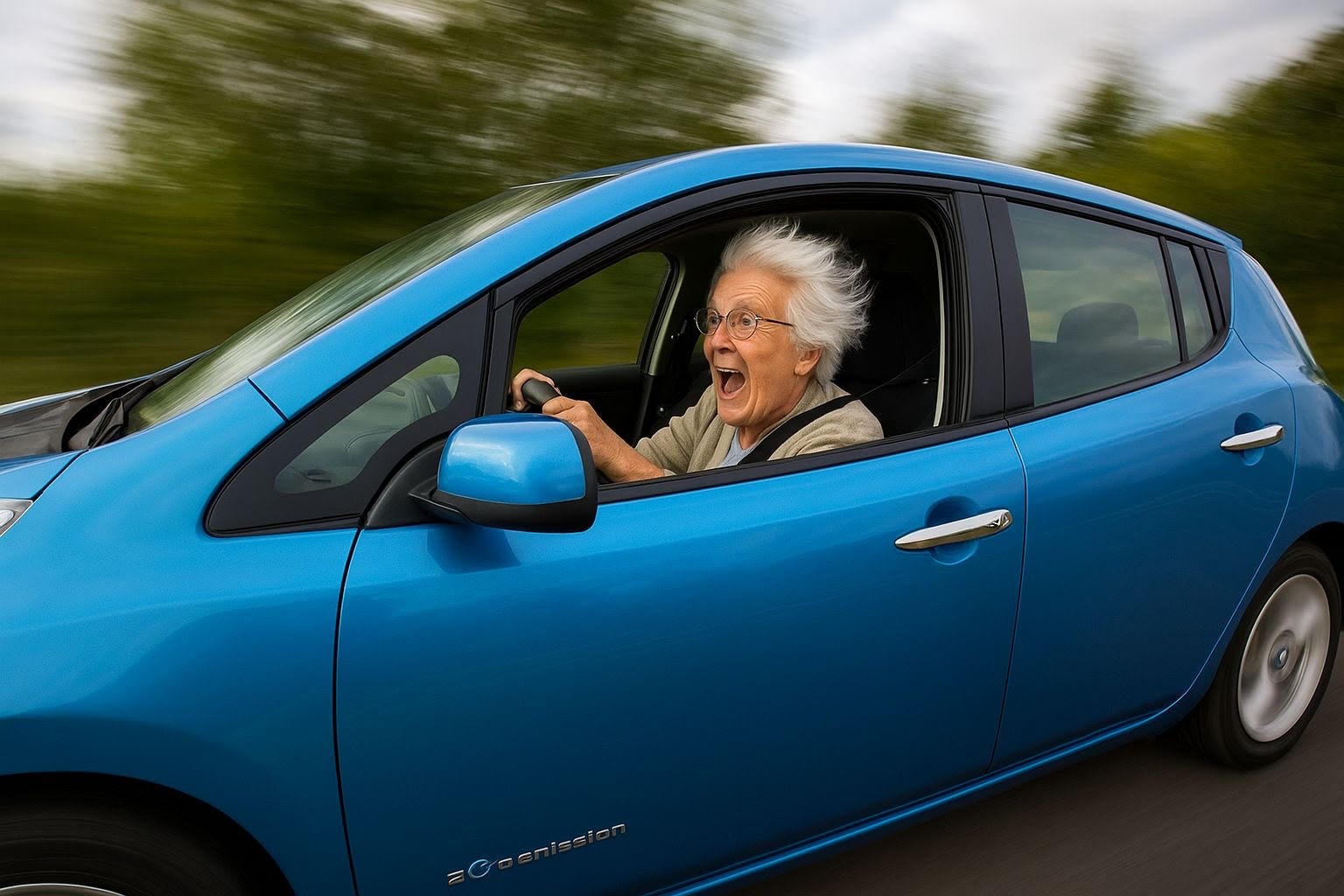
Finally, in November 2025, just after I’d had to have all four brakes replaced on my car (sigh), a blue 2024 Nissan Leaf SV Plus with just over 7500 km came on the screen. I called the dealer in Guelph and went through my set of questions: single owner, check; no accidents, check; larger battery, etc.
The price was high but it was about $12K under what a new Nissan Leaf would cost. Within a week, I had bought the car, organized for a Level Two Charger to be installed in my garage, and found a kind friend willing to drive me to Guelph for pick up.
First impressions behind the wheel
The first few weeks of local driving were blissful. The car was quiet of course, and felt solid. It was convenient to charge at home. When driving, I could feel the ‘regenerative’ braking coming on when I lifted my foot off the drive pedal. There are many advantages to this kind of braking in EVs, but the main one is that recovered kinetic energy is put back into battery storage.
Now for the part about ‘range anxiety’. On a cold day in December with a forecast high of minus 9 and high winds, I set off for my first EV trip to Toronto.
I knew that batteries lose charge much faster in cold weather, but given that EVs dominate the car market in Norway (about 97% of new car purchases), I didn’t worry.
Well, I failed to account for the fact that Norway has installed many, many fast chargers. My drive to Toronto took 7.5 hours.
I encountered a series of charging mishaps that sound, in the retelling, like the keystone cops. I lived to tell the tale thanks to the kindness of strangers.
I knew there were different charger companies operating in Ontario (at least six), but I didn’t realize that while the chargers themselves are mostly standard, the plugs at the end of the charging cable are different. You can’t just assume that the nearest charger will have plugs that work with the ports in your car. Nor can you assume that all public chargers are fast chargers; they aren’t.
Plus, each of the chargers have their own apps which have to be downloaded separately to your smartphone and an account set up. Some require funds to be uploaded in advance.
As for connectors, there are three types: CHAdeMO, CCS and NACs/Tesla Superchargers. The latter will become the standard ‘soon’, but my car only uses a CHAdeMO (an older standard) for fast charging.
In theory, the range of my EV would allow me to make it to Toronto without having to recharge.
That’s brings us to Lesson #1:
In practice, in the ‘real world’ conditions of winter’s bitter cold, you cannot count on the optimal range.
Now, most places between Owen Sound and Toronto only have one or two chargers at a given site and not all of them have CHAdeMO connectors. Apps tell you if a charger is ‘available’ but by the time you get there, it might be taken.
The first place I tried, just outside Schomburg, had two chargers of the type I needed: one was taken (with a car that needed to charge for an hour); the other had a ‘network outage’.
The kind driver who was recharging advised me to drive north on the 400 (don’t ask) to the Outlet Mall where there are several chargers. I mistakenly turned off too soon, finding myself on the outskirts of Bradford. Thank heavens the travel service building was open and there were helpful women inside who directed me to a charger in town.
The charger in town worked, but it was a slow charger with no nearby stores close by. I’d have frozen before the car had enough charge.
And here we have Lesson #2:
You can’t count on a quick charge on an unknown route, either.
I decided to risk driving south along the 400, thinking I could charge at the ONroute service station in the Maple plaza near King City.
However, as I drew near, I saw it was closed permanently for ‘development’.
Watching the battery icon dip close to 10%, I drove to the PetroCan in Woodbridge, having read that they had two chargers. When I arrived, one was ‘out of service’ and the other was being used.
After sitting for half an hour, shivering, awaiting my turn to charge, I discovered the only one working was a DC Level 3 fast charger (NACS) that would not work with my particular car (see above).
That was Lesson #3:
Finding an available charger doesn’t mean you’ve found your charger.
The fellow charging his car advised me to go a kilometre west on Highway 7 to the Canadian Tire. “They have a FLO fast charger with the CHAdeMO connector,” he promised.
He was right — and the charger was not being used! Hallelujah.
I successfully charged my car, while warming up inside the store, and made it to Toronto in time for the evening concert (which was a main reason for this trip).
My return drive home from Toronto took only 4.5 hours, with a successful charge in Orangeville. But since this adventure, I’ve decided that my winter trips to the Big Smoke will be different. I’ll either take the bus or, if my Toronto-going friend could go, rent a gas car for the trip.
If you lived in Toronto, owned a non-Tesla EV, and did most of your long-distance driving on the 401 and 400, you could use the fast chargers that are part of the Ivy Charging Network at the ONroute service stations (assuming they are all open). They have connectors that support all EV models.
But if you live in Grey and Bruce, it takes a little more work to find a FAST charger with a CHAdeMO connector on the direct route to Toronto. There are some, but it takes planning — and a little bit of Irish luck — to find them in a place where you aren’t standing around for forty minutes in the cold.
Yes, you can leave the heat on in the EV while charging, but this will extend the total charging time. It may not be convenient to do that.
So, what do I think overall about my EV car purchase and driving adventure?
I’ve decided this kind of adjustment is the price to be paid for following my conscience. It’s not a big sacrifice. I enjoy the EV. And ninety-five percent of my driving is within a two-hour radius. I take few winter long-distance drives.
The best thing is that I’ve learned a lot! Not just how to set up, drive and charge an EV, but I’ve also discovered I can buy a CHAdeMO to CCS adapter for my car that will give me access to more chargers. A new 2026 Nissan Leaf already has a NACs (Tesla) port for DC Fast charging. Things are changing quickly in the EV world.
For an elder trying to do right by the planet and the next generation, learning to drive electric feels like the right kind of challenge.
Letters to the Editor do not necessarily reflect the opinions or beliefs of The Owen Sound Current and its editor or publisher.
Related:


Thank you so much for this article Shawna. I too am planning to buy my 'last' car soon and am considering an EV or Hybrid. Think I'll put it off for another year and see what changes happen with the Canada/China deal.