Letter: Lego Visions a Good Conversation Starter, But Harbour Talks Need Grounded Vision
In this letter to the editor, resident Sasha Fernando responds to a columnist's Lego model vision of what Owen Sound's harbour could be, advocating for an Indigenous-led approach grounded in reality.
LETTER TO THE EDITOR
Reading your recent column about the Lego model of Owen Sound’s harbour and visiting Grey Roots Museum to see the piece tucked away in the gallery, it sparked a number of thoughts.
First, Christy Hempel’s Lego is charming, and it does a good job of starting a conversation.
See Hempel’s column for reference:
Not because Lego is a serious urban-planning tool, but because it’s accessible. Who doesn’t like Lego? And who knows, maybe it will be worth something on BrickLink one day.
More importantly, the model invites people who don’t attend committee meetings or read planning documents to imagine change, ask questions, talk about possibilities, and perhaps even design their own Lego vision.
It does what good public-facing work should do: it gets people leaning in, talking, and imagining.
Christy frames the model as a way to spark hope, and that part works. At a time when Owen Sound needs hope around its downtown core and waterfront, this kind of engagement helps people imagine something better than the status quo.
The problem isn’t imagination. It’s sequence.
The imagined harbour, animated by festivals, art, walkways, small boats, and water-based recreation, becomes less a vision grounded in Owen Sound and more a projection of what we might wish the harbour to be.
At that point, the Lego stops functioning as a prompt and starts acting as a stand-in for unresolved realities. Hope drifts into fantasy, and planning gives way to fairy dust.
The column suggests Owen Sound look to other countries for inspiration and leans heavily on “activation” as a strategy to bring people together.
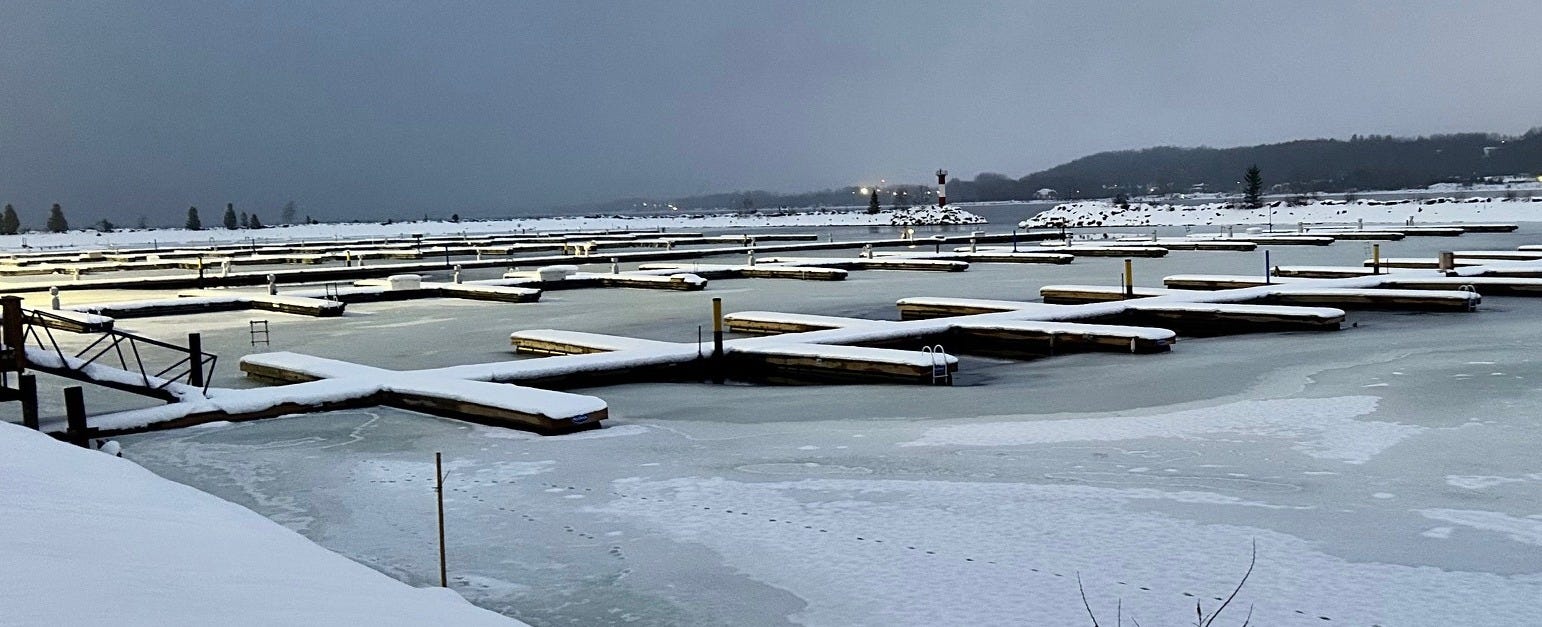
These ideas are appealing, but they raise an essential question: activation for whom, and on what terms? What does this harbour look like on a windy Tuesday in February, when there’s no festival, no patio, and no one to “activate” anything?
The harbour is not a blank slate waiting to be animated. It is a working landscape shaped by a long history of industry, contamination, prohibition, transportation, and big water, layered over much longer realities of Indigenous presence since time immemorial and exclusion.
Any hopeful vision that skips these foundations is starting in the wrong place.
The article does not meaningfully engage with the fact that Owen Sound is colonially seated within Indigenous territory, nor that the relationship between Indigenous peoples and these waters is living, legal, and ongoing. This is not about wording or symbolism; it is about governance and responsibility.
Indigenous rights and decision-making are not optional additions to waterfront planning. They are foundational. A future vision that does not begin there risks becoming another well-intentioned rebrand rather than a substantive shift in how this place is understood and cared for.
Ecology is another absence threaded through the vision. Fishing, swimming, and playful contact with the water are imagined uses, while remediation remains secondary. But water health is not a backdrop to redevelopment; it is the prerequisite.
Owen Sound’s harbour has carried decades of industrial use, and climate-driven storm events now redistribute contaminants in ways that complicate restoration rather than resolve it. Without confronting what the harbour can safely support, visions of vibrancy remain speculative.
That same lack of grounding extends to fisheries. Fishing appears as an activity rather than as a system tied to ecology, culture, and land use. The deeper questions remain unasked: what fisheries still exist, what pressures they face, and how harbour conditions affect their viability.
Declining fish populations, habitat loss, water quality challenges, and changing lake dynamics are not abstract concerns. They directly shape shoreline design, public access, and the limits of recreational use. Treating fisheries as scenery rather than infrastructure is another example of vision outpacing reality.
Climate change barely enters the conversation, and that omission matters.
Georgian Bay is big water: cold, windy, and increasingly volatile. Warmer winters do not bring gentler conditions; they bring more winter wave action, greater shoreline erosion, and increased stress on infrastructure. Heavier rain events intensify runoff and pollution, further straining already compromised aquatic systems.
Designing floating walkways, patios, and seasonal attractions without centring climate resilience is not hopeful. It is fragile.
Geography matters, too. Owen Sound is not the Kawarthas. It is not Muskoka. Nor is it Denmark or Mexico. Slet ikke godt. No bueno. Owen Sound is not comparable to canal cities or resort waterfronts where sheltered water, density, and short cruising distances make casual boating and year-round activation feasible.
Boating here is big-water boating: exposed, cold, and unforgiving. Recreational access is increasingly narrow, and boat ownership remains expensive. A harbour designed around boating as the primary engine of vibrancy risks serving a small slice of users while calling it “community.”
This is why global comparisons feel misplaced. Borrowing ideas can be useful, but place is not branding. Owen Sound’s strength is not that it could be somewhere else. It is that it is a cold-water harbour on big water, with a distinct history, climate, and culture.
Finally, there is the relationship between the harbour and the rest of the city.
Waterfront activation is often framed as a catalyst for community life, but a boardwalk or festival space cannot carry a downtown on its own. Housing, safety, mental-health supports, winter foot traffic, and basic services determine whether public spaces feel welcoming or performative.
A truly vibrant harbour works on an ordinary Tuesday in February, when the wind is up, the docks are quiet, and the people who live here year-round are still showing up.
None of this dismisses the Lego model.
It succeeds at what it sets out to do: starting a conversation. It reveals how fragmented and underused the waterfront currently is, and it invites people to imagine alternatives.
But the next step is not more hope. It is more foresight.
A grounded vision for Owen Sound’s harbour would begin with Indigenous leadership as governance, not as a checkbox. It would start with healthy waters, viable fisheries, and resilient shorelines.
It would design for winter, wind, and climate change as deliberately as it does for summer ease. And it would prioritize public access that does not depend on wealth, equipment, or seasonal luck.
Hope matters. But hope without realism is not optimism. It is avoidance.
Owen Sound deserves connection, a vibrant harbour, and a downtown core built not on comparisons to the incomparable, but on responsibility to the people who have been here since time immemorial, to the land and water, and to the community that lives here today.
Respectfully,
Sasha Fernando
Owen Sound
Letters to the Editor do not necessarily reflect the opinions or beliefs of The Owen Sound Current and its editor or publisher.
Related: