It Smells Like Dirt in Here
Master gardener Jennifer Deeks shares an ode to petrichor, the scent of the earth, and the science behind what so many of us love about it.
COMMUNITY CONTRIBUTION
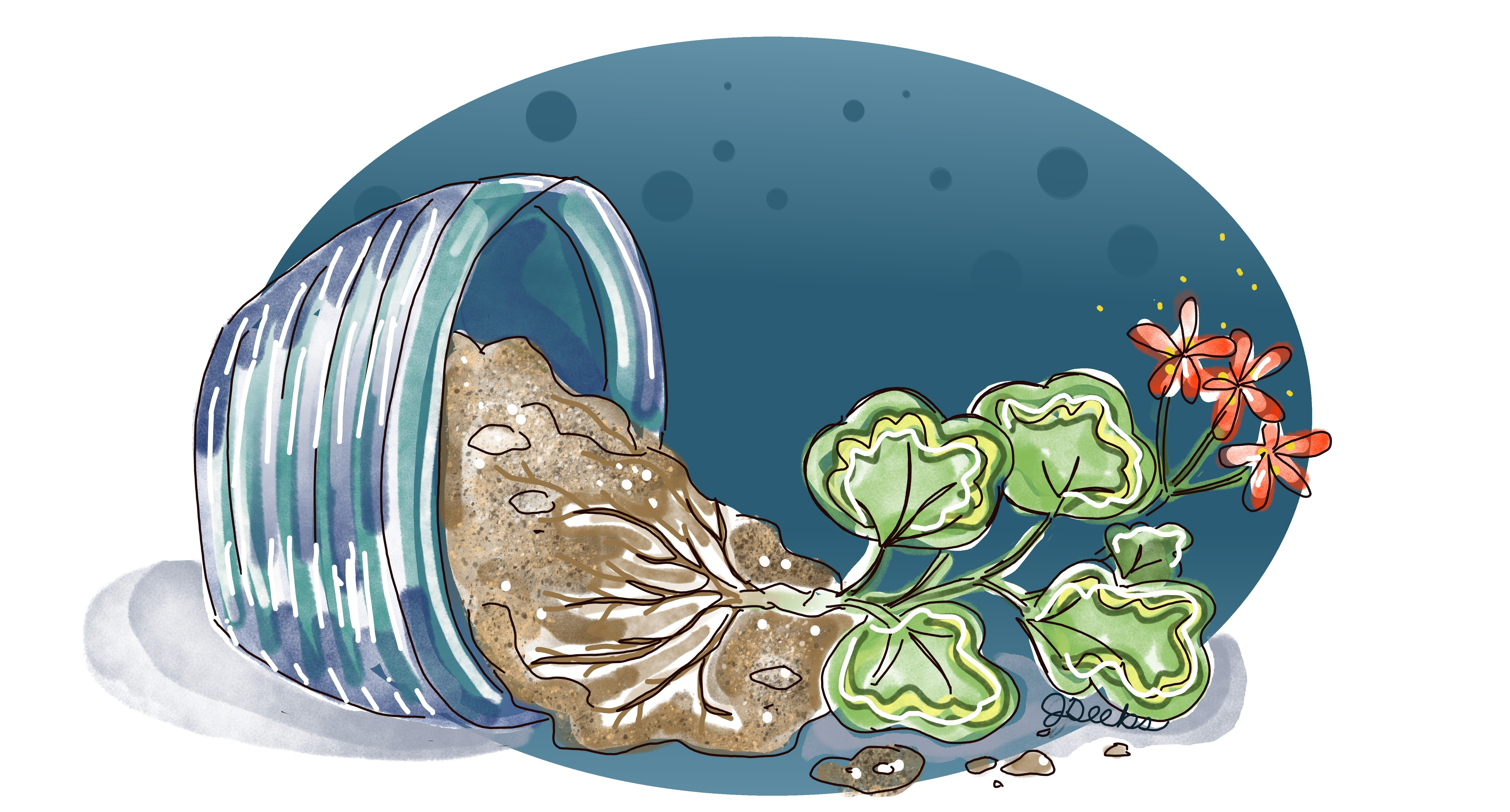
I am re-potting some indoor plants today. It is something that needs to be done occasionally because a houseplant pot is a small, closed ecosystem which eventually runs low on nutrients and organic matter. To remedy this, you dump out all the old soil, give the roots a good shake, and put it back in a larger pot with some fresh soil.
My favourite part of doing this? The smell.
The smell of fresh earth has a distinct odour. This becomes even more apparent when the soil becomes wet. You may be familiar with the term “petrichor,” which is that instantly recognizable scent that appears at the beginning of a rainstorm.
Apparently, humans found this smell scientifically interesting as early as 1891, when they first began researching it, but we did not isolate the chemical compound responsible until 1965.
The compound is called “geosmin”, which literally means “earth smell”, and the odour is a type of chemical in the terpene group – the same organic compounds that are of much interest in cannabis production.
Geosmin is primarily produced by a type of bacteria called “Streptomyces” that is involved in decomposition. Interestingly, these abundant soil bacteria behave more like a fungus. It creates a branching mycelial network that stretches through the soil, releasing spores perfumed with geosmin.
Recent research has found that small invertebrates, particularly springtail insects, are strongly attracted to this and chemical and are able to disperse the spores widely. This indicates that the bacteria are releasing the scent to attract organisms that will spread their spores for them.
Humans have a relatively poor sense of smell compared to many other creatures. But we are able to detect the scent of geosmin in parts per trillion, an infinitesimally tiny concentration, which implies both that we evolved alongside it and that there must be some survival value in being able to detect it.
The current working theory is that because moist soil contains more of these bacteria and moist soil likely means a nearby water source, it would be advantageous to be able to sniff out wet areas. Camels have been shown to use the scent of geosmin to detect water from up to 80 kilometres away, so someone is still using it to find water!
Oddly enough, although the smell is pleasant, many humans also strongly detest the taste of geosmin and describe it as “musty” or “mouldy” – likely because it can also indicate bacterial contamination of food or water.
I adore the experience of walking into a humid greenhouse and deeply inhaling that sweet, earthy smell. The same experience can be had while digging in the garden – especially after it has rained – or in the winter while working with house plants or early seed starting.
I would describe the resulting emotions as soothing and grounding, coupled with a deep connection to nature. The science would seem to indicate that what I am feeling goes much deeper, tapping into an evolutionary past when water did not magically appear from the faucet and when the ability to smell wet earth was a survival mechanism.
References
Meganathan, R. “What causes the characteristic smell of soil?” https://www.niu.edu/clas/biology/about/faculty/meganathan/smell-of-soil.shtml. Accessed January 16, 2025
Chater, Keith F. “The Smell of the Soil”. https://microbiologysociety.org/publication/past-issues/soil/article/the-smell-of-the-soil.html. Published May 7, 2015. Accessed January 10, 2026
Fox, Alex. “How Rain Evolved Its Distinct Scent—and Why Animals and Humans Love It”. https://www.smithsonianmag.com/smart-news/smell-rain-explained-180974692/. Published April 17, 2020. Accessed January 16, 2026.
Hawking, Tom. “The science behind the smell of rain”. https://www.popsci.com/science/smell-of-rain-petrichor-science/. Published June 12, 2025. Accessed: January 12, 2026.
Thank you to sponsors of The Owen Sound Current Writers’ Fund, who make these community contributions possible. Contributions from the community do not necessarily reflect the opinions or beliefs of The Owen Sound Current and its editor or publisher.