

High School Students Gather at Bruce-Grey-Owen Sound MPP's Office to Protest OSAP Changes
More than 100 students from two Owen Sound high schools walked out of class Thursday, gathering outside MPP Paul Vickers’ office to protest proposed OSAP cuts.

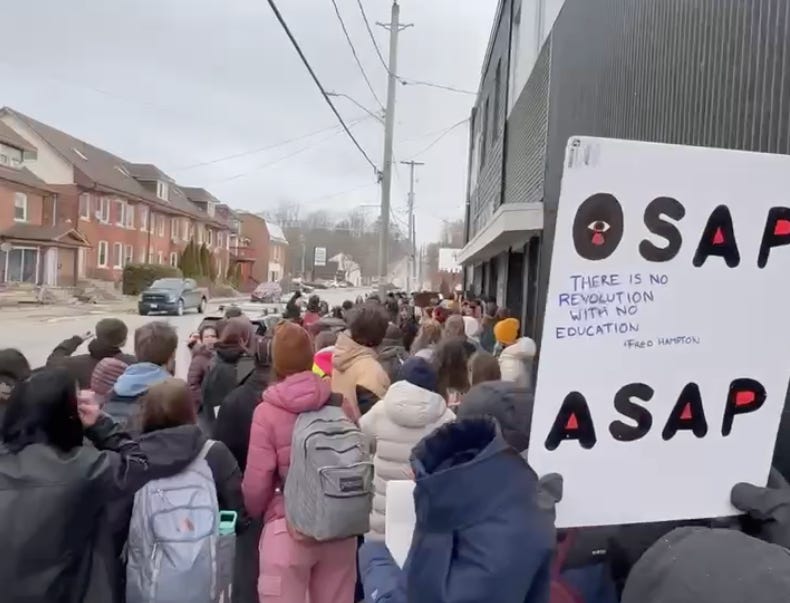
More than 100 Owen Sound high school students walked out of class Thursday afternoon to protest proposed changes to Ontario’s student financial aid system, gathering outside the downtown constituency office of Bruce-Grey-Owen Sound MPP Paul Vickers.
High school students from Owen Sound District Secondary School and St. Mary’s High School walked out as their third period of the school day was set to begin. The two groups, coming from separate ends of the city, marched into the downtown core and met in front of their provincial representative’s office just before 1 p.m.
The group chanted, “Hands off our OSAP,” and “No cuts, no fees, no corporate universities,” among other messages they hope their MPP and the Ontario government will consider.
Vickers has not released an official statement about the protest. However, he did come outside at one point to explain to students why the government decided to make the changes.
The demonstration is part of a province-wide student movement protesting proposed changes to the Ontario Student Assistance Program (OSAP) announced by the provincial government earlier this year.
Proposed OSAP Changes Would Shift Aid Toward Loans
Under the proposal, OSAP would shift toward a more loan-based model beginning in fall 2026. Grants — which currently make up the majority of aid for many students — would be capped at 25% of total funding, shifting the program toward a more loan-heavy model.
OSAP had evolved to increasingly favour grants over loans since its inception. Launched in 1966 as the Provincial Ontario Student Assistance Program (POSAP), the program initially relied primarily on government-backed loans, with federal and provincial funding combined to support post-secondary access.
By the 1990s, Ontario introduced loan-remission programs such as the Ontario Student Opportunity Grant (OSOG), which reduced debt loads for graduates whose borrowing exceeded a set threshold.
Reforms in the early 2000s expanded funding and introduced upfront grants such as the Millennium–Ontario Access Grants, increasing support for lower-income students.
The 2012 30% Off Tuition Grant aided middle-income families, while 2016's overhaul pooled grants into the Ontario Student Grant, covering full tuition for families under $50,000.
In 2019, the government reduced OSAP funding significantly, raised student contribution expectations, and eliminated free tuition for many low-income students.
The Ford government’s proposal to cap grants at 25% — with loans making up the remaining 75% — would mark a significant shift away from the grant-heavy model introduced in the mid-2010s.
Students and advocacy groups say the change could significantly increase debt for those pursuing post-secondary education, particularly for lower-income families and first-generation students.
The issue has sparked demonstrations across the province in recent weeks. Hundreds of students rallied outside Queen’s Park in Toronto earlier this month, while walkouts have been organized at high schools in several Ontario communities.
Local Students Organized Owen Sound Walkout
The local protest was first organized by an Owen Sound District Secondary School student who began raising awareness about the issue last week, distributing posters and encouraging classmates to take part in the coordinated action. The action originally planned for March 11 was rescheduled due to weather.
Speaking previously to Owen Sound Current, the Grade 10 student said the proposed changes created anxiety about the affordability of higher education.

“It gives me a lot more anxiety about growing up and being able to afford to live in Canada,” the student said. “There are a lot of people out there it’s going to be a lot harder for.”
The student also criticized remarks made by Premier Doug Ford in February while defending the policy changes. During a press briefing at Queen’s Park, Ford referred to “basket-weaving courses” as an example of low-value programs, urging students to pursue careers in fields such as healthcare, trades, and STEM.
Critics argued the comments dismissed arts and cultural education and overlooked the broader role of post-secondary learning.
Student walkouts are not explicitly prohibited under Ontario law and are often treated as a form of student expression, though schools may still classify unapproved walkouts as a disruption or truancy under the Education Act.
When informed of the upcoming walkout last week, Bluewater District School Board said it “respects the rights of its students in sharing their voices on issues impacting their education.”
School boards typically focus on maintaining safety and monitoring student conduct during such events.
Related:
