
Grey County’s Age-Friendly Plan Shows Progress, But Our Aging Population Is Raising the Stakes
Grey County’s latest Age-Friendly Community Action Plan update shows a region that is both growing and aging quickly, with rising pressure on housing, transit, health care, and local services.

Grey County’s latest update on its Age-Friendly Community Action Plan offers a useful snapshot of a region changing quickly — and of the public systems now under pressure to keep up.
The report, presented as a 2026 progress update, shows a county that is both growing and aging at the same time.
As of 2025, Grey County’s population is estimated at 115,215, up 23% from the 2016 Census.
At the same time, roughly 28% of residents are over 65, well above the national average of 19%.
By 2035, the County projects that more than 32% of residents — nearly one in three — will be 65 or older, while the number of people aged 85 and up is expected to almost double.
Those shifts matter because they shape nearly everything local government is being asked to plan for: housing, transportation, health care, accessibility, social isolation, and the ability of people to remain in their communities as they age.
Progress, But Only Partway There
Grey County’s Age-Friendly Action Plan was launched in 2022 and includes more than 100 recommendations across eight broad areas, from housing and transportation to social participation and community health services.
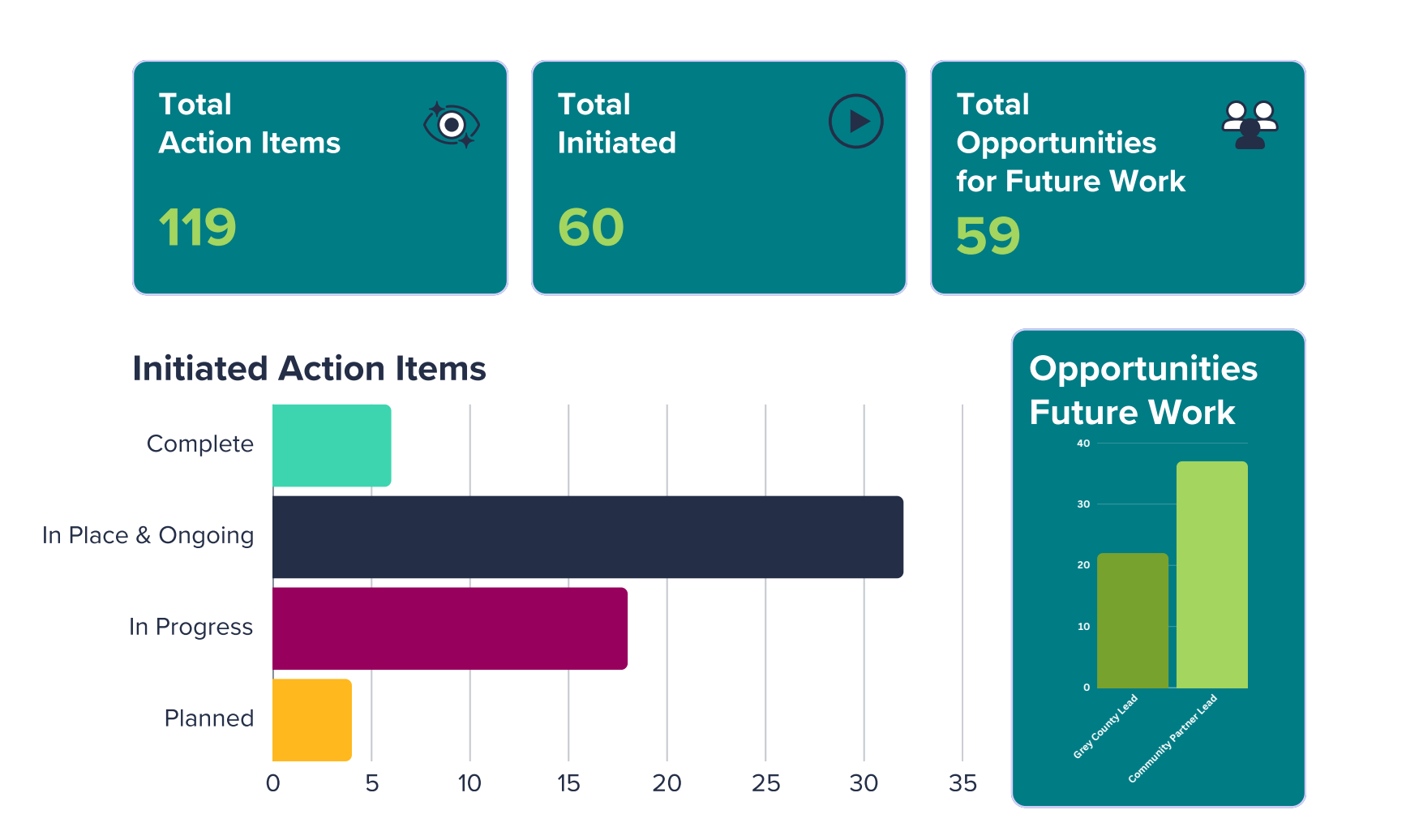
In its latest review, the County says it assessed 119 summarized action items. Of those, 60 have been initiated in some form — whether complete, ongoing, in progress, or planned — while 59 remain categorized as opportunities for future work.
That means roughly half the plan is underway, while the other half remains unfinished.
The County points to a number of concrete developments since the plan was introduced, including policy changes in official plans, expanded cycling signage and paved shoulders, the rollout of additional residential unit policies across all member municipalities, and growth in local age-friendly fairs and seniors’ programming.
But the report is also candid about what has slowed progress.
A Plan Without a Dedicated Coordinator
Among the clearest admissions in the update is that Grey County does not currently have a dedicated Age-Friendly Community coordinator.
The report says that absence has made it harder to manage implementation, align work across departments and partners, pursue grants, and evaluate results. Responsibility for the plan currently sits with the County’s Planning Department.
The County notes that hiring a coordinator in the future “could meaningfully accelerate progress.”
That matters because many of the issues the plan touches are not simple municipal service questions. They overlap with health care, homelessness, transit, food security, mental health, and addiction — all areas where Grey County says no single organization can act alone.
Housing, Transit and Health Care Pressures
Some of the strongest signals in the report are tied to housing and access to services.
Grey County says its short-term emergency housing in Owen Sound has served 480 individuals since opening in 2024, including families, more than 50 children, and 25 people over 65.
Since 2021, the County’s Housing Fund has provided $5.845 million to support affordable housing projects for seniors, supportive housing, and transitional housing.
On transportation, the report highlights up to $9.5 million in Ontario Transit Investment Funding secured with Bruce, Wellington and Dufferin counties and Saugeen Mobility and Regional Transit to study the feasibility of a unified transit network.
The County also points to its Community Paramedicine program and the expansion of its Supportive Outreach Services program, which now operates seven days a week and has delivered more than 12,000 services since launching in 2021.
Taken together, those figures point to a county trying to adapt to changing demographics while also responding to rising complexity in local needs.
What’s Still Missing
The report also highlights a long list of things that have not yet happened.
Among the “opportunities for future work” identified by Grey County are:
an accessible housing development guide,
a housing directory,
more sidewalk linkages,
broader broadband access,
expanded telemedicine awareness,
a volunteer information hub,
more public washrooms,
and stronger coordination around mental health and addiction services.
Some of the unfinished items fall squarely within Grey County’s own scope. Others depend on municipalities, community organizations, or other levels of government.
The report also acknowledges that some original performance measures were difficult to track and that some of the identified project leads are no longer suitable, making evaluation harder than intended.
What the Report Really Shows
At its core, the report is less about a single program than about what it takes to make a rural region livable for people at every stage of life.
Grey County says it wants communities where residents can age with dignity and independence. The numbers in the report suggest that goal is becoming more urgent, not less.
The county is older than the country as a whole, growing quickly, and facing rising demand in housing, health care, transportation, and community services. The plan shows progress, but it also shows how much of the work remains unfinished.
In that sense, the update is not just a report card. It is a reminder that demographic change is already here — and that the question is no longer whether Grey County needs to adapt, but how quickly it can.
Source: Grey County Age-Friendly Community Action Plan 2026 Progress Update
Related:


