

Grey County Sets 300-Unit Housing Goal, and Lays Out Why Building Is So Hard
Grey County endorsed a 10-year housing plan targeting 300 deeply affordable homes, as staff laid out soaring demand and the steep cost of building as obstacles.

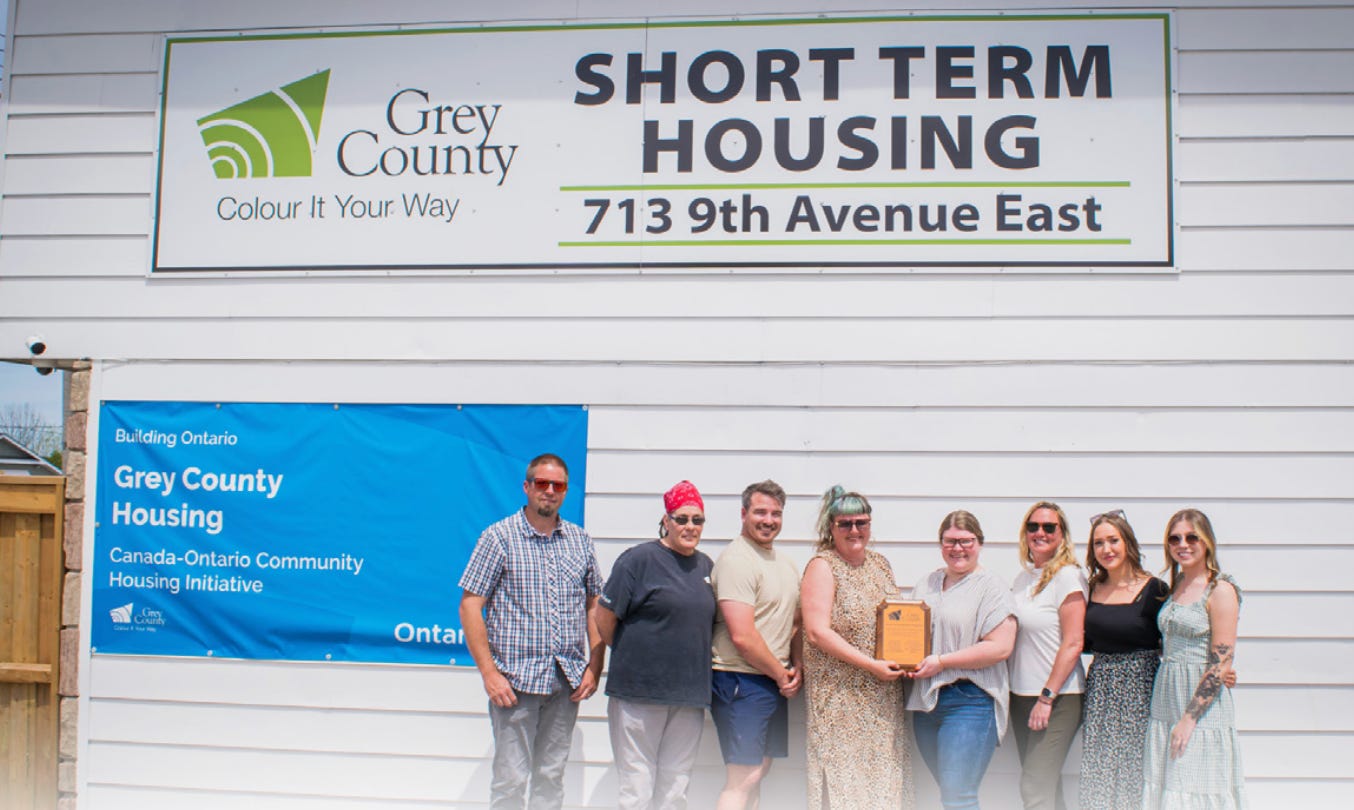
Grey County council has unanimously endorsed a new 10-year affordable housing and homelessness strategy, sending it to the province for review — and in presenting it, the county’s community services director set out in blunt detail both how far demand has outrun supply and how hard it is to actually build the homes the plan calls for.
The strategy, Grey County: Colour It Home, passed on a recorded vote May 28 with one member absent. As the provincially designated service manager, Grey County is required to maintain a 10-year housing and homelessness plan and review it every five years; director Anne Marie Shaw told council this is a brand-new version, built around three priorities: creating new affordable and supportive housing, supporting the community housing sector, and strengthening the homelessness system to reduce chronic homelessness.
The plan defines “affordable” narrowly — housing for people who financially qualify for rent-geared-to-income units, not market-rate “affordable” rents.
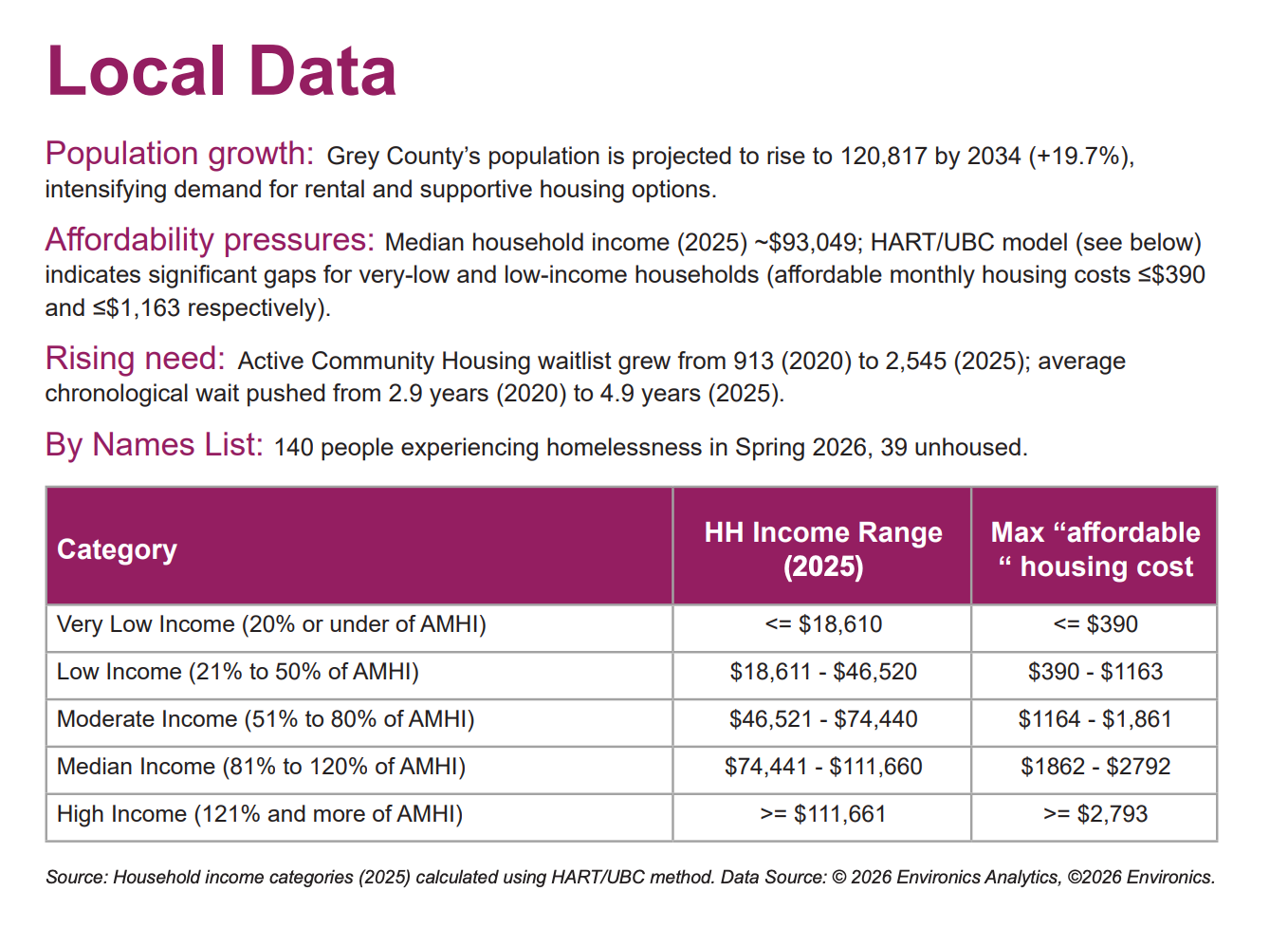
The need has grown sharply. The county’s active community housing waitlist nearly tripled, from 913 in 2020 to 2,545 in 2025, and the average wait climbed from 2.9 to 4.9 years.
On the By-Name List — a real-time record used to coordinate support — 156 people were counted at the end of 2025, 21 fewer than a year earlier, with the decline driven mainly by fewer people being newly identified (151 in 2025, down from 182). About 81% were experiencing chronic homelessness, which Shaw defined as being homeless for six months or more in a year. A spring 2026 snapshot put 140 people on the list, 39 of them unsheltered.
Against that, the plan’s 10-year targets are 300 deeply affordable units and 50 or more supportive or transitional homes, a 50% cut in the rate of people returning to homelessness, and “functional zero” in chronic homelessness.
It also commits to placing mental health and addictions supports in every community housing building within five years.
Why building is so challenging in current environment
Shaw walked council through the economics of an affordable build, and the numbers explain why the pipeline moves slowly. At roughly $350,000 a unit, a 40-unit project runs about $14 million for construction alone — before land or soft costs such as studies and design.
And because affordable projects can’t carry a full mortgage, she said, the county needs 40 to 60% of capital costs covered up front — on a $14-million build, at least $7 million — or the math doesn’t work.
“That’s why I think it’s difficult to build affordable housing right now,” she said, “because a lot of things have to align.”
The written plan lists a pipeline of county and non-profit builds: a 36-unit shovel-ready project in Owen Sound (2026), 34 units in Dundalk (2027), a further 30 units in Owen Sound in pre-development (2027), four units in The Blue Mountains (2028), and 40 units in Durham and 90 in Owen Sound on land already acquired (2029 or later).
Speaking to council, Shaw said a non-profit that has spent five years working toward an Owen Sound build of about 40 units is close to starting, and that a Dundalk build is near, pending conservation-authority approvals.
A separate 19-unit supportive housing project at Rockview, in Owen Sound, is the subject of an agreement being finalized with the Canadian Mental Health Association. Shaw said a report on it will come to council later this summer.
What’s working — and what isn’t
Some interventions are showing early results, staff said. A case-management pilot launched in October pairs people housed out of the short-term shelter with a support worker for six months. So far, Shaw said, none of those clients have returned to homelessness — against the 30 to 40% the county typically sees return.
The pilot is small and early, but she framed it as evidence that people need ongoing support after they’re housed, not just a unit.
She was also candid about the system’s limits. A portion of the people experiencing homelessness in Grey County, she said, cannot currently be served, because the intensive, around-the-clock individualized supports they need either don’t exist locally or aren’t ones the person will accept.
Housing alone, she added, won’t resolve the underlying addiction and mental health crises driving much of the need — problems she said require provincial and federal funding and system change.
That funding gap runs through the plan itself, which conditions construction on senior-government money “as funding allows” and lists a lack of government grants and uncertain operating dollars among its main risks. The county’s tax levy for housing alone is about $7 million, supplemented by provincial funds and tenant rents.
Some of the discussion turned to who should be doing this work. Owen Sound Deputy Mayor Scott Greig noted the city hears it “should be getting involved” in housing and asked what the county’s efforts cost. Shaw said the city partners by securing land for future builds, works with the county on encampments through its bylaw department, and backed Safe ‘n Sound’s 150-day downtown outreach pilot.
Mayor Ian Boddy pushed back at residents who say the city isn’t doing enough. Citing a BMA municipal benchmarking study, he said Grey’s per-capita housing spending was higher than any other municipality’s, and contrasted Owen Sound with what he had seen in Toronto and Ottawa.
The BMA study Boddy cited is a subscription benchmarking comparison of participating municipalities and is not public; Owen Sound Current could not independently verify the per-capita ranking.
“Owen Sound looks pretty damn good in the street compared to all those other places, contrary to what uninformed people think,” he said.
Boddy addressed his critics directly: “I hope everyone that has sent me an email calling me lazy and useless and saying do something is paying attention today. Grey County’s been doing it for 10 years. Look at this plan. It’s a really good plan.”
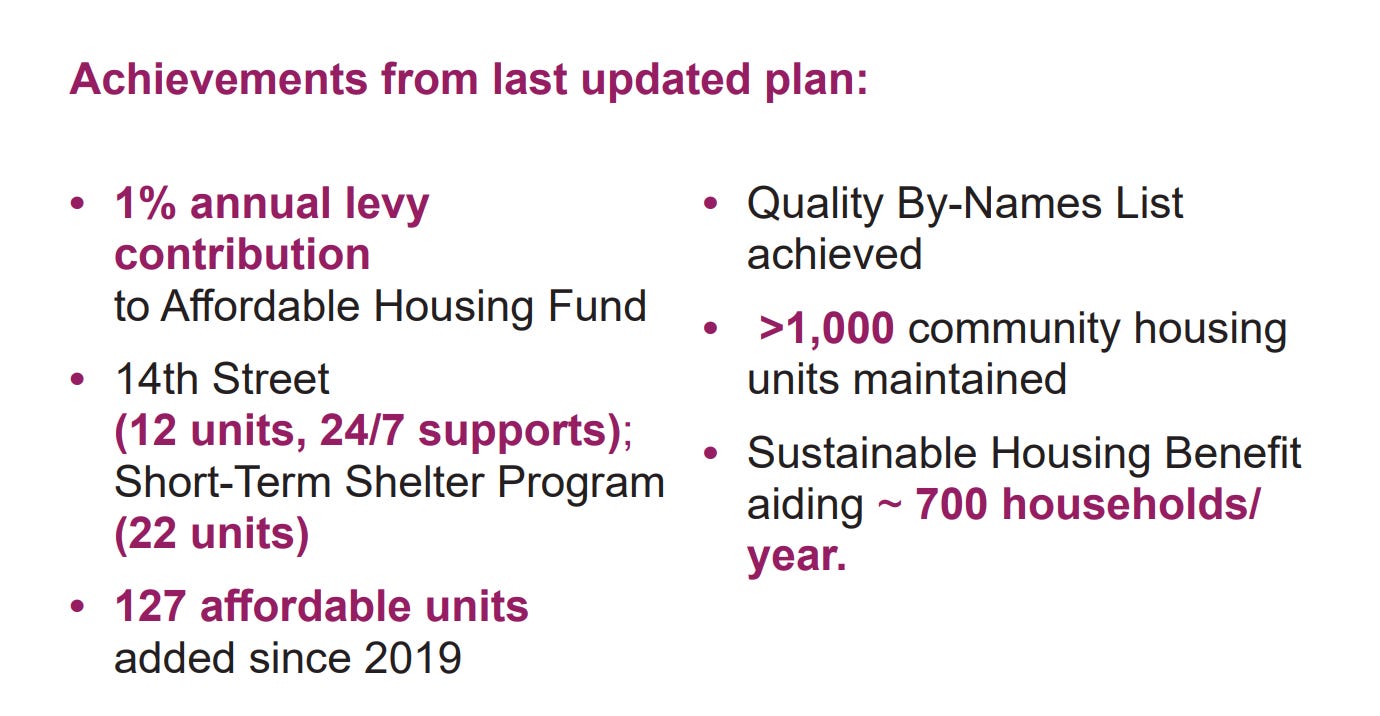
The county credits the previous decade’s work with adding 127 affordable units since 2019, the 12-unit 14th Street transitional program, a converted-motel short-term shelter, and a Sustainable Housing Benefit it says helps about 700 households a year. Safe ‘n Sound’s overnight shelter is scheduled to open around November.
With council’s endorsement, the plan now goes to the province for approval. Shaw said staff will report back to council annually as it is implemented.
Read Grey County: Colour It Home, Grey County’s Affordable Housing & Homelessness Strategy (2025–2035), on the county website.
Related:


The city should build housing. Not contract it out. 3D printed houses walls can be done in one day, saves 90 % of the Labour. Building stick frame houses with 2x4s and all the other things needed is slow and so labor intensive and we don't have the tradesman anymore because the young ones aren't getting into it. We've been building houses this long for a century and a half. It's time to get into the new millennium.