
Grey County Residents Push Back on Gravel Applications, Citing Auditor General Findings
In response to a 2025 Auditor General report that finds little progress on aggregate management recommendations, a group is calling for a moratorium on new gravel pits, including in Grey County.

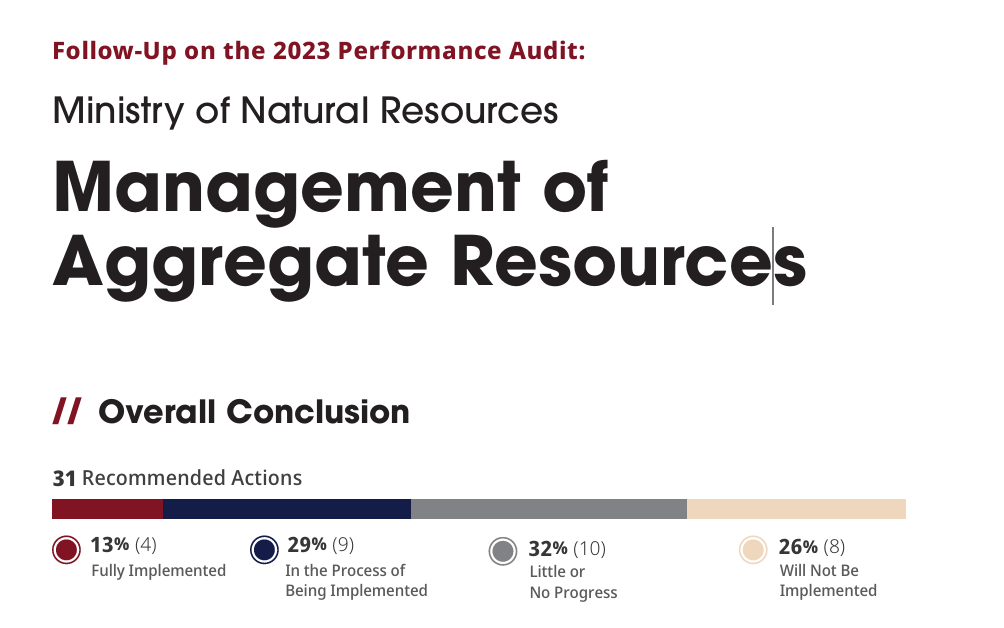
The Reform Gravel Mining Coalition (RGMC) is calling for an immediate moratorium on new gravel pit and quarry approvals across Ontario, including four active applications in West Grey, citing ongoing regulatory failures identified in the Ontario Auditor General’s recent follow-up report on the management of aggregate resources.
The RGMC says the 2025 follow-up report shows that two years after the Auditor General first flagged serious problems in how the province of Ontario — specifically the Ministry of Natural Resources — oversees gravel mining, most of the 31 recommendations made in 2023 have seen limited or no progress.
According to the RGMC, only four recommendations have been fully implemented, while ten have seen little or no progress, and eight will not be implemented at all.
The RGMC is a province-wide alliance of residents’ groups advocating for government action to protect public health, the environment, and community interests from the impacts of Ontario's gravel mining industry.
“The Auditor General has once again highlighted serious regulatory failures in how gravel mining is overseen in Ontario,” Doug Tripp, co-chair of the Reform Gravel Mining Coalition, wrote in a prepared statement.
“Despite clear warnings and recommendations, Ontario continues to approve new gravel pits and quarries while key inspection, enforcement and rehabilitation measures remain incomplete, leaving communities and the environment at risk,” he added.
The coalition’s release emphasizes that these findings reflect longstanding concerns raised by local groups in Grey County, where residents have expressed frustration over dust, noise, heavy truck traffic, and risks to groundwater and the Saugeen River.
“Our community has been dealing with heavy truck traffic, dust, noise and concerns about groundwater and the Saugeen River for years, yet inspections are rare and enforcement is almost nonexistent,” said Judi Smelko of the Saugeen Preservation Society Inc.
“The Auditor General’s report confirms what we’ve been living with — approving another pit here before fixing the system would only make things worse,” she added.
RGMC says the report identifies continued issues with:
Infrequent, inconsistent, and poorly documented inspections, with no quality control measures
Minimal use of enforcement tools despite known non-compliance
Failure to rehabilitate long-dormant and depleted sites
Lack of assessment or rehabilitation of legacy sites on Crown land
No framework to assess cumulative impacts on communities with multiple pits and quarries
RGMC also highlights that the report raises concerns about the province’s understanding of aggregate supply.
While new estimates were released in 2024, RGMC points to the Auditor General’s observation of ongoing gaps in data quality and recoverability, and the province’s lack of commitment to regular updates or improved verification.
In addition, RGMC notes that the province has declined to pursue several key reforms, including:
Evaluating whether aggregate fees cover the true cost of inspections and enforcement
Establishing regular updates to supply-and-demand data
Supporting policies to increase the use of recycled aggregate
“These are not technical gaps, they are policy choices,” Tripp said. “Approving new pits and quarries without fixing inspections, enforcement, rehabilitation and data transparency simply shifts long-term costs onto municipalities, taxpayers and local residents.”
In Grey County, RGMC and local partners are calling on all levels of government to oppose gravel pit expansions until oversight systems are reformed.
The coalition is encouraging municipalities to pass resolutions demanding that the province halt new approvals until all of the Auditor General’s recommendations are fully addressed.
Related:


