

Editorial: Owen Sound Elects Everyone to Represent Everyone. How's That Working For Us?
Owen Sound elects its mayor, deputy mayor and seven councillors at large, meaning every voter votes for every seat. Research suggests municipalities our size are more likely to elect by wards.

EDITORIAL OPINION
Nominations close August 21. Until then, the field is provisional and the campaign hasn’t properly started, which makes this a useful moment to ask a question that tends to get lost once it does.
Does the way Owen Sound elects its council actually serve the people who live here?
There were decisions made this term that narrowed the public’s ability to participate. The tempting read is that this is a personnel problem; that the right names in those chairs would fix it. And nine new faces would certainly change the tone at the table.
But tone isn’t structure, and it’s worth asking whether the way we’re represented is doing some of the work, too.
Owen Sound elects its mayor, deputy mayor and seven councillors “at large.” That means every voter votes for every seat. Every member represents the whole city, which means no member represents any particular part of it.
The alternative is a ward system, where the municipality is divided into geographic districts and each district elects its own representative.
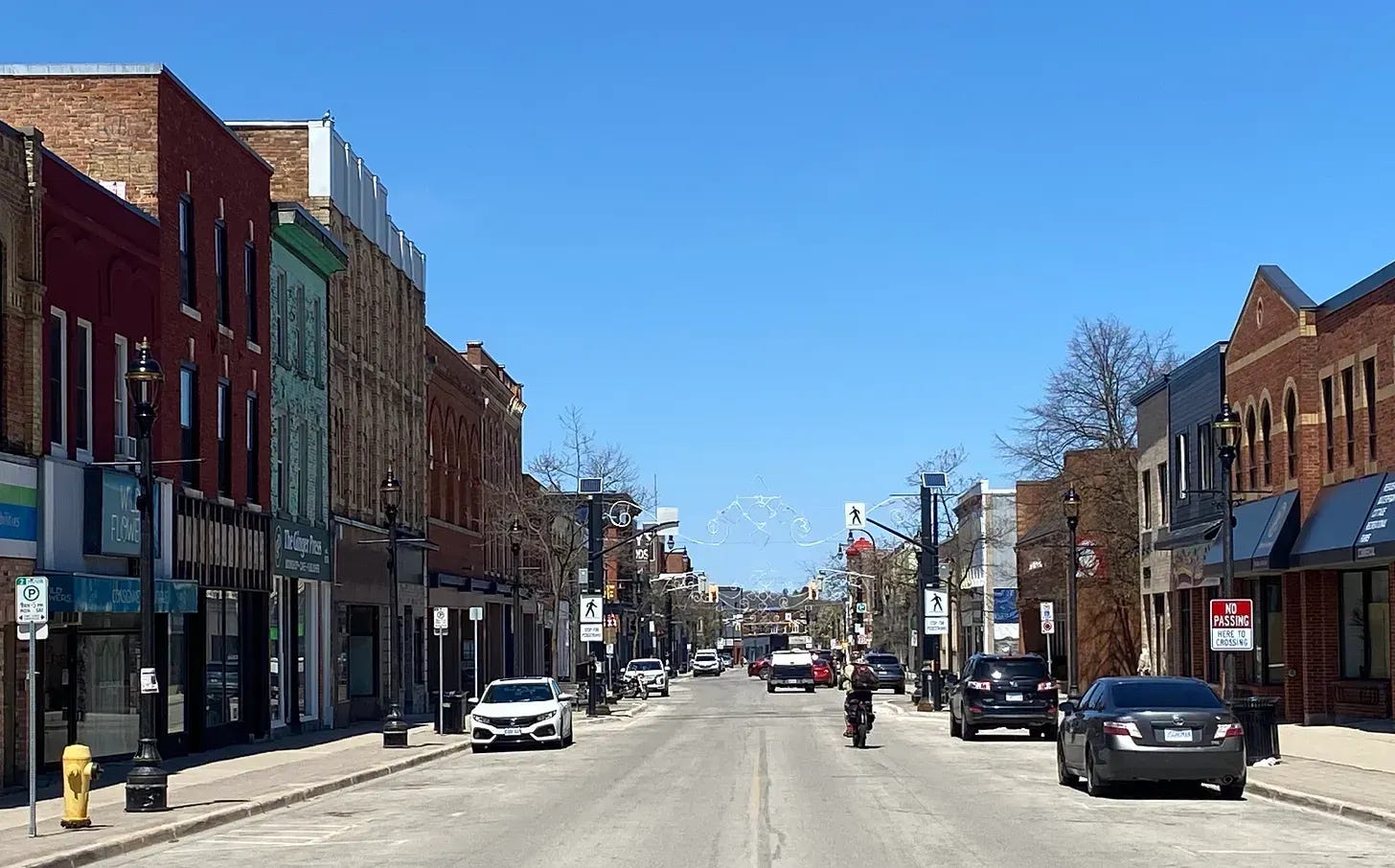
It isn't hard to picture what that would look like here. Owen Sound is a city of distinct parts — the east hill north and south of 16th St, and the west hill north and south of 10th, downtown and the river. Whatever lines were drawn, most of us could name which side of them we live on.
Under the current system, none of that shows up on a ballot. It doesn’t show up when you have a problem, either, and go looking for the person who represents your part of town.
That may be part of why municipalities tend to change course as they grow. Research published in Canadian Public Administration in 2025, mapping electoral institutions in every elected municipal government in Canada, found that about 70% of municipalities elect at large — but that the probability tips at around 10,000 people, past which a municipality is more likely to use wards than not.
Owen Sound had 21,612 residents at the 2021 census. We are roughly double the point where wards become the more common answer.
Here at home, the split is sharp. All nine Grey County municipalities elect at large. Half of Bruce County doesn’t: Arran-Elderslie elects one councillor from each of five wards, Saugeen Shores elects two from each of three, and Kincardine and South Bruce mix ward seats with at-large seats.
The largest municipality in Grey-Bruce where voters get a councillor of their own is Saugeen Shores, at 15,908 people. Owen Sound is bigger, and gives no one a dedicated representative.
Wards are not obviously better; there are pros and cons. Ward councillors can become advocates for their patch at the expense of the city, for example. Boundaries have to be drawn, then redrawn as populations shift, and that fight is its own headache. If the one councillor for your ward is unresponsive, you have no direct recourse until the next election.
Those are real costs, and anyone arguing for wards should own them.
But here is what they buy:
One person who is unmistakably yours, whose re-election turns on whether the drainage problem on your street ever got fixed.
Campaigns small enough that a first-time candidate can afford to run one.
And a guarantee that every part of town has someone at the table, which nothing in the current system provides.
You might reasonably say you can contact any of them, or all of them at once. And you can.
But nine addresses is not nine people accountable to you. In the at large system they are each responsible for everything and yet are not, in practice, responsible for anything or anyone in particular.
Ask a question and any of them can reasonably assume someone else will take it. No one’s re-election turns on whether they answered you, because no one’s seat depends on your part of town.
That is what the at large council structure produces. In a township of 4,000, where the councillor is the person ahead of you at the grocery store, the structure matters less. In a city of 21,600, it matters quite a bit more.
The same electoral research I referenced above found that seven is the most common council size in Canada, and that outside the largest cities almost every council is nine members or fewer. Owen Sound is not short of councillors. It has as many as anywhere comparable.
The question isn’t how many people sit at that table; it’s who each of them has to answer to.
None of it works, of course, if people don’t vote. Turnout in Owen Sound’s 2022 municipal election was 39.71% — 6,230 ballots from 15,690 eligible voters. Whatever system we use, someone has to show up and choose. That work comes first.
And none of this changes before October 26.
A ward system is created by by-law, and under the Municipal Act, 2001 that by-law has to pass before January 1 of an election year to apply to that election — meaning the end of 2029 for the next one.
The council elected this fall would have about three years, which sounds like plenty and isn’t.
Municipalities run a boundary review first, and Burlington’s most recent one took roughly ten months of public consultation before council voted. After that, anyone can appeal the by-law to the Ontario Land Tribunal, and the Tribunal has overturned ward by-laws before. Residents can also force the question themselves by petition, which obliges council to consider one.
The work would have to start early in the term to finish at all, which makes it a fair thing to ask the people currently asking for your vote. So that’s one of the things we’ll be asking them.
What else should we be asking? Candidate questionnaires go out after nominations the field is finalized in early September. If there’s something you want on the record before you vote, tell us in the comments.
Related:


