

Deputy Mayor to Glassworks Cooperative Housing Project: No Support Here
Monday's deputation resulted in three land-supply figures, three job-capacity figures, two unit counts, a servicing analysis built on a 2007 study, and a Council that took no position at all.

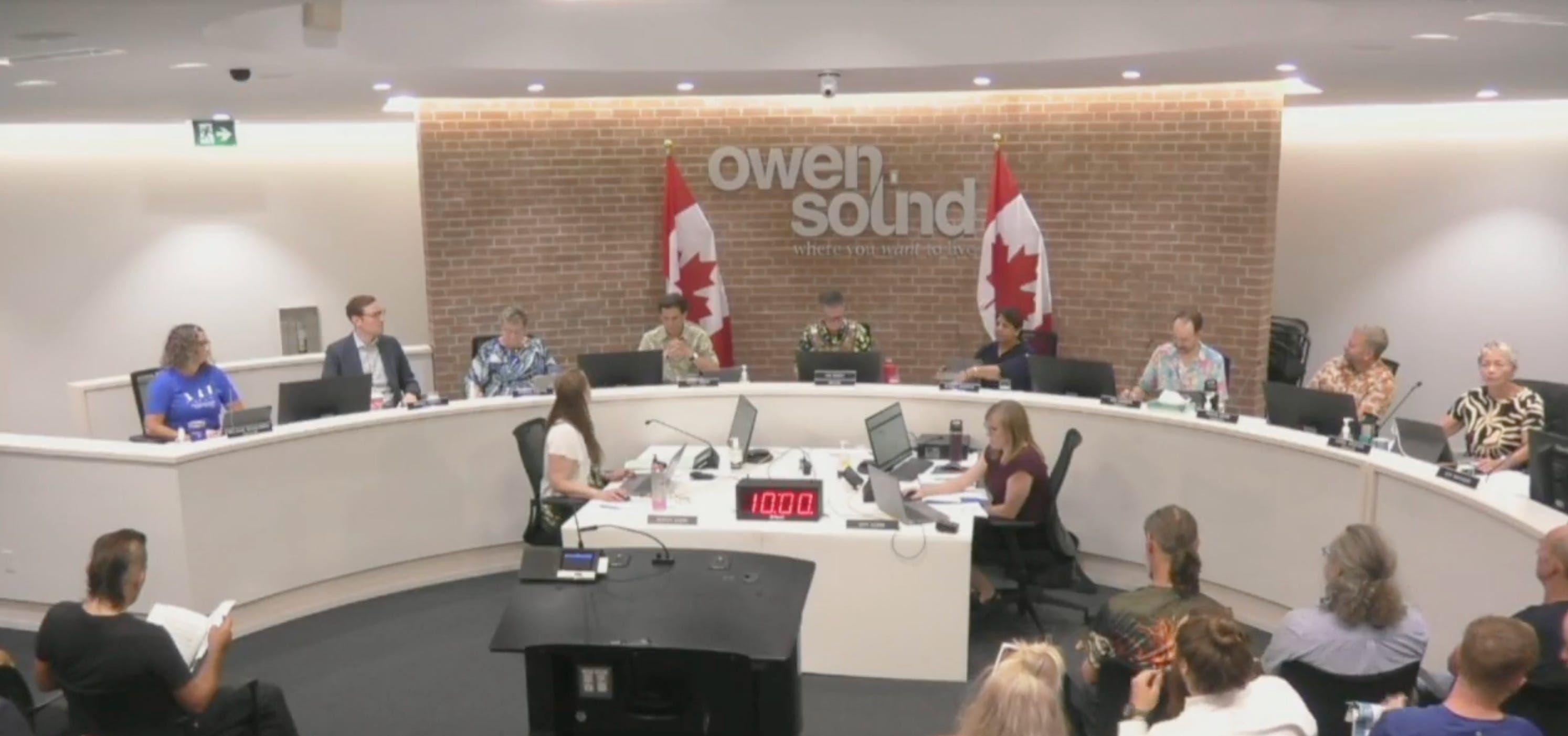
Glassworks Development Co-operative came to Owen Sound City Council on Monday with a proposal for roughly 500 units of affordable ownership housing, two commissioned consultant reports, letters from about a dozen supporting organizations, and a financing partner it says has $80 million to $100 million available.
It asked Council for one thing: a signal that the project is worth pursuing.
It didn’t get one.
The co-operative owns an 18.6-hectare property at 1919 26th Street East. The land is designated Flexible Employment Area — industrial and business uses — so housing there requires an Official Plan amendment and a rezoning.
Board president Kristopher Stevens told council that City planning staff, in comments dated Jan. 7, advised the co-operative to establish the policy case for conversion before filing applications.
Glassworks did. It hired urbanMetrics to produce an employment land needs assessment and Martin Rendl Associates to produce a planning justification report. Both conclude Owen Sound has far more employment land than it needs to meet its 2051 job targets, and that this parcel isn’t required.
Stevens told Council in March the co-operative would bring those reports back seeking approval in principle. On Monday, it did.
“We’re looking for agreement in principle that this is a good idea for Owen Sound,” he said.
The reports have not been reviewed by City staff, and no staff report on them has come to Council. Nothing at Monday’s meeting indicated that any member of Council had read them. No councillor asked a question about their findings.
Deputy Mayor withdraws his support
Deputy Mayor Scott Greig said he had been an enthusiastic supporter of the concept and had recorded a video for Glassworks five or six years ago. But that was before, he said, the co-operative bought land zoned for employment.
“I don’t feel that you have secured yourself in the appropriate land at this time,” he told Stevens. “I will take the moment to withdraw that support.”
Greig, who also sits on Grey County council, said the province directs municipalities to protect serviced employment land, and that neighbouring municipalities have spent millions acquiring more of it.
He did not name a site he considers appropriate. Stevens had said minutes earlier that an extensive search found no comparable site in Owen Sound that could deliver both housing and an employment hub at a price working households can afford.
Mayor: It’s not a hearing
Coun. Jon Farmer asked why Glassworks was seeking Council direction “rather than follow the clear and established planning and approval process” that applies to any other development. Stevens said he isn’t a planner and asked the co-operative’s planner, attending online, to answer.
Mayor Ian Boddy cut it off. He said the item was a presentation, not a hearing.
“We don’t have the authority or anything to give some kind of approval in advance,” he said.
No motion was moved. No vote was taken. Council is not required to respond to a deputation, and it didn’t.
Owen Sound Current has previously reported the mayor’s reluctance to take up housing at the Council table. In July 2024, Boddy said homelessness did not “fit into anything we do,” and Council voted 5-4 that night to give the mayor and committee chairs authority to keep items off the agenda. In May 2026, he called residents who emailed him demanding action “uninformed.”
Support and approval are two different asks
Boddy is correct that Council cannot approve an application that hasn’t been filed.
But approving an application and indicating support are not the same thing, and Ontario’s planning system treats them as separate instruments.
The province’s own framework for Minister’s Zoning Orders lists, as a qualifying route, requests “supported by a single-tier or lower-tier municipality (for example, through a municipal council resolution or a letter from a Mayor).”
Municipal councils routinely pass resolutions of support and give direction to staff. The City of Vaughan has established a formal process for handling municipally-supported zoning order requests.
Whose job is it, really?
Owen Sound has leaned on the County-versus-City line before. In May, answering residents who had emailed demanding action on housing — some, he said, calling him “lazy and useless” — Boddy pointed to Grey County’s decade of work and told County council the city “looks pretty damn good.”
The County is the service manager under the Housing Services Act. It runs 997 rent-geared-to-income units and is required by law to maintain a housing and homelessness plan.
That is the County’s role. Land-use planning is not.
Grey County cannot rezone 1919 26th Street East; only Owen Sound can. The Official Plan amendment and the rezoning are City Council’s decision.
Other lower-tier municipalities in Grey and Bruce have used their own tools.
In Bruce County, the Town of Saugeen Shores adopted a policy in 2024 to put town-owned land toward affordable housing, then broke ground this July on 28 below-market homes built on town land in partnership with Habitat for Humanity Grey Bruce and a private developer.
In Grey County, the Town of The Blue Mountains created a wholly-owned attainable housing corporation in 2013 and bought the former Foodland site in Thornbury in 2019 to develop as rental housing. That project has since stalled — no acceptable bids came in — but the town put its own corporation, land and money behind the attempt.
The door the province opened
Under the 2024 Provincial Planning Statement, municipalities can now remove land from employment areas at any time. The old requirement, a municipal comprehensive review undertaken once a decade, is gone. Conversions can proceed as an Official Plan amendment, at council’s discretion.
The change was made partly at municipalities’ own urging. Submissions to the province argued that lands designated employment decades ago sit empty because of where they are, and that conversion should be permitted at municipal discretion.
Other municipalities have used it. Toronto’s Official Plan Amendment 591, approved by the Minister in December 2023, approved 24 employment land conversion requests at once. Its OPA 804, now before the Minister, proposes redesignating 255 hectares.
Oakville went the other direction, passing amendments to protect its employment lands while it completed a full review with a commissioned market study.
Other cities are also treating non-profits and co-ops as development partners.
In St. Catharines, ground was broken in June on a 492-unit affordable co-op at the former Hotel Dieu Hospital site — backed by $183 million from the federal government through CMHC, and by the City of St. Catharines and Niagara Region, which contributed fee waivers, tax rebates and grants. It's the largest co-op housing project in the region's history, developed by a partnership including the city.
Kitchener has provided city-owned land to Kitchener Housing Inc. and, in a separate project, to Habitat for Humanity, and council granted YWCA Kitchener-Waterloo a 50-year lease for 41 units of supportive housing for women experiencing homelessness.
Owen Sound uses some of these tools. This April, council waived roughly $127,000 in permit fees for St. Clare Place, a 40-unit affordable project, on top of development charges it had already forgiven. It has run its own non-profit housing company since the 1980s. The City also front-ended a $3.5-million cost to extend water and sewer into the Sydenham Heights area, according to the Owen Sound Sun Times in October 2021.
Yet in 2022, council voted 8-1 against developing a municipal housing plan, with members citing the risk of duplicating the County.
The need for housing is clear
Grey County’s growth forecast has Owen Sound needing 2,750 new housing units by 2051. The City’s own Official Plan sets a goal that 30% of new housing be affordable.
The 2024 Housing Affordability Report by the Institute of Southern Georgian Bay, cited in the co-operative’s planning report, estimated a county-wide shortfall of roughly 2,400 units for households earning under $41,000, rising to 3,600 by 2046.
Glassworks says it can build about 500 units for households earning $35,000 to $85,000, on land it already owns, serviced from a road that already runs past it.
It asked whether that was worth pursuing.
Council didn’t answer, and didn’t offer another route to an answer. Twice, Boddy stopped the co-operative from responding; first when its planner tried to answer Farmer’s question, then when Stevens sought to respond to Greig. Neither ruling was unusual for a deputation.
The mayor said staff would continue to work with Glassworks. That means more studies, more consultant fees, and eventually a complete application — filed by a co-operative that now knows one member of Council is opposed, no other member has said otherwise, and the body that will decide the application would not discuss it.
Editor’s Note: An earlier version of this article incorrectly described Barrie and Guelph as lower-tier municipalities. They are single-tier. The comparison has been corrected.
Related:


