
Council Settles 2026 Capital Spending as Five-Year Plan Waits Until July
The trail gets repair money and the tower a closer look, but the five-year plan that shapes future tax bills doesn't get decided until July.

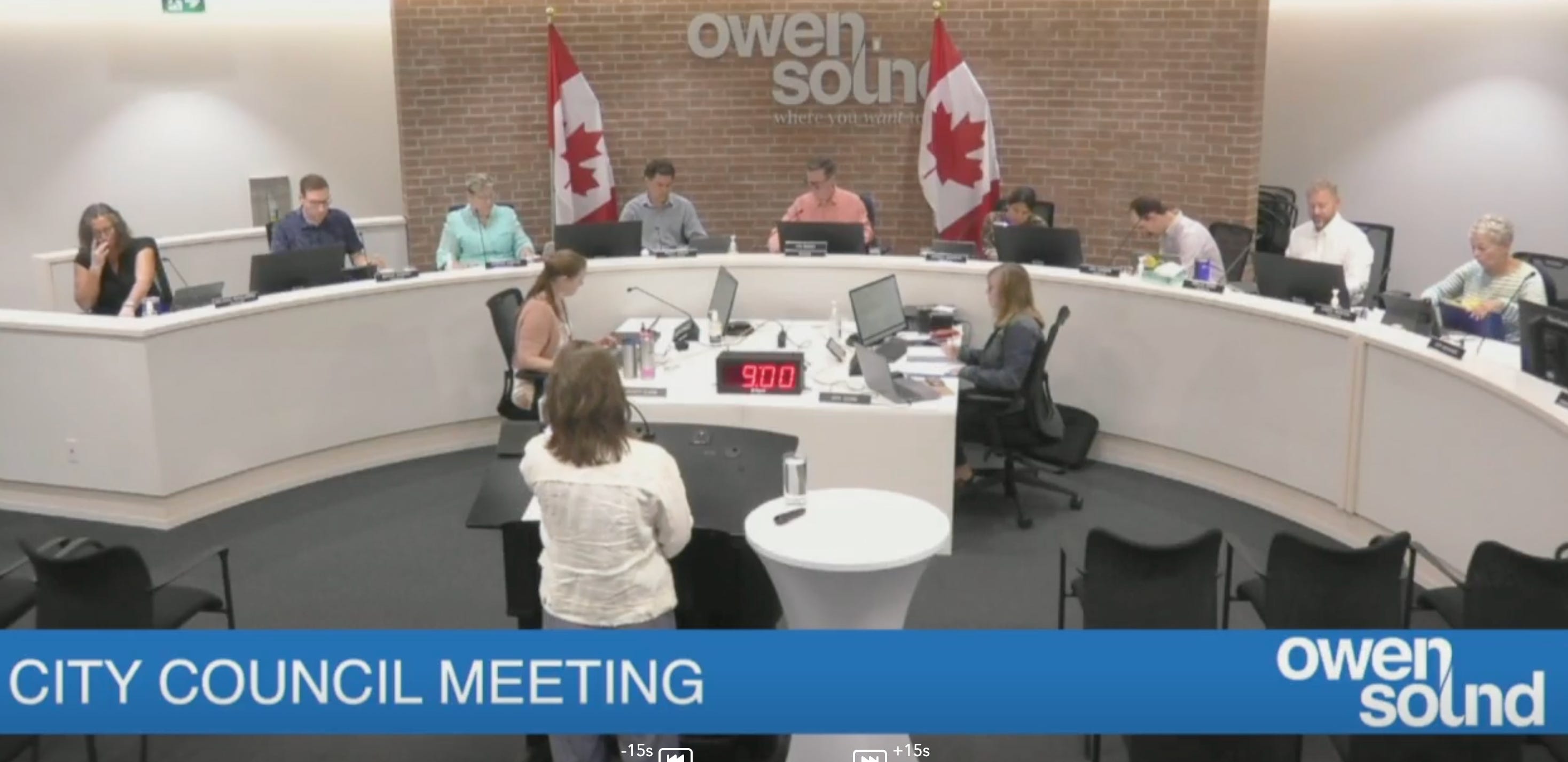
Owen Sound council spent more than five hours June 23 on capital spending, though most of the meeting concerned a plan it has not yet adopted.
Staff presented the 2027-2031 multi-year capital plan for information. Council did not vote on it. Staff will bring it back for approval at the second council meeting in July, and that meeting is where the plan and its tax implications are set to be decided.
The decisions council made June 23 dealt with 2026 projects and a handful of smaller line items. Council also gave staff informal direction on several reserve changes and sent a cluster of items back for July reports.
The 2026 spending council approved
Nine Bends Trail
Council approved up to $70,000 from the Capital Reserve Fund for an engineering analysis and preliminary design of the trail off 1st Street West, closed because of slope and drainage failures.
Staff estimate the trail draws close to 3,000 pedestrians a month in peak season and links to Harrison Park and the River District.
Council amended the motion to add up to $10,000 for immediate consulting work aimed at reopening part of the trail sooner — potentially by removing specific trees while leaving their stumps to hold the slope. The $70,000 design is expected to return through committee in 2027.
The eventual slope stabilization appears on the city's unfunded capital list at an estimated $2.94 million, though staff told council the true scope and cost won't be known until the engineering work is complete.
Harrison Park west entry roadway
Council received this report for information. Staff had already completed a roughly $25,000 temporary repair to the park’s main vehicular entrance, funded from the Parkland Reserve, to carry it until a permanent replacement — listed at $350,000 in the 2027 project ranking — comes forward through the five-year plan.
Centennial Tower
Council received the report for information, allowing staff to spend $39,700 from an already-approved budget on detailed design and invasive material testing of the 1967 tower, closed since August 2024. After debate, council directed that the work weigh decommissioning and removal alongside rehabilitation, with results to return before any 2027 tender. A fuller account of that debate is in a separate story.
4th Avenue West
Council voted 6-2 to reconstruct the street between 15th and 20th to its existing width — Option 1A, the design staff recommended — keeping on-street parking and setting aside a narrower traffic-calming alternative. The vote was a show of hands, not a recorded vote. A separate story covers the decision.
A $30-million year inside a five-year plan
The plan covers 2027 through 2031. Staff described 2027 as a high spending year — the presentation’s bar chart showed roughly $30 million — lifted in part by reserve surpluses, including funds freed up when a grant covered Bayshore work the city had already budgeted to fund itself.
Staff credited a dedicated 1% annual increase to capital funding with giving the city enough predictable money to plan multi-year projects rather than budgeting one year at a time.
Staff put the 2027 funding sources at about 42% from the capital reserve, 18% from developer contributions, 17% from other reserves and 16% from water and wastewater rates, with debt, grants and development charges making up the balance. The police facility accounts for about 11% of the 2027 capital budget — roughly $370,000 — and $2.9 million across the full plan.
On debt, staff said current debenture payments run about $1.6 million a year. The plan anticipates borrowing for the $5.1-million fire hall rehabilitation council approved in 2025, adding about $610,000 a year starting in 2029 — a payment staff said the city can absorb without raising the levy beyond the committed 1%.
When a councillor asked where a resident could find the plan’s total budget and the net amount drawn from taxes, staff acknowledged the presentation did not set those figures out explicitly and said the July approval report would.
Reserve changes and the county roads question
Staff sought council’s informal support for reserve changes returning in a formal policy this summer: folding the standalone Trails reserve into the Parks Capital Reserve, creating a separate campground reserve and eliminating the legacy airport facility reserve by moving its balance into the capital reserve fund. Council passed a motion directing staff to report back on reducing the $590,000 WSIB reserve, which staff said sits well above the city's actuarial exposure — currently about $48,000.
The largest unknown over the plan is Grey County’s potential transfer of county roads — including 2nd Avenue East, 3rd Avenue East and Grey Road 1 — to the city. Staff built the plan on the assumption that no transfer has occurred, and flagged it as a material variable affecting project scope, timing, funding and development charges. Staff said the city is still seeking clarity on asset conditions, lifecycle costs, timing and compensation. Grey County council was scheduled to take up the matter June 26.
Staff also walked council through three pressures shaping the plan: provincial Buy Ontario procurement rules, which staff said are already delaying municipal vehicle deliveries by 12 to 18 months; staffing and capacity limits on how many projects the city can deliver; and construction-market volatility tied to tariffs, material prices and contractor availability.
Consent agenda and smaller votes
Council received three consent-agenda reports for information: a playground replacement strategy, replacement of the Bayshore Community Centre’s 1983 ice-floor cover and arena seating, and the Harrison Park tennis and pickleball court resurfacing.
A fourth — an update on the Fortress area of the Downtown River Precinct — was pulled from consent; council instead directed staff to report back at a July meeting with costs and options for advancing work on that block in 2027.
Council also took up several smaller line items. It voted to remove a $10,000 flagpole at the Julie McArthur Regional Recreation Centre. A motion to cut $10,000 in funding for water-bottle refill stations failed on a 4-4 tie, leaving the money in the plan; council then directed staff to report back on whether an earlier initiative to add public water fountains and refill stations had advanced.
A separate motion to require staff to notify council before advancing any project from a future year of the plan was defeated 3-5. Council asked staff to report on options for refurbishing the city’s deteriorating chain of office. All of these were show-of-hands votes.
What happens next
The five-year plan returns for approval at the second council meeting in July, the point at which council can still amend or remove projects. Several specific items — the Fortress block, the chain of office, the water-fountain review and the WSIB reserve — are also due back that month.
The terms of any Grey County roads transfer, the full cost of the Centennial Tower project and the funding and timing of the unfunded Downtown River Precinct phases all remain unresolved.
The June 23 special meeting ran from 9 a.m. to 2:05 p.m. at City Hall. A recording is posted on the city’s website.
Related:


