
Council Keeps 4th Avenue West Largely As-Is, Rejecting the Design Its Committee Backed
Staff's report recommended the status quo but cautioned it could worsen speeding near a school — and council had already turned down its committee's preferred design.

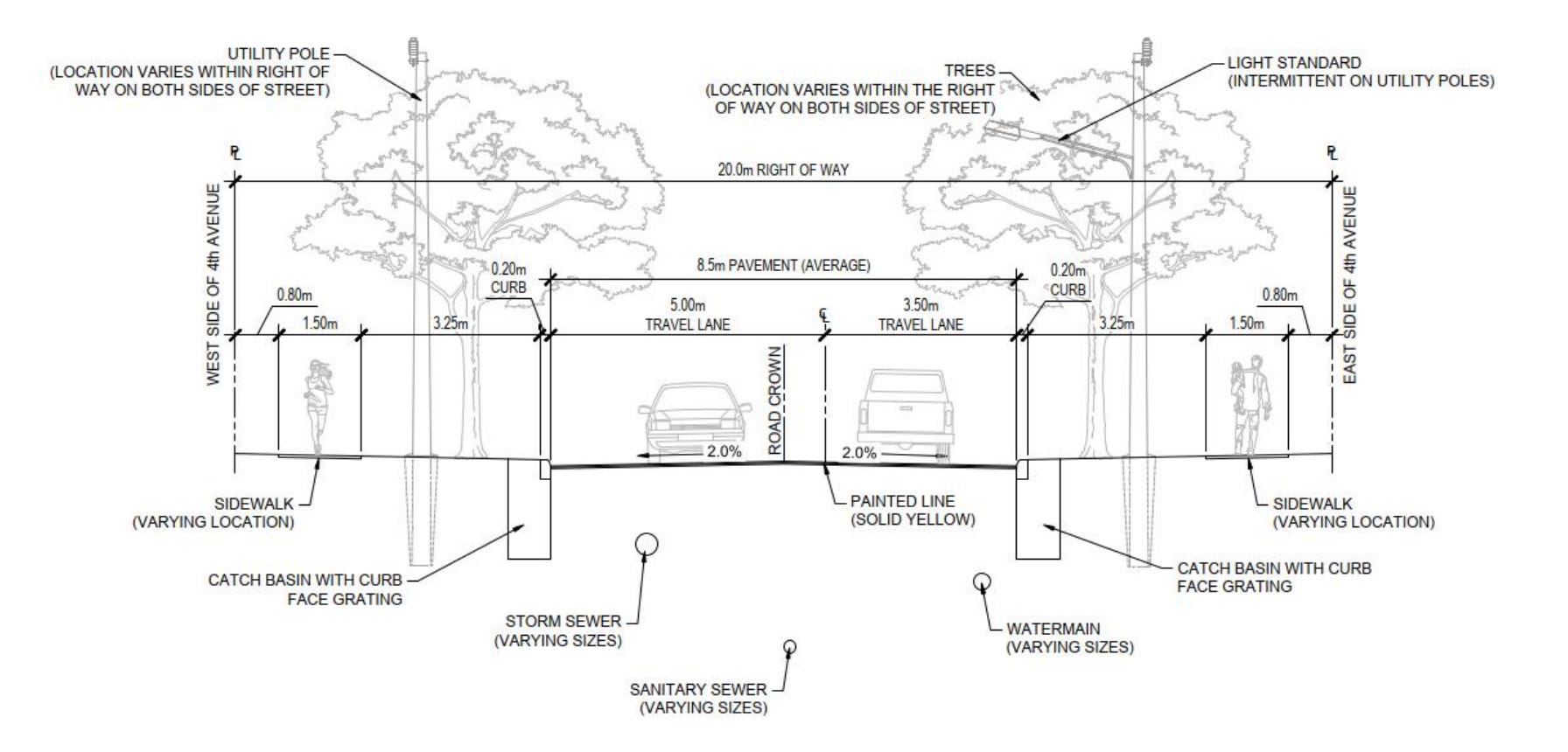
Owen Sound council has chosen to rebuild 4th Avenue West between 15th and 20th streets close to its current layout, directing staff on June 23 to carry a “status quo with modernizations” design into detailed design and tender ahead of construction in 2027.
The 6-2 vote, taken at a special capital-budget meeting, ended a reconstruction debate that had stalled twice since April — and it left council having set aside the design its own Operations Committee recommended.
The vote was a show of hands, not a recorded vote, so the two members opposed cannot be identified. Deputy Mayor Scott Greig moved the option.
The design — Option 1A — keeps 4th Avenue West’s existing cross-section: one 3.5-metre lane, one 5-metre lane with on-street parking and 1.5-metre sidewalks on both sides. Added to it are accessibility and geometric upgrades at the corners and a protected pedestrian crossing.
It is the same cross-section the city’s consultant, WSP, put to the public as “Option 1” in February, now carrying those two modernizations.
A design that narrowed from four options to the status quo
When WSP presented the project at a public information centre on February 3, it offered four cross-sections. Three narrowed the driving lanes, removed on-street parking, or both — two of them adding a separated multi-use path, one adding bicycle lanes. The fourth kept the street as it is.
Staff and the Operations Committee favoured the most ambitious of those: Option 3, a narrowed road with a separated multi-use path, which the committee recommended on April 23 as the design that best met the community’s needs for a comparable cost.
Council did not adopt that recommendation. At its April 27 meeting it declined the committee’s option and deferred the project to 2027, and staff then dropped the multi-use path from the options entirely.
By the time the project returned, the choice had narrowed to two: the status-quo rebuild and a stripped-down traffic-calming alternative with two 3.5-metre lanes, no parking and no bike lanes, the freed width turned to grassed boulevard.
A motion to adopt the traffic-calming design had been before council since May 25, when it was deferred a second time. The repeated deferrals also pushed the work itself: WSP’s February schedule had construction starting in 2026; it is now slated for 2027.
Staff recommended the status quo, and cautioned against it
Staff recommended Option 1A, but for a narrow reason: it matched the preference council had signalled in April for keeping on-street parking.
On the merits, their report pointed the other way. The traffic-calming alternative would cost less to build and be easier to plow, staff wrote, and they put a caution on the record that leaving a wide driving surface on a street with known speeding problems could increase both how far drivers exceed the limit and how many do.
4th Avenue West is a collector road that runs through a school zone between 16th and 19th streets, where the posted limit drops to 30 km/h on school days near Timothy Christian School. Staff noted that the traffic-calming measures the public usually asks for — stop signs and speed bumps — are not suited to this stretch, which is why earlier designs had leaned on a narrower road profile.
The option council chose is the one WSP’s own February materials listed as addressing neither the street’s parking nor its cycling-safety concerns.
Parking, plows and a collector road
Greig said 3.5-metre lanes are too narrow for a road meant to move traffic and would leave a tight squeeze for larger vehicles — campers, fire trucks and snowplows — particularly in winter when snowbanks narrow the road further. Banning parking, he argued, would only push it onto nearby side streets.
Coun. Jon Farmer made the case against. The status-quo design reflects neither the feedback gathered through engagement nor the most responsible use of the project’s budget, he argued, and it contradicts itself — treating 4th Avenue as a collector meant to move traffic while preserving parking along one side. If the priority is moving traffic, he said, council should drop the parking rather than rebuild the wider surface.
Staff told council that during engagement, gathered through public information sessions and the city’s OurCity feedback portal, concern about traffic speed ran roughly equal with concern about losing parking, and that tree removal along the street was also a worry for residents.
Cost and funding
Mason Bellamy, the city’s manager of public works and engineering, told council the status-quo design is expected to cost about $80,000 more to build than the traffic-calming alternative, based on preliminary assumptions.
Revising the design back to 1A will add an estimated $15,000 to $20,000 in engineering, and staff said the wider road will cost more to maintain and eventually replace over its life.
The project is expected to be funded entirely through the Ontario Community Infrastructure Fund, with most of the cost tied to replacing aging underground water, wastewater and storm infrastructure — work staff say is needed regardless of the surface design.
What input is left
The vote sets the design direction. Staff will now prepare tender-ready drawings for a construction tender ahead of the 2027 season, with council and staff hopeful the work can be finished next year.
Staff said they do not plan to hold another public information centre on the final design unless council directs them to, so residents are not scheduled for another formal look before it goes to tender.
Council has set aside a separated path, then bicycle lanes, then a traffic-calming design staff called cheaper to build and better suited to the street’s speeding problem, in favour of rebuilding 4th Avenue West much as it stands, on a design staff recommended while warning it could make that problem worse.
Related:


